
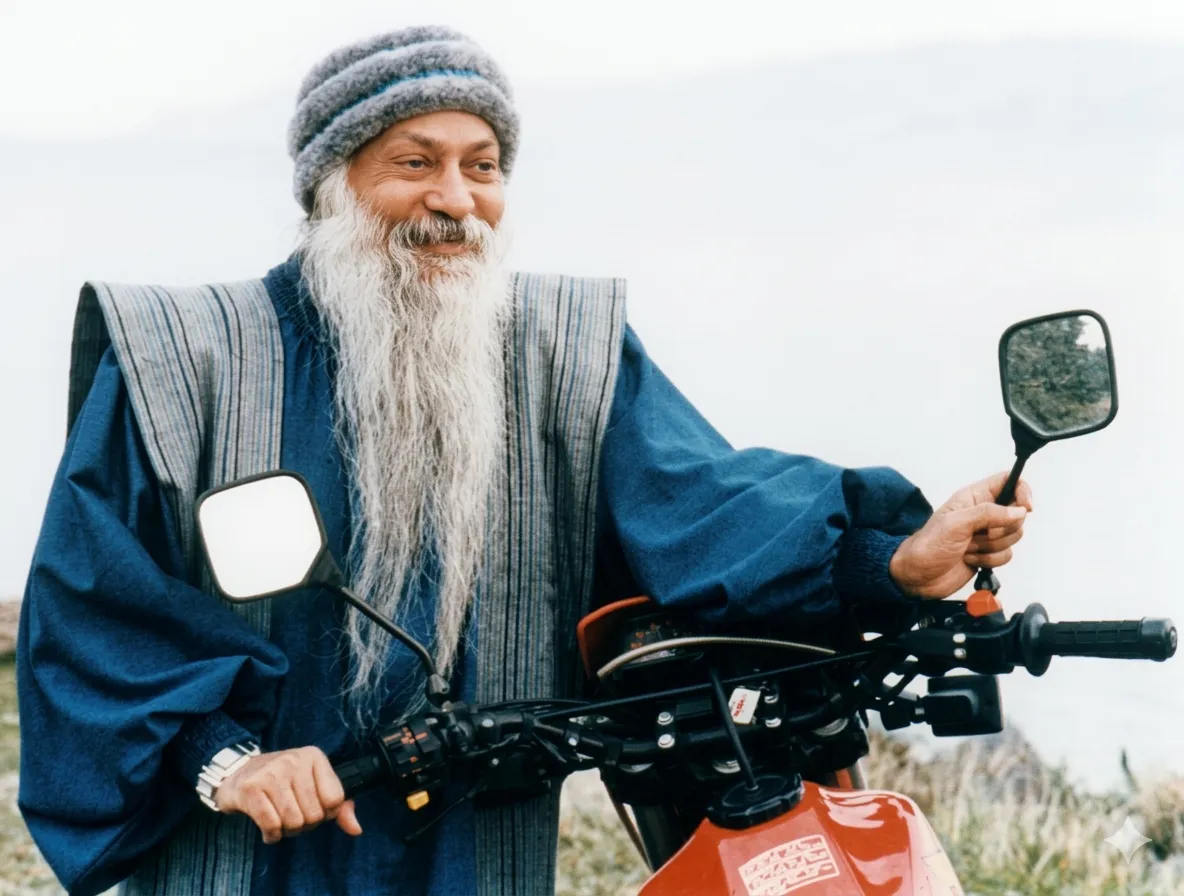
We want power because we were told we’re not good enough, so our natural wish to grow gets pushed toward trophies outside instead of becoming happy and loving inside.
From the Discourses
Passages where Osho speaks to this question — each links to the complete discourse.
Beloved Osho, it seems to me that I don't understand anything
If I say something, there is no need to believe in it. There is no need to disbelieve either. Remain open. If I say something, then try it. Then look at the trees without any ideas whatever. Look at the birds and the sky with no knowledge. Drop language and see whether what I am saying gives you clarity. If you can drop the word "rose" and then see the rose flower, what happens? You will immediately feel a new kind of relationship arising between you and the flower. Don't even call it a flower; there is no need. Your language is not needed to support it; it exists without language. Why bring language in? Put language aside. Put aside your continuous gibberish that goes on inside the mind. Just look. In the beginning it is difficult -- the language will come up again and again, just out of old…
Osho, it is said that there are basically only three desires—sex, property, and power—and all the rest are their offspring. Of these, Freud calls sex fundamental; Marx, property; and Adler, power. Though all three seem right in their own way, the confusion does not clear. Osho, in this dispute of Freud, Marx, and Adler—the disputants are gone, but the dispute continues—I choose you as the arbiter. Will you hold court? If yes, what will your verdict be?
In Buddha’s time, Amrapali was famed as supremely beautiful. Emperors lined up at her door—an audience with her was rare even for kings; her price was hard to pay. Yet one day Amrapali donned the yellow robe and came to Buddha’s feet: “Initiate me.” Buddha said, “You are so beautiful; emperors are mad for you—what do you lack?” She said, “Let them be mad. I have seen it all. There is no substance in it—children’s toys.” Has anyone ever been fulfilled by sex? Or by wealth? Or by power? No. Yes—delusions, hopes, dreams—plenty. But no dream is ever complete; hopes turn into disappointments; sooner or later the illusion shatters. All three miss the mark. If any one of the three were right, religion would have no place. If all three were wholly right, religion would have no place. Religion has a place precisely because there is a fundamental mistake in…
Beloved master, all my life I have been intrigued by power and the recognition I can take from it. Now, that seems very confined and petty. Yet, I sense also that there is a more authentic type of power, not dependent on other people or their reactions -- more within myself. Can you please talk about my attraction towards this?
It needs a deep insight to understand that whether you torture others or you torture yourself, there is no difference at all -- except that the other can defend himself. At least there is that possibility. If you start torturing yourself, there is nobody to defend you. You can do anything with your own body. This is simply masochism. It is not, in my understanding, finding the source of your inner being. Hence I would not like to call it power, because that word is contaminated. I would like to call it peace, love, compassion... you can choose the word. But power has been in the hands of violent people; whether they were violent with others or with themselves does not matter. I think the people who were violent with others were more natural and the people who were violent with themselves were absolutely psychotic. But the people who have…
Beloved Osho, why does everyone want to pretend to be what they are not? What is the psychology behind it?
You are being taught everything, but you are not being taught to be yourself. This is the ugliest form of society possible, because it makes everybody miserable. I have heard of another great man, a great professor of literature who was being retired from the university. All the university professors had gathered, all his friends had gathered, and they were rejoicing. But suddenly they became aware that he was missing. One of his friends, an attorney, went out... perhaps he in was the garden. But what was he doing there? He was sitting under a tree. The attorney was his closest friend, a boyhood friend. The attorney said, "What are you doing here?" He said, "What I am doing here? Remember fifty years ago? -- I came to tell you that I wanted to kill my wife. And you said, `Don't do any such thing. Otherwise -- fifty years in…
Osho, you say that within every aspiration its opposite is hidden. In the longing for honor, humiliation lies concealed; in the very longing to live there is a fear of death. Why is there such a cruel law?
I said, “That is exactly why he still hasn’t forgiven you. Get someone a job and he will never forgive you. He will take revenge someday. For on that day you were so high that you granted him a job. Pain arose in his mind then—he had to fold his hands to you, had to wag his tail before you. He will take revenge sooner or later.” People say, “We do good, and people do bad to us.” It is sheer mathematics. The one to whom you did “good”—what else will he do but “bad”? He must settle the score. Because whenever you did your ‘good deed,’ you must have looked at him with such arrogance: “See, you little worm! You live by my grace.” I said, “Remember the day this man came wagging his tail before you and you got him the job. Today he is showing you the…