
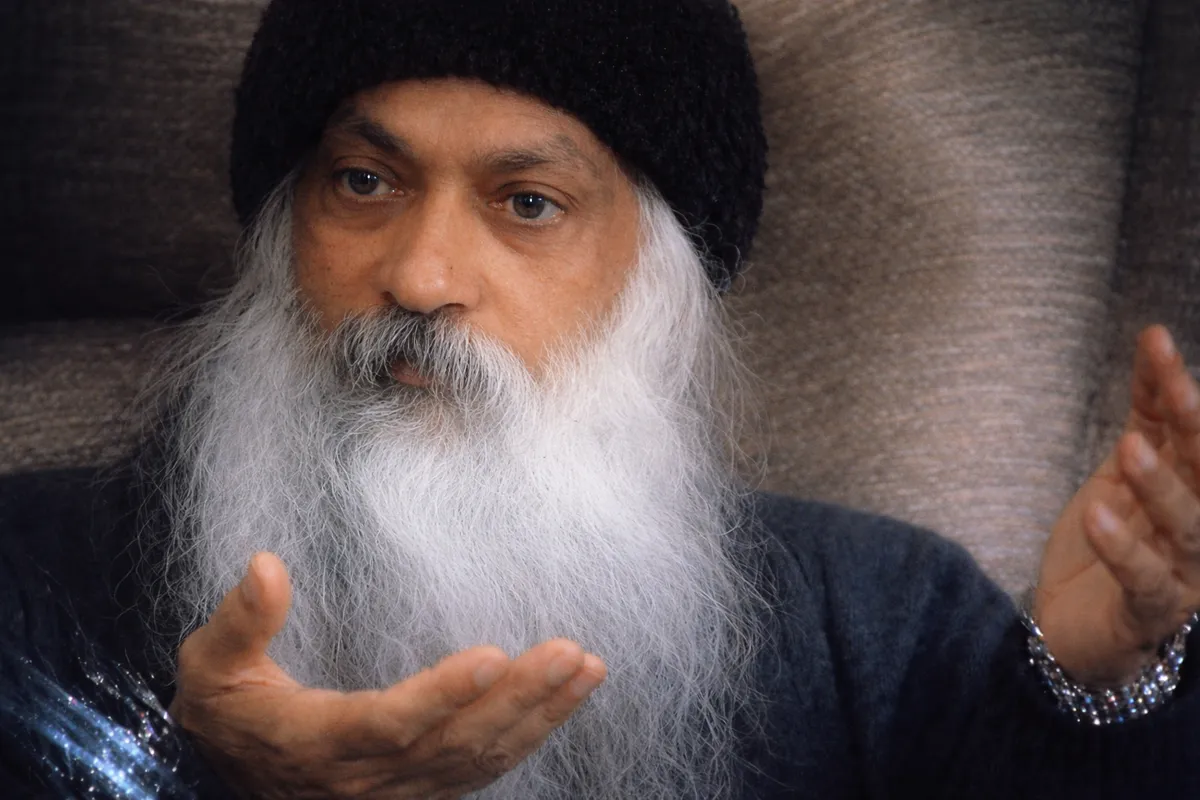
Don’t bow to my body; bow inwardly to the Divine that is everywhere—that’s real respect.
From the Discourses
Passages where Osho speaks to this question — each links to the complete discourse.
A friend has asked: Osho, I forbid people to touch my feet! But why do I forbid it?
But behind whom? Defeated by whom? Bowed to whom? Bowed to the Infinite—such people are raised up, lifted. Defeated by the Infinite—such people have won; now there is no possibility of defeat. So of course I say: do not bow at my feet. Because this “mine-and-thine,” this “my feet” feeling, is itself the obstacle to bowing. Where mine and thine disappear, bowing begins—bowing arrives. So do not be upset. Some friends said to me, “Whatever you say… we will still touch your feet!” In our land, habits are strange. If someone says, “Don’t touch my feet,” it becomes a clever device for getting one’s feet touched. Tell people, “Keep your distance,” and they come closer. Abuse them, and they will think, “This man is a Paramahansa.” This is our centuries-old wrong habit, and clever people exploit it. It seems that the one who says, “Do not touch my feet,” must…
Another friend has asked something related. He says, Osho, when you get up—someone folds their hands to you, someone touches your feet—I feel very puzzled. He has written that he feels very surprised. Why should anyone touch someone’s feet? Why should anyone fold their hands to someone?
And then it is worth asking: someone else is bowing, and some third person is getting upset! If they were bowing and they themselves were troubled, it would be understandable. But one person bows at someone’s feet and another person gets disturbed. What a strange disturbance! Why are you disturbed? Why should I be disturbed? Two people are loving—and I become disturbed! I grow restless: why are two people loving? What does my restlessness reveal? One person is giving another respect, reverence, thanks—and I get upset. Why am I disturbed? There can be two or three reasons. One: seeing others bow, my inner ego, which never knows how to bow, gets badly hurt. If no one bows, it relaxes. If someone bows, it feels wounded. Like this: three men are walking and a beggar stands before them. One of the three takes out money and gives it, and the other…
Osho, what should I call you—Prabhu, Vibhu, or Shambhu? I ask this so that I may bow at your feet continuously. Only there do I wish to bow for all three times. Now please hear my prayer!
So absorbed in worship that one forgets even to raise the hands. You don’t remember to bow—you are bowed. So immersed in devotion! “Now, for prayer, my hands no longer rise; the heart seems lost in surrender and consent.” The temperament is so drowned in worship, in prayer: who remembers when to raise hands, when to offer flowers, when to mark the forehead? Bowed is bowed. Bowing is not an outer affair. It is inner—an inward mood. You ask to bow for three times. You will be in trouble, and you’ll put me in trouble too. If you must bow, bow—just spare me! “Because I may bow at your feet continuously.” What is the fear? Why make it “continuous”? Is this moment not enough? Settle this moment within itself. The next moment will care for itself. Why keep accounts of tomorrow? Surely your today is poor. Talk of tomorrow arises…
Either say, “Don’t fall at anyone’s feet.” Even if they do understand “don’t fall,” for them it will only mean: don’t touch feet. But that when a person seems to be touching someone’s feet, he may in fact not be touching feet at all—that they can never see. He is doing something entirely different, and they have no idea of it. They cannot possibly know it. It is beyond their imagination. (The audio recording of the question is unclear.)
But they do understand other things. For example, if they get angry—if rage arises—they are ready to break someone’s head, to hit someone on the head with a shoe; and it never occurs to them, “What will come of hitting someone with a shoe?” They are simply expressing a feeling. Or when someone falls in love with someone, he embraces them; he never thinks, “What will come of embracing?” These are expressions of the feelings that arise within us. (The audio recording of the question is unclear.) What is happening inside him is the question—not the feet. Somewhere within him something has arisen, perhaps without his even knowing it, and his head has become joined to someone’s feet. What he is gaining or not gaining is not for someone else to understand. But if, seeing him, someone imitates him and places his head at someone’s feet, he will gain nothing.…
Question: Third question: Osho, I took sannyas on 11/5/80. I see it as your grace, because it took many years. That very day also turned out to be an auspicious day for touching your feet. I touched your feet and you touched me too. I was filled; I was intoxicated. Then the Energy Darshan program began. I took part in that too. But in it there came a moment when I felt: am I getting hypnotized? Then I stopped myself. A little later another moment came when I felt, ah, this is Energy Darshan! Then I plunged so deep that I was gone—and I came out blissful. Osho, I have placed my boat in your hands; now do with me what you will. Then why did this happen? What happened gives me much pain. Forgive me.