
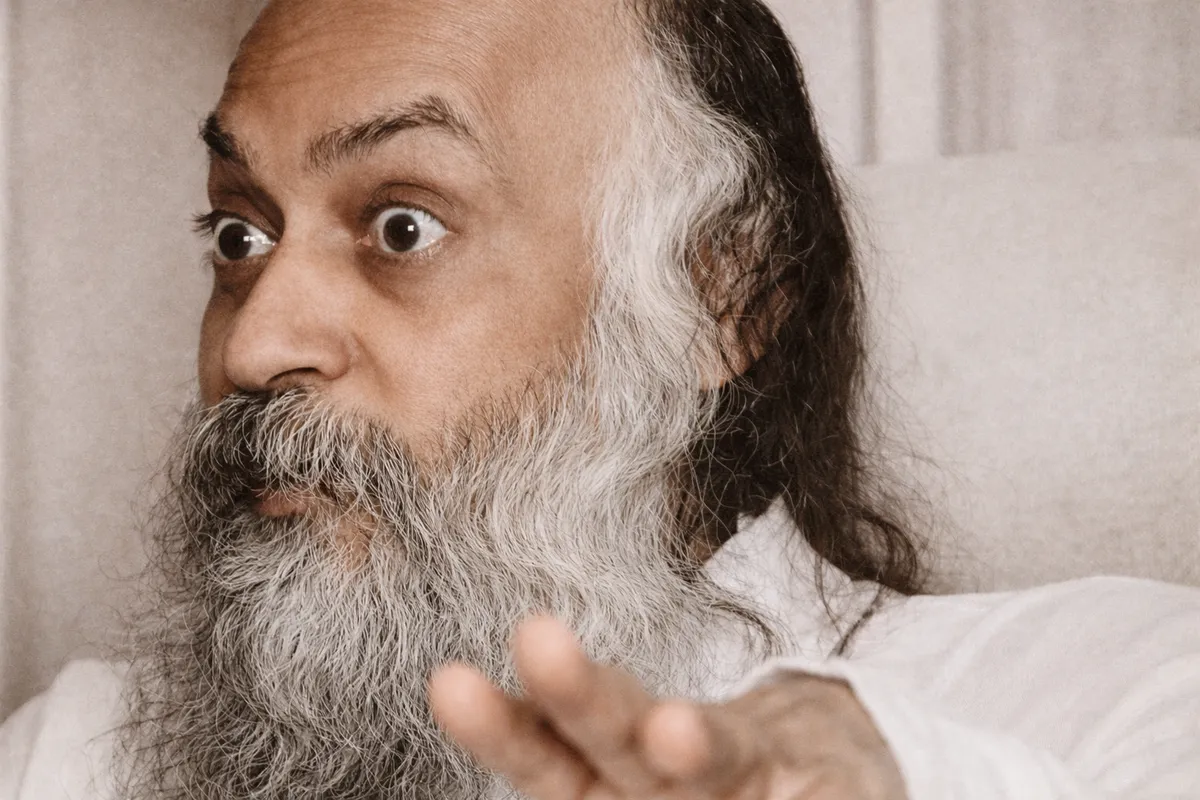
When someone deeply loves a master, they sense a special inner light, so normal words feel too small, while outsiders think it's over-the-top.
From the Discourses
Passages where Osho speaks to this question — each links to the complete discourse.
Osho, why do all religions exaggerate in praising their respective spiritual masters?
O embodiment of color, O embodiment of light, O embodied tenderness and warmth— What need was there to come from the moonlit assembly? Where you were, in that very paradise your beauty would have blossomed— What need was there to people this hell? These dimples and moles, this body carved from dreams— And a heart for which even the softness of dimples would be sacrificed. Here it is only thorns, only sparks everywhere— Step carefully, O springtime of spring, tread with care. When thirst is upon you, even poison is drunk like nectar— Who knows on which goblet that innocent gaze might come to rest? I have seen even the tavern drown in those eyes— Whether the thirst of those eyes will be quenched or not, who knows! All are lovers of beauty, people of vision, people of heart— Someone at home, someone in an assembly will adorn you. You…
Although you have made me alive towards christ, buddha, mahavir, krishna, lao tzu and all those known as enlightened ones, and it is really difficult for me to conceive of you as separate, yet when someone starts talking high of anyone, it automatically comes out of my mouth, that there has never been a greater master than shree rajneesh and maybe there will be none in the future also. Is this due to my love towards you, due to my ego, or is it reality? Or am I biased? Please enlighten.
But that is just the beginning. That is necessary to come close to the master. But come still closer and there comes a moment when the two flames of the disciple and master become one. There is a jump, a leap, and the two flames become one. Then you become aware. Then you will laugh at your own statements. Now you know that enlightened people are not different at all. Only names differ. Buddha is a name, Jesus is a name, Krishna is a name, but the enlightenment that has happened to them is the same. The closer you come to Buddha, the closer you will come to Christ also. It is as if you are moving from the periphery of a circle towards the center. On the periphery one point is Buddha, another point is Jesus, another point is Ramakrishna. The closer you come to the center, the more…
Osho, I am your disciple, you are my Master—this I want to declare to the whole world, but I cannot say it. What should I do?
Let it remain a silent experience. There is no need to say it. Otherwise the ego will arise. Why do you want to say it? What is the purpose? If you are a disciple, the world will come to know on its own. When flowers bloom, their fragrance reaches the nostrils. The sun rises—without any drumbeat, without any proclamation, without any advertisement—and the birds awaken. Even in sleep one somehow knows the sun has risen. Your song will burst forth; that alone will give the news. Your fragrance will be carried on the air; that alone will be the message. There is no need to add a bulletin. Beware of the ego’s expeditions. The ego is very skillful, very tricky, very cunning. It keeps looking for ways to make itself bigger. If there is wealth, rank, reputation—fine, it climbs aboard and rides. Not only that: knowledge, meditation, renunciation, sannyas—there too…
Osho, the witness, the seer, consciousness is always separate—virginal and unbound. And the whole play of life is nothing but the movement of the gunas within themselves. In such a situation, if a person’s qualities of sattva, rajas, and tamas are calmed in a scientific or chemical way, or if a person is made sattvic, will he then attain that ever-free witness? If the witness is forever free and present, then by chemically altering the three gunas will it not be revealed? Would the person not then become religious? What is the fundamental difference between solving the problem arising from the
Sadhana means we are dissolving the current itself, not breaking the bulb. There is no point in breaking the bulb. In fact, the bulb is useful; it tells you whether the current is flowing or not, whether there is current or not. Your anger within tells you you are still sunk in ignorance. Lust tells you your life energies have not yet become aware. If we remove these elements, anger will stop manifesting and you will also stop knowing that you are in deep ignorance. It is as if a man is sick and we snatch away the symptoms of his disease so that he doesn’t even come to know he is ill. And keep in mind, anger is an opportunity. Only the unwise say anger is simply bad; I do not say so. Anger is an opportunity; you can use it badly or well. Anger is a chance. In…
Beloved Osho, in the morning you said that the brahman is not to be found through the worshipped, but in the worshipper himself. But the sadgurus -- the spiritual masters -- have always been worshipped by their disciples as god. Please explain the significance of this.
Jesus goes on using parables. I myself go on using parables, anecdotes, stories. Not that they are essential -- they are a sheer wastage of time -- but I use them just for you because children can understand stories better than anything else. It is hoped that if nothing is understood, at least the stories will be carried in the mind and just around the story some flavor of the real thing may also be carried unconsciously. But if you will not forget the story, if you can remember the story, then just by association something else may also be carried in remembrance. Jesus used so many parables because talking to children no other way is possible. Buddha goes on telling stories.... It is because of you that the Upanishads repeat. There is no significance other than that. It can be said in a single sentence that senses will not…