
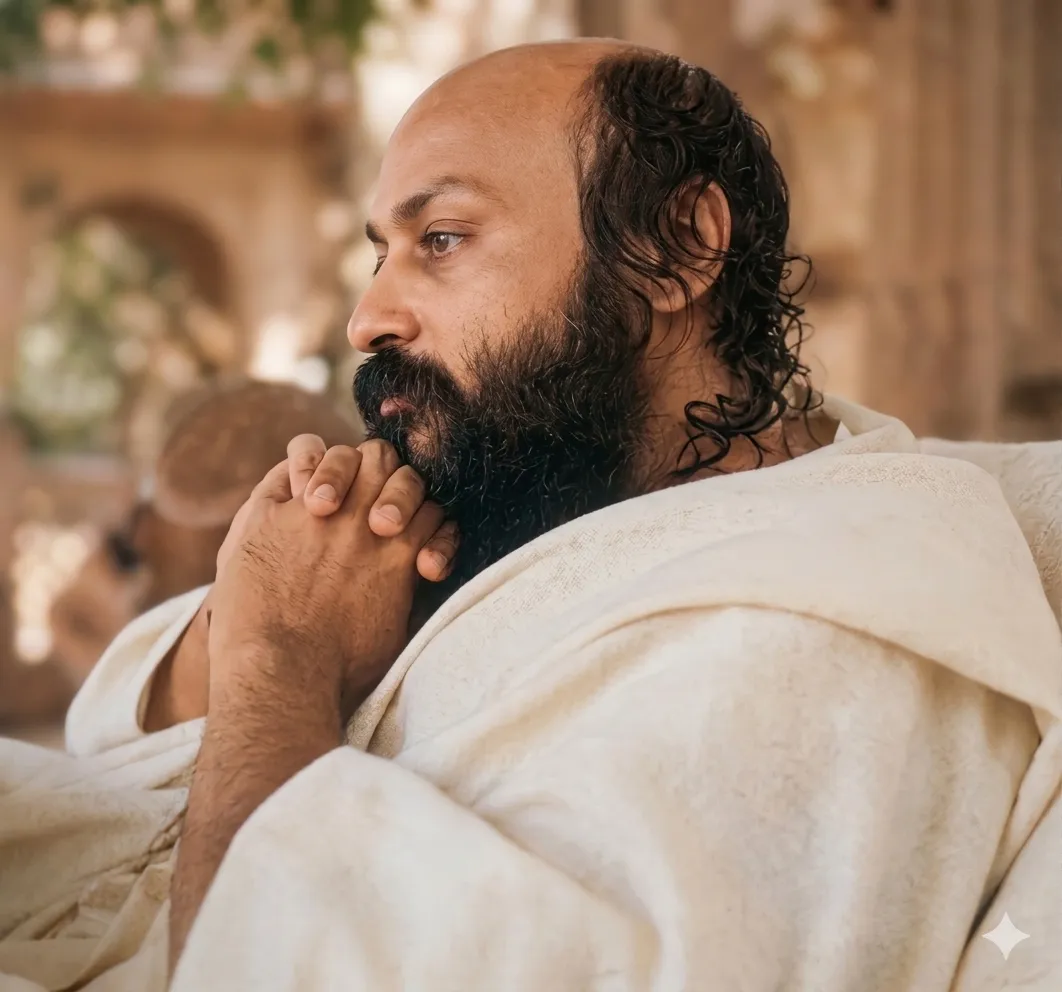
He doesn’t bring up Jews because there aren’t many around him in India, it can cause pointless debates, and he prefers focusing on living spirituality over old labels.
From the Discourses
Passages where Osho speaks to this question — each links to the complete discourse.
Osho, when you speak of religions, you usually mention christians, mohammedans and hindus, but not jews. Is there a reason for it?
And, moreover, Judaism is a dead religion, just as Hinduism is. In fact, there have been only two source religions in the world: Hinduism and Judaism. Both are dead. Jainism and Buddhism are offshoots of Hinduism but because the root is dead the branches are dead too. And Christianity and Islam are branches of Judaism, and because the root is dead the branches are dead too. These are dead phenomena. I am not much concerned with the past. Yes, something beautiful has happened in Judaism, too, and that is Hassidism -- and I have talked about it a lot. Just as I love Zen people in the tradition of the Buddha, I love Hassids in the tradition of Moses and I love Sufis in the tradition of Mohammed. These three are still alive in some small way because these three have never become established religions; they have always been anti-establishment,…
Osho, reading Martin Buber it felt as if, through Hasidic practice, he had come close to buddhahood—a great man. He wanted to build a commune grounded in Jewish humanism that embraced both the spiritual and the material dimensions of life, yet the Jews themselves rejected him. Especially over Eichmann and the Arabs, Israel tried to prove him a traitor, while he was only calling for forgiveness and friendship rather than revenge. Reviled in his own land, while people across the world—especially Christians—were influenced by him. Osho, as we settle in Kutch, please say something about this in th
Newer religions are eager to expand, imperialistic; hence they readily accept humanism. Christianity is eager for it; so are Jains, Buddhists, and Islam. All, except Hindus and Jews, want all humanity to gather under one flag; they search for pleasant pretexts, craft beautiful principles—but the underlying urge is empire-building. I will certainly call Martin Buber a great man, but not a buddha. I make a basic distinction between a great man and a buddha. A great man is a person like us; the differences between us are of degree and quantity. We know less, he knows more. Perhaps our character is weaker, his stronger. Our lifestyle less graceful, his more so. Our thoughts less logically consistent, his clearer. But between him and us there is no qualitative difference. Between a buddha and us there is a qualitative difference; he belongs to another realm. It is not a matter of more…
Question: BELOVED MASTER, WHY ARE SO MANY JEWS HERE? But religions have existed, and they are powerful, for the simple reason that they create fear in you -- fear of hell -- and they create greed in you -- greed for heaven. They wound you deeply. The more you bleed, the more your wound bleeds, the more powerful they are over you. My effort here is to redeem you from all your wounds, to redeem you from the fear of hell and the greed for heaven. There is no hell and no heaven. Those are not places somewhere, those are just your own states of mind. Whenever you are in anger, in rage, you are in hell; and whenever you are in love, in compassion, you are in heaven. So you can move from heaven to hell many times in a day.
Beloved Osho, what part of moses' teaching in the sinai desert could bring down the ages such a chain of suffering to the israeli nation? Is there any fate for a nation? And from your knowledge, did the jews have any chain for transferring the torah from one master to the other?
Adam Shapira, these two religions, Judaism and Hinduism, are the most ancient religions in the world. Just because they are the most ancient, they are the most rotten too! And out of this rottenness, what else can you expect? The mind of man clings to the old. And religion is not like wine, that the older it is the better; the fresher it is, the better. Religion is not wine, it is just a hot cup of tea, an old, ancient cup of tea.... But thousands of flies, and pundits and rabbis will be found in it; there will not be much tea in it at all! And it was bound to happen. The Hindus and the Jews both became dominated by the pundits, the scholars, theologians, rabbis. They lost track of the enlightened masters. Even though sometimes enlightened people happened in spite of the rotten tradition, they were not…
Question: OSHO, HOW NOT TO BE A JEW? Gyan Deva, IT IS REALLY DIFFICULT not to be a Jew because to be a Jew is not only to be part of a certain culture, religion, tradition -- there are Jews everywhere, in Hindus, in Mohammedans, in Christians -- to be a Jew is more a psychology than a religion. Calculativeness is Jewishness, always to be calculating about life, always thinking in terms of business, in terms of money, in terms of profit. That's what I call Jewishness. All Jews are not Jews and all non-Jews are not non-Jews either. Jewishness is a far wider phenomenon. Hindus are confined to the Hindus, Mohammedans ar confined to the Mohammedans -- Jews are spilled all over. It is something psychological, far more psychological than cultural. It is easy not to be a Hindu; you have just to get rid of your concepts.