
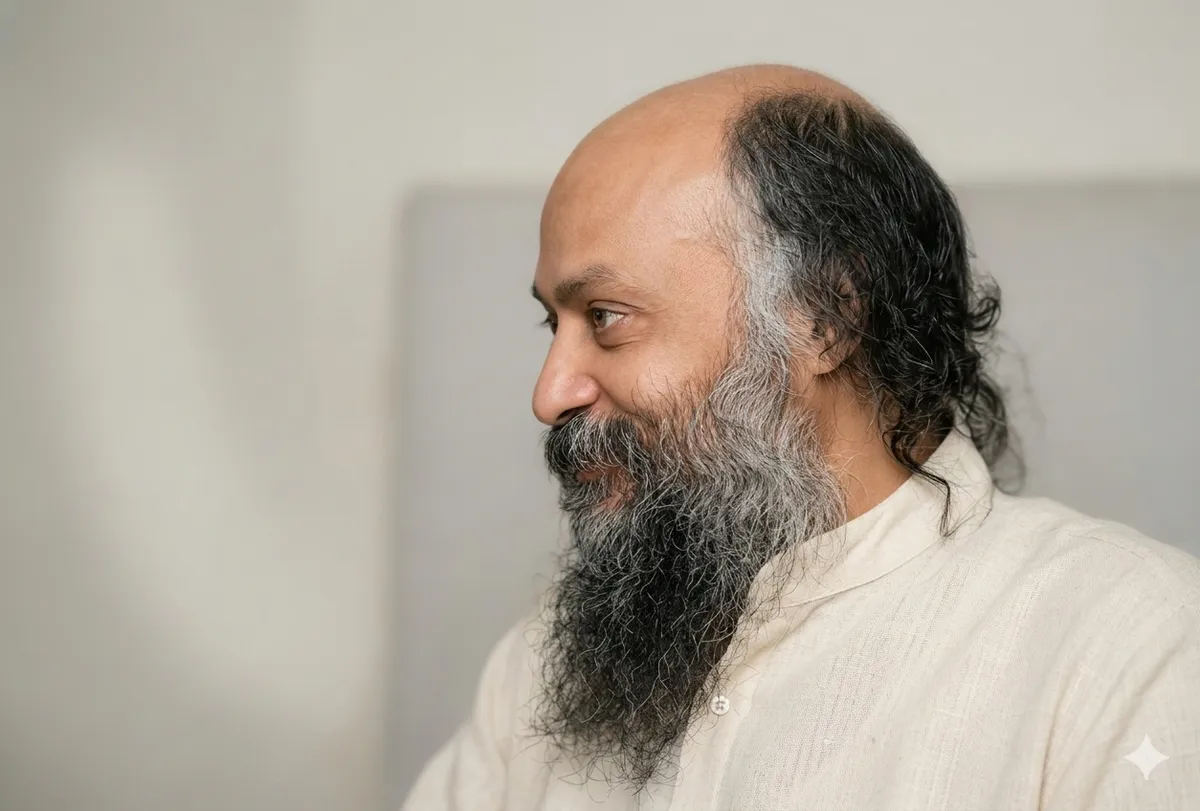
Don’t try to sort his words into true or false now—either trust fully or ignore fully, then check by your own experience.
From the Discourses
Passages where Osho speaks to this question — each links to the complete discourse.
Beloved Osho, last night you said that sometimes you lie and offer condolences for our frustrations. Then when are we to believe you and how are we to know if you are talking to us in truth or in trick?
Never believe me; do not believe me at all. Be alert. Whatsoever I say may all be lies; it may all be just a trick to give you consolation -- just to help you to take a step ahead. Do not believe me! And it is difficult for you to decide when I am speaking truth and when I am speaking a lie. That is why I say wholesale: Do not believe me -- because how can you decide? You do not know what the truth is; hence, how can you decide? If you know the truth already, then there is no meaning for me, no use, in telling you any lies. But because you do not know and you cannot understand the language of truth, it will be absurd for you -- you can understand only the language of lies. But lies are of two types: there are lies…
Beloved Osho, last night you said that we should either believe in whatsoever you say as true, or we should disbelieve you totally, taking what you say as untrue, and that both ways will help us. But what is to be done by those persons who are not capable of being total in either way? Is there any third alternative possible in this matter?
There is none and there cannot be. The third is already your state. These two are the alternatives to come out of that; the third you are already -- confused. You can only come out of this confusion with any total effort. Why is it difficult to be total either in belief or disbelief? Why is it easy to be in the middle? -- because if you are in the middle, then no change is needed: you are already there. And if you go on thinking about what to believe and what not to believe, your mind remains the same. It is your mind which chooses what to believe and what not to believe. You choose according to your mind. Then how can this mind change? If your mind is the chooser, it will choose something which can become a food to it. It will go on discarding all that…
Beloved Osho, what is the relationship between meditation and witnessing? In what way are mind and ego dissolved by them? Is surrender possible without attaining complete egolessness? To what extent are orange clothes and the mala helpful for meditation and witnessing? Also please explain the difference between witnessing, wakefulness and right remembering.
Then there are some who say doing has no attraction for them, but thoughts come rushing in waves. They are thinkers-they have no juice for doing. They have no interest in the outer, but great waves arise within, a great tempest. And they cannot be inside for a single moment without thoughts. They say, "If we sit silently more thoughts come. When we sit silently more thoughts than usual come. Just mention worship, prayer, meditation, and a great deluge of thoughts -- -armies -- come in wave after wave and drown us. What should we do?" The master says, "Drink meditation mixed in with your thoughts. Don't stop your thoughts, but when thoughts come observe them. Don't get lost in them, stand a little apart, at a distance. Calmly watching your thoughts, you will gradually attain witnessing. Add meditation to your thoughts." Then there are some who say, "We have…
Beloved Osho, I trust you unconditionally. At the same time, I don't believe you. Can you speak about trust and belief?
I am not going to leave any successor because we have seen what happens to successors. Two thousand years of popes coming and going.... If you want to find idiots in history, it is so easy -- take the names of all the popes, because other names have disappeared. These popes are representing Jesus Christ, and because they are representing Jesus Christ they are infallible. I am not going to leave any successor behind me, because in the first place I, myself, am fallible. How can my representative be infallible? I am not special, not holier-than-thou. I am not a messiah, not a prophet, just a simple, ordinary human being like you. You cannot manage with such a man to have anything like the whole history of Christianity, Hinduism, Buddhism. They fall into the same pit, into the same darkness. And the basic reason is that their prophets and messiahs…
I cannot believe that anything like samadhi or satori exists. Unless I myself have experienced it, how can I believe you are the buddha or anybody else?
Two centipedes go to the movies. Brigitte Bardot is the star. The show is over. 'A beautiful film,' says one of the centipedes. 'And this Bardot has legs -- real class,' responds the other exuberantly. To which the first nods and says: 'Yes, but so few.' Now, a centipede is a centipede. Unless Bardot has a hundred legs, what does it matter to a centipede? Maybe they are even class -- but so few.... The bishop goes to the country. He has a friendly chat with a shepherd. 'How big is your flock?' he asks. 'Five hundred and fifty, ' answers the shepherd, who doesn't know the bishop. 'So, in a certain way, we are colleagues -- I also have a large flock,' begins the bishop, hinting at his spiritual post. 'Oh?' says the shepherd. 'And how many sheep do you have?' The bishop reflects, 'Well, it must be a…