
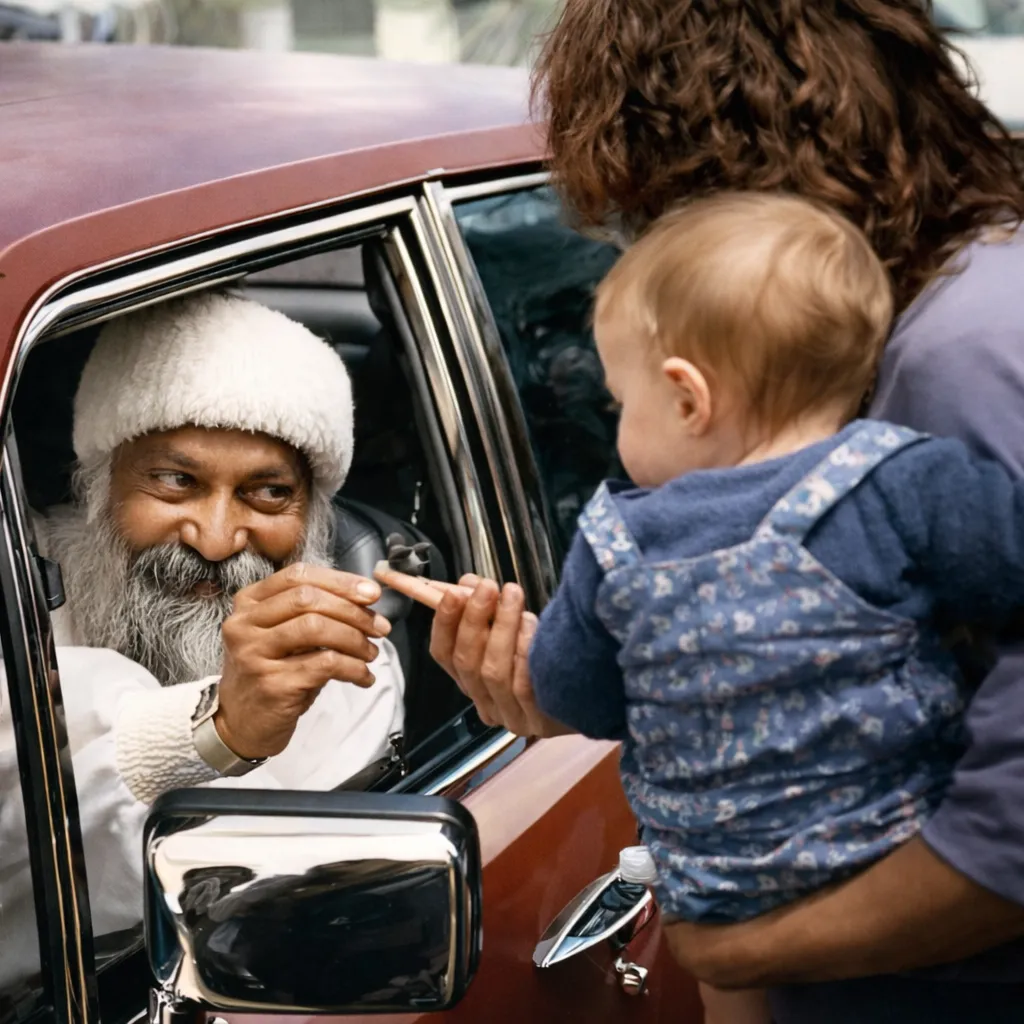
According to Osho, saints speak not to deliver truth in words—because the vast is unsayable—but to point you beyond language toward silence, the only medium that truly reaches. Their words are fingers indicating the moon, reminders not to stop at scriptures or doctrines. They risk being misunderstood and idolized, yet they speak so your journey doesn't end with concepts but ripens into direct experience.
Saints talk to point you past their words to a silent truth—like pointing at the moon so you look at the moon, not the finger.
From the Discourses
Passages where Osho speaks to this question — each links to the complete discourse.
Question: First question: Osho, truth cannot be spoken—then why do saints speak? Precisely to bring you news of that which cannot be said. So that you do not take only what can be said as the whole of life and come to an end there. There is the unsaid; there is that which can never be said—and that is the essence. The small can be said; how to say the vast! Words are so tiny—how can the limitless be contained within the narrow bounds of words! One can point; one cannot fully express. Saints speak so that you do not end your journey in words alone. Words are very small. Language does not travel far; the true reach is of silence. Words rise from the throat and reach the ear; there they remain. Silence travels far—into the infinite.
Well asked: “Whenever someone enters the vast, expression is bound to happen.”
There is no mention of Jesus anywhere except in the Bible. The Bible is written by his own disciples; therefore it is not “reliable,” people say. Thousands doubt whether Jesus ever existed at all! Whether Krishna ever was—people doubt it. Such vast beings—and history leaves no imprint of them? Because you write history; when no imprint is made upon you, how will any imprint appear on what you write! Your writing carries the imprints of Genghis Khan, of Tamerlane, of politicians, agitators, killers, bandits. No one doubts whether Genghis Khan or Tamerlane existed—there are millions of proofs. Krishna? Christ? There seem to be no proofs; believe if you will, if you won’t, no one can compel you. What could be the reason? How does history remain so untouched? Because you write history. Your heart itself remains untouched. When no mark is left upon you, how will any mark be left…
Osho, of that which is indescribable—by speaking of it, why would a Shandilya place a stone before humanity?
And if the choice is between God and these wandering ones—let no injustice be done to these wanderers. That is why Shandilya speaks. That is why Buddha had to speak. It is their great compassion. They have not placed stones in your way; they have given the key to turn those stones into steps. And at least do not be unjust to Shandilya by making such a charge. For Shandilya is not telling you to drop affection; he is saying, purify affection—stone becomes a step. Shandilya is not telling you to drop love; he is saying, love can become a step—purify it, it becomes devotion, and you will rise. Shandilya is not telling you to renounce the world; he is saying, do not hate the world—otherwise that very hatred will become the obstacle. Shandilya does not preach dispassion-as-aversion, asceticism, grim austerity—he is opening the doors of the temple of love.…
A puzzled monk once said to fuketsu, "you say truth can be expressed without speaking, and without keeping silent. How can this be?" fuketsu answered, "in southern china, in the spring, when I was only a lad, ah!. How the birds sang among the blossoms."
Zen brings the whole truth to the world. Zen is a great blessing to the world; it brings the whole truth. The whole truth is: Truth cannot be said, and yet can be said. If not said, then showed, indicated. The ordinary duality is transcended. We are always moving from one pole of the duality to the other. Sometimes we say, "Yes, it can be said"; this is one pole. Then we become aware, "How can it be said?" -- the other pole. Then we keep silent, but then again we become aware that there is something left: "Yes, it can be said." This way it goes on moving, it swings. Zen says truth is a transcendence, transcendence of all duality. The duality between the word and the silence is also to be transcended. The Bible says in the beginning there was the word. The Vedas say in the beginning…
If truth cannot be expressed in words, then why have all the buddhas used words?
A parable: THE GREAT MYSTIC, Rabia of Basra, was immensely beautiful. And a beauty not of this world. Once a rich young man from Iran comes to Basra. He asks people, "Is there anything that is out of the way, something special here?" "Yes," they all tell him. "We have the most beautiful woman of the world!" The young man naturally becomes interested and he asks, "Where can I find her?" And they all laugh and say, "Well, where else?... in a brothel!" That repulses the rich young man, but finally he decides to go. And when he gets there, the matron asks for an exorbitant fee. He pays the fee and is ushered in. There, in a silent and simple room, a figure is praying. What beauty she has! He has never seen such beauty and grace, not even in his dreams. Just to be there is a benediction,…