
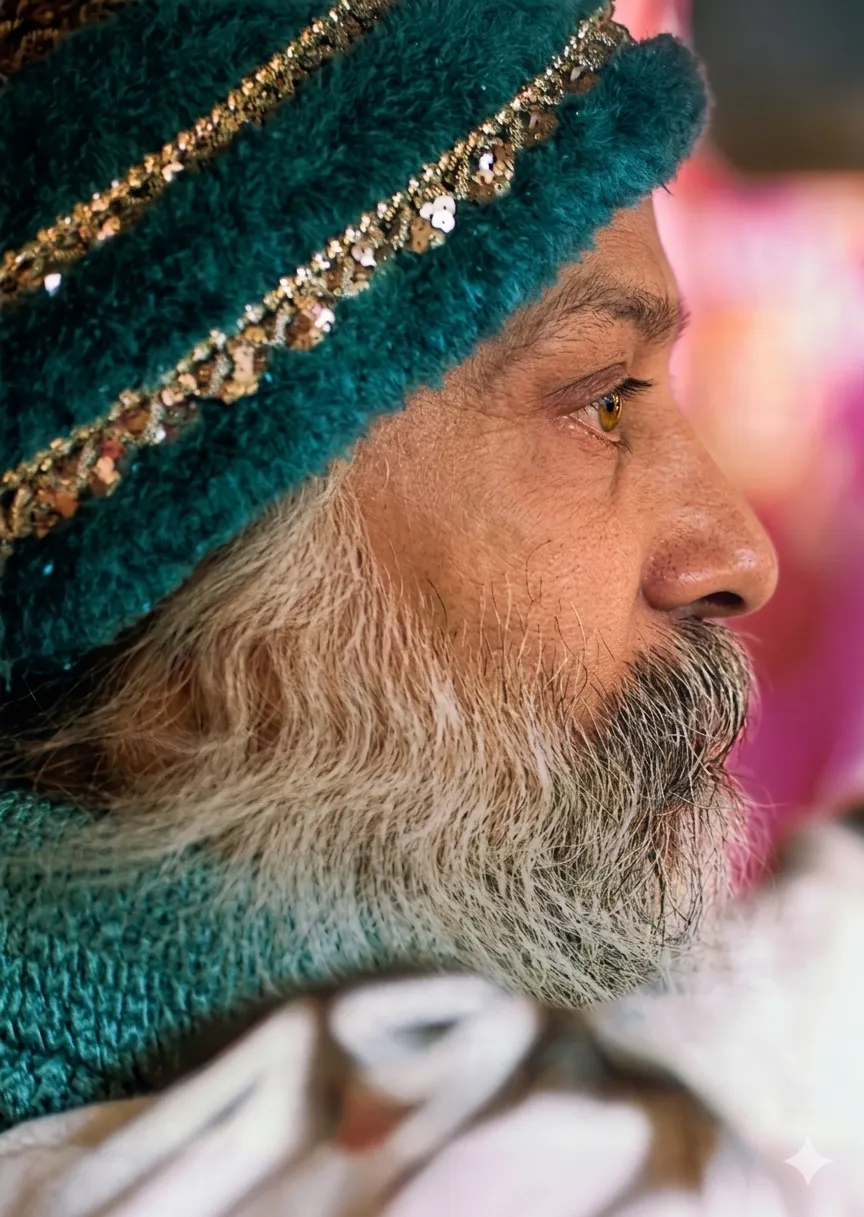
Going for truth can be lonely and painful, but that heat cleans you so you can really see and feel one with life.
From the Discourses
Passages where Osho speaks to this question — each links to the complete discourse.
First you have to become a little happier, you have to learn to be a little more love-full, joyful; your life has to have the color of a little happiness. Then go into the search for truth and you will be moving in the right direction, because then no lie can ever deceive you. You are no more interested in lies, because you are no more interested in consolation and comfort. Now you are ready to know the naked truth as it is. And to be a seeker of truth is the greatest thing in life. Satbodh One cannot find truth by mere thinking. Thinking is not the process that leads you to the truth. It leads only to inference. And inferences are just inferences, they are hypothetical. They may be true, they may not be true. They are just conjectures, not real conclusions.
Osho, the Upanishads say that seeking truth is like walking on the edge of a sword. Saint Dariya says that in the search for the Divine there is burning, only burning, at first. And you say: go singing and dancing toward the Lord’s temple. Which approach is the right one?
Anand Maitreya! Truth has many facets, and all of them are true at once. There is no question of choosing. Each one has spoken as he saw. The Upanishads are right, because to walk the path of truth is risky—very risky! The crowd is steeped in untruth, and when you walk toward truth, the crowd will oppose you. It will throw a thousand obstacles in your way, laugh at you, call you mad. There is a certain safety in the crowd; the one who walks the path of truth becomes solitary. The crowd breaks ties with him, severs relations, and society treats him as an enemy. Otherwise, would people have crucified Jesus? Would they have cut off Al-Hillaj Mansoor’s head? They were people like you who crucified Jesus and beheaded Mansoor. Look closely at your hands and you will find the stains of Mansoor’s blood. They were people like you—not…
truth cannot be achieved by human efforts because all human efforts are bound to originate in the mind and mind is the barrier between truth and consciousness the mind has to be put aside that's what man is capable of doing not using the mind, putting the mind aside by-passing the mind, transcending the mind and the moment the mind is not functioning consciousness immediately becomes connected with the truth the barrier is no more there hence the bridge happens and that is the greatest blessing in existence when truth showers on you only with the experience of truth life becomes meaningful, significant a celebration a man without truth is a beggar a man without truth is not yet really alive he is simply living in a kind of dream he is not awakened not awakened to the tremendous beauty of existence to the immense ecstasy of life not aware…
Go beyond your doubt, your doubting mind, and then you will really be a seeker of truth. A seeker of truth neither believes nor doubts. He is simply available, ready, open, vulnerable. He is ready to go with the universe wherever it leads. And the universe is always leading you, guiding you towards the ultimate expression of your being. If you can surrender to existence, if you can allow yourself to be overwhelmed by it, then the transformation happens so easily, without any bloodshed and without any damage. Not even scars are left in you. One changes so silently, so noiselessly, as if nothing has happened. On the outside everything remains the same and on the inside nothing is the same. One can seek truth either out of misery or out of bliss. Both people are seekers, but the first one is going to miss, he will never reach.
Osho, Sufis are regarded as seekers of truth—the truth which is the knowing of objective reality. An ignorant, greedy, and tyrannical king decided, “I will bring even this truth under my control.” He was the lord of Murcia in Spain, and his name was Roderic. He further resolved that Umar al-Alawi, the Sufi of Tarragona, would be forced to reveal this truth.
Consequently, Umar was arrested and brought before the royal court. Roderic said to him, “I have decided that the truth you know you will tell me in words I can understand. And if you do not, you will have to forfeit your life.” In reply Umar asked, “In this generous court, do you accept the universal principle that when a person, in answer to a question, speaks the truth, and if that truth does not incriminate him, he should be set free?” Roderic said, “So it is.” Umar then said, “Let all present here be witnesses to this. And now I will tell you not one but three truths.” Roderic said, “We must also be assured that what you call truths are actually true. Therefore, whatever you say must be accompanied by its proof.” Umar replied, “For a lord such as you, to whom we are about to give not…