
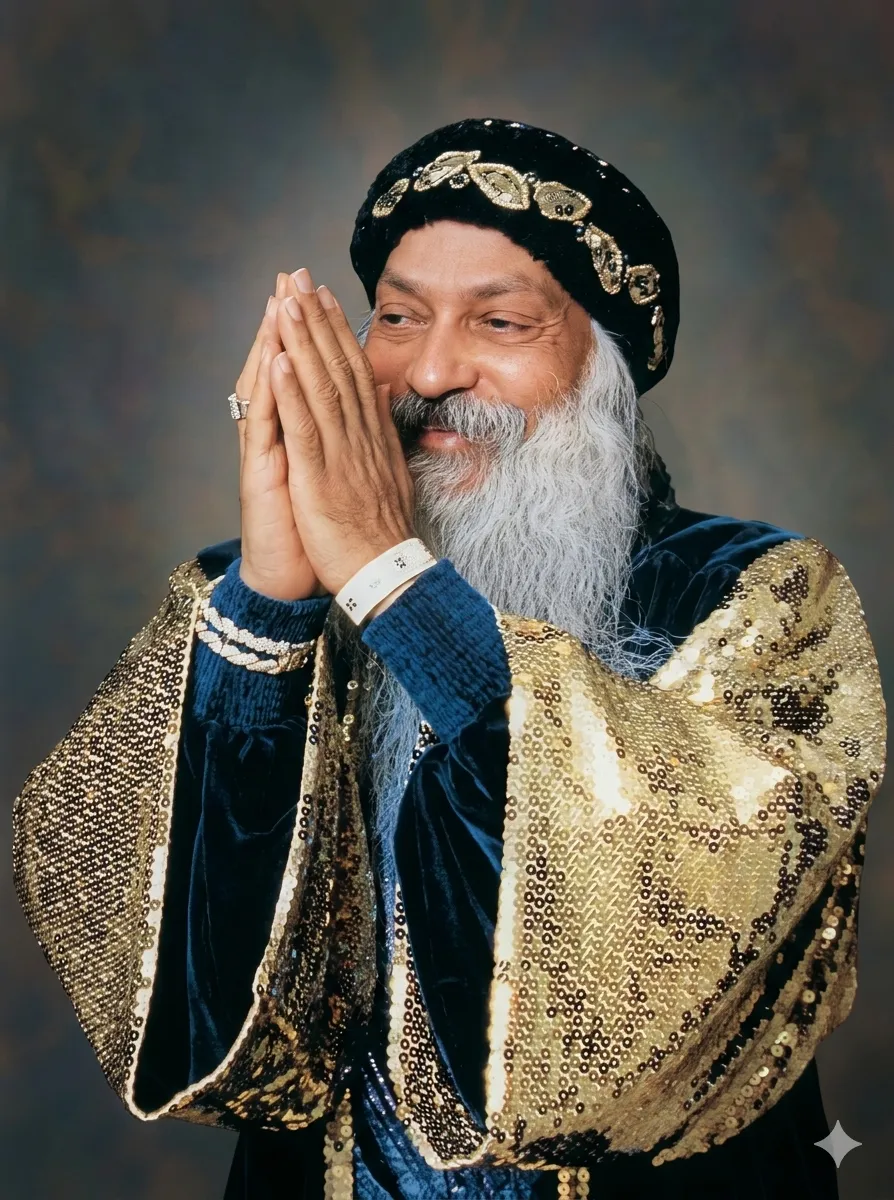
Forced bows don’t make anyone humble; they just make the person being bowed to feel bigger.
From the Discourses
Passages where Osho speaks to this question — each links to the complete discourse.
Osho, when one bows, whose ego is broken—the one who bows, or the one who is bowed to?
No, no—this is not about breaking the ego. Here Mahavira is keeping the male ego entirely protected. He is safeguarding the male ego. The nun bows to the man...
Another friend has asked something related. He says, Osho, when you get up—someone folds their hands to you, someone touches your feet—I feel very puzzled. He has written that he feels very surprised. Why should anyone touch someone’s feet? Why should anyone fold their hands to someone?
And then it is worth asking: someone else is bowing, and some third person is getting upset! If they were bowing and they themselves were troubled, it would be understandable. But one person bows at someone’s feet and another person gets disturbed. What a strange disturbance! Why are you disturbed? Why should I be disturbed? Two people are loving—and I become disturbed! I grow restless: why are two people loving? What does my restlessness reveal? One person is giving another respect, reverence, thanks—and I get upset. Why am I disturbed? There can be two or three reasons. One: seeing others bow, my inner ego, which never knows how to bow, gets badly hurt. If no one bows, it relaxes. If someone bows, it feels wounded. Like this: three men are walking and a beggar stands before them. One of the three takes out money and gives it, and the other…
Osho, you have earlier said, “Live moment to moment, live in the present.” Now you are saying, “Return to the past.” What should we do?
So it is with the mind—there are ruts. The past means endless grooves. However much you understand, your intellect agrees, you make decisions, you resolve—at the moment of resolve you feel something is going to change. But not even an hour passes before your decision breaks. Then only self-condemnation is produced, nothing else. Your saints, your fakirs, your priests and pundits—most of the time they only succeed in producing self-condemnation in you, nothing else. Their words are logically correct. You cannot even say they are wrong; you have to admit they are right. In that admission you take a decision. But against what are you deciding? Inside are grooves carved since who knows when, deep tracks. Walking in them has become a habit. It is easy to walk in them. They will pull you again and again. The meaning of returning into the past is: these grooves must be erased.…
Osho, there is an old belief that if the noble and the great bow to those who are smaller than themselves, the juniors incur sin. Obviously, that would feed their ego. Then why is it that, both when you come for discourse each day and again when you take your leave, you fold your hands and bow to us?
So that you keep remembering that you are not small; so that you keep remembering that, though you may have forgotten, your very nature is divine; so that you keep remembering that godliness is your treasure. Yes, if you inflate your ego, it will be a mistake. And if you awaken your godliness, it will be merit. Sin and virtue depend on your vision. For me there is no way except to see God in you. Once That is seen within oneself, it begins to appear in everyone. Every straight or slanted line, your form emerges. How many times I wished to paint some other picture, to free my mind from the prison of your shape— but in every mirror your beloved reflection descends. I do look at you, of course, but it is not you that appears there; I bow to that which appears. You too, slowly, with the…
Osho, whenever someone tells you that such-and-such is happening in meditation and you say, “Good, that is auspicious,” the ego grows even more. And at all other times the ego keeps raising its head. Even while writing this question the ego thought a lot about it, and still...?
And I tell you: only the shadow remains with you; you have lost the soul. Imagine what your plight must be! Losing a shadow caused such trouble; you have lost the soul and kept only the shadow. But perhaps you don’t notice much trouble because those among whom you live have also lost their souls. The truth is, if you gain your soul, the trouble begins—those without souls become your enemies. Otherwise, why would people stone Mahavira, insult Buddha, crucify Mansoor, poison Socrates, kill Jesus? The crowd is without soul. Whenever a soul-full person stands among them, they become very uneasy. What foolishness! They should learn from the soulful how to become soulful. But seeing a soulful person, they get anxious. They say, “His presence proves we failed to become what we should have become. We lost.” Anxiety arises: “Our life is wasted. Remove this man; his presence is a…