
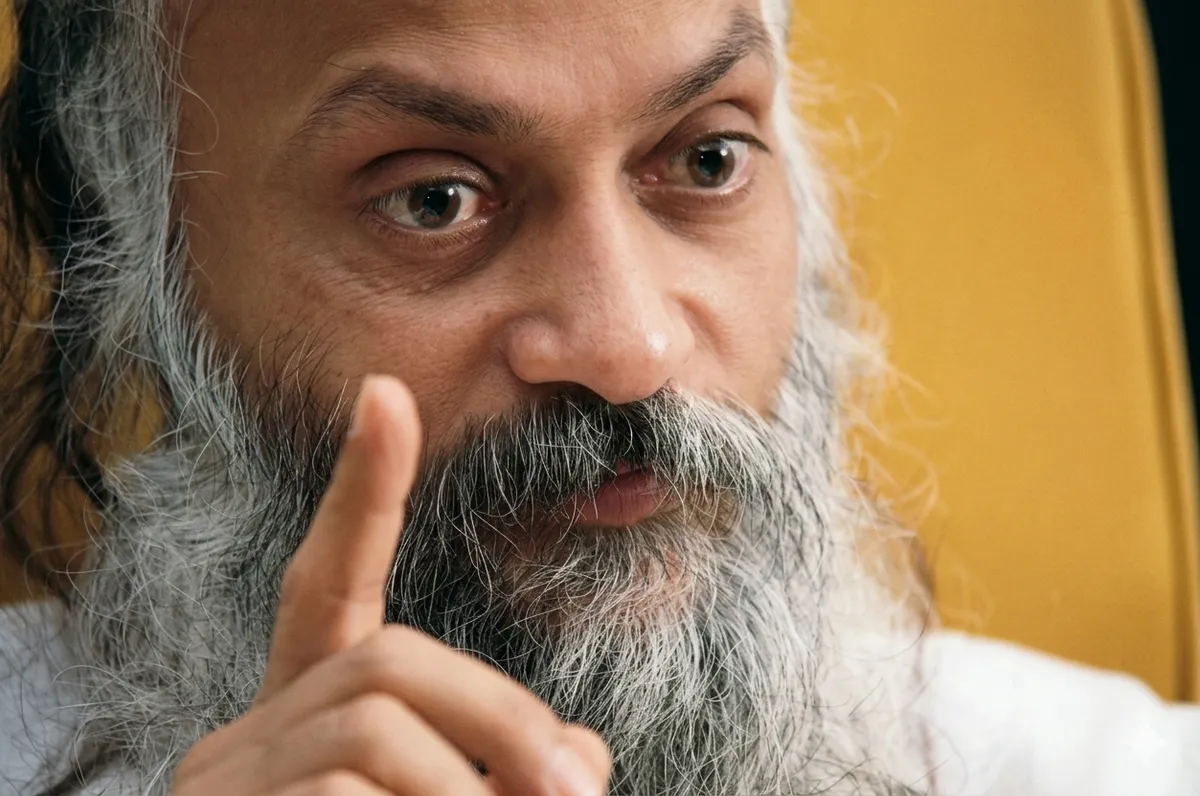
When a wise drop falls into the ocean, it doesn’t disappear; its special taste spreads through the whole ocean.
From the Discourses
Passages where Osho speaks to this question — each links to the complete discourse.
When an enlightened being dissolves into the cosmos, does his uniqueness dissolve also?
The enlightened man, even while he is alive in the body, has already dissolved. He knows that he is no more, he knows that he is a nothingness. The dissolution has already happened. In fact, nothing has dissolved, because nothing had been separate from the very beginning. Separation was an illusion. The feeling that 'I am separate from existence' is just illusory, it is not a reality. The enlightened man comes to realize only that he never existed before, that he does not exist now, and that he will not exist in the future. The whole exists, not the parts. You may think that you are separate, but that is just a dream. Only the dream dissolves -- nothing else; only the ignorance is lost -- nothing else; only sleep dissolves -- nothing else. But the question is relevant. What happens to the uniqueness of a Buddha, a Lao Tzu,…
Beloved Osho, I heard you saying that enlightenment is the transcendence of mind -- conscious, unconscious, sub-conscious -- and that one dissolves into the ocean of life, into the universe, into nothingness. I also hear you talking about the individuality of human beings. How can the individuality of an enlightened person manifest itself if he is dissolved in the whole?
The ordinary, unconscious human being has no individuality; he has only a personality. Personality is that which is given by others to you -- by the parents, by the teachers, by the priest, by the society -- whatever they have said about you. And you have been desiring to be respectable, to be respected, so you have been doing things which are appreciated, and the society goes on rewarding you, respecting you more and more. This is their method of creating a personality. But personality is very thin, skin-deep. It is not your nature. The child is born without a personality, but he is born with a potential individuality. The potential individuality simply means his uniqueness from anybody else -- he is different. So first, remember that individuality is not personality. When you drop personality, you discover your individuality -- and only the individual can become enlightened. The false cannot…
You said enlightenment is individual, but does individuality remain after enlightenment?
No. Individuality does not remain after enlightenment, but enlightenment is individual. You will have to understand it. A river falls into the ocean. When it has fallen the river has disappeared -- there is no individuality of that river left, but only an individual river falls into the ocean. You fall into the ocean of enlightenment as an individual: you cannot take your wife with you or your friend with you -- there is no way. You go alone. Nobody can take anybody. How can you take anybody? When you meditate you meditate alone. The moment you close the eyes and you become silent, everybody has disappeared -- the wife, the friend, the children. The nearest are also no longer near; the closest are farthest now. In your deep silence, inner collectedness, you alone exist. This aloneness will fall into the ocean. So, enlightenment is individual. Of course after enlightenment…
In reality there is no ego, no self, no atman. You say you are not a person but a presence, that you are a mirror. When it is cloudy outside you are cloudy. You reflect whatever is. You also say everyone is unique. Where is the uniqueness to be found in a mirror? Uniqueness implies separateness, individuality. Enlightenment is union. I know uniqueness must be so in enlightenment,for I cannot imagine christ or buddha running their ashram the way you do if they were alive now and all three of you were doing that. Knowing that, I still do not understand this paradox. It puzzles me deeply. Please
Enlightenment is the disappearance of the ego, of the individuality, of separation. Just as the Ganges falls into the ocean -- what uniqueness can it have? It was unique, it had its own form, its own color, its own strength. It was different from any other river. But when it falls into the ocean what uniqueness can it have now? All other rivers are falling -- the Amazon and Thames -- and they all are disappearing into the ocean, and they all are becoming salty. So is enlightenment... the river disappears into the ocean. "I KNOW UNIQUENESS MUST BE SO IN ENLIGHTENMENT..." No, Sharda. That very idea of uniqueness is part of the pathology of the human mind. Enlightenment is utterly ordinary. THAT is its extraordinariness. In this life everything is special, particular, unique, EXCEPT enlightenment. That is its uniqueness, if you want to use the word 'unique'. But its…
Osho, you said last night that those who have become void, valley-like, do not react but they respond, and that the responses of these different enlightened ones will be different -- that the valley will reecho in its own unique and individual way. Now a question arises whether those who become absolutely void, nothingness, still have a personality and individuality. If so, then please explain how this becomes possible.
THIS is one of the paradoxes of spiritual life: the more one dissolves into the Divine, the more unique one becomes. The dissolution is not of the individuality but of the self. The dissolution is not of the uniqueness but of the ego. The more you are an ego, the more you are like others, because everyone is an egoist. The ego is the most ordinary thing in the world. Everyone is an egoist; even a newborn child is an egoist -- a perfect egoist. So it is not anyone's achievement; it is not extraordinary. Really, it can be said that to be just ordinary is the most extraordinary thing possible because no one feels just ordinary. So to feel oneself extraordinary is just the most ordinary thing. Everyone feels like that! So ego is not something unique. If you have an ego, it is not something unique. Really, egolessness…