
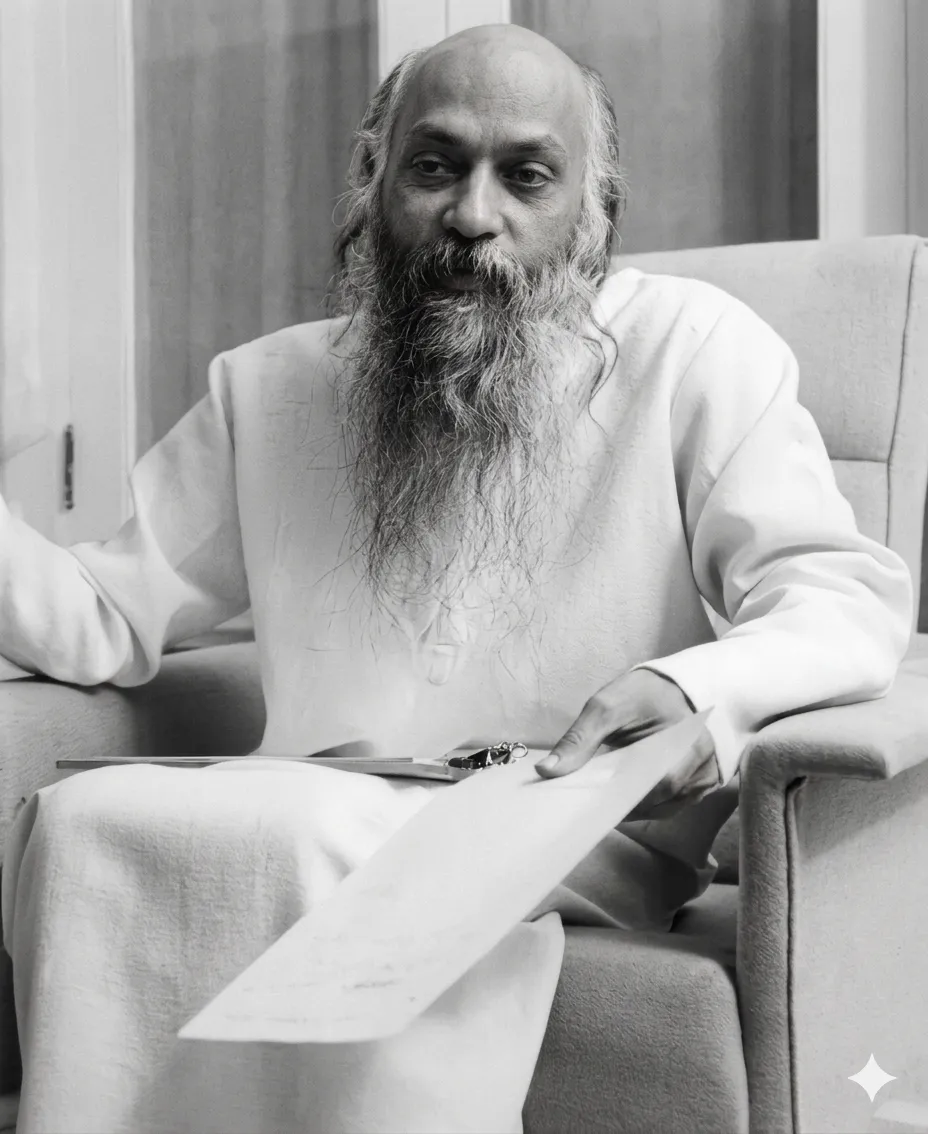
According to Osho, the ‘dullness’ is a natural mid‑stage: thoughts are slowing, but the new movement of consciousness isn’t clear yet. Don’t panic or change methods; don’t label it inertness. Keep meditating with patient, simple watchfulness. Accept the in‑between, and continue. By persisting, the apparent dullness dissolves and a subtler aliveness—awareness itself—emerges.
When meditation feels boring or foggy, it means thoughts are slowing—just keep calmly watching and it will open into clearer awareness.
From the Discourses
Passages where Osho speaks to this question — each links to the complete discourse.
In the beginning you will find only darkness or absurd, irrelevant thoughts, dreams floating here and there. It will look like a chaos but go on watching, go on looking. We are not worried about what you are seeing. Our whole effort is to see. Remember, the emphasis is on seeing, not on the seen, so it does not matter what you see. Thoughts, desires, memories, dreams -- it doesn't matter what you are seeing. Everything is just an opportunity to make the inner eye function. So remember the emphasis otherwise people become tired; they think 'What is the point? We don't see any light, we don't see god, we don't see the soul we don't see this, we don't see that. Just ordinary thoughts are there so what is the point? They have missed the whole message.
Osho, you say that if there is awareness, then how are the two to be brought into harmony?
That is precisely the practice of active meditation: awareness. Awareness is the very means of going into emptiness in relation to all actions, to the movements of the mind as well. For example, if you lie there for half an hour—what will you do? In that half hour, whatever thoughts are moving in your mind, you are to be simply aware of them. Simply a witness—what else will you do? Just become a witness. Keep silently watching; let them move. But obstacles arise in our seeing. We become absorbed. We fail to remain a witness. We don’t even notice when we have become one with those very thoughts. That sense of awareness fades; a kind of stupor, a moorchha, comes in. A thought comes, a memory arises, and we stop being the watcher. We become part of that thought and of its flow. That is moorchha. And the opposite is…
Nothing else matters... only meditation. Howsoever it happens, allow it to happen. If it happens in the day, then the day. If it happens in the night, then night. If it happens in the city, then the city. If it happens in the mountains, then the mountains. Everything else is irrelevant. The only thing relevant is that it should happen. Techniques are also irrelevant. Whatsoever technique fits you, that is the technique for you. So don't be obsessed that this technique has to fit. Basically, you are the end -- the technique is just the means. Be selfish and always find out in what situation, in what way, by what method, you are feeling better, calmer, more collected, centred -- that's all. [The T'ai Chi group was at darshan tonight. They gave a demonstration.
Osho, should one just keep watching it? Keep feeling it? What thought should be there at that time? What feeling should be there at that time?
So you can prevent meditation from happening—and you are preventing it—but you cannot make it happen. Our whole problem is very reversed. The reality is that when someone asks me, Meditation is not happening, he is asking the question upside down. In fact, he is striving with all his life’s breath to make sure that meditation does not happen. He has spoiled lifetimes to see that meditation does not happen. And for meditation he has erected a thousand kinds of barriers so that it cannot happen. You are fully arranged so that you do not become a witness. And then when you hear from someone that there is great bliss in witnessing, you think, All right, let me also become a witness. So you try to become a witness too. And all your arrangements to prevent witnessing continue as before; nothing in them changes. Within that very setup you also…
It has been asked: It has been asked, Osho, you tell us to think—yet what will come from thinking alone? As I keep thinking, I get drowned in thoughts themselves, and my conduct does not change. My conduct remains exactly the same. So please tell me, how is conduct to be changed?
Commonly it is said, “What value is there in thought? The real value is in conduct.” This is utterly false and futile. It is false and futile because conduct, deep down, is nothing but the expression of thought. Where there is no seed of thought, there can be no plant of conduct. Yes, it is possible to throw a false conduct over oneself from the outside. But false conduct has no value whatsoever, except that it deceives others and destroys one’s own life. The question asked is: “What will happen by thought alone?” This is why I ask, and why the question arises—if I were to pray to you, I would say: as yet no thought has been born in you. You are taking others’ thoughts to be your own. Hence the problem of trying to bring thought and conduct into harmony. If the thought were truly yours, it would…