
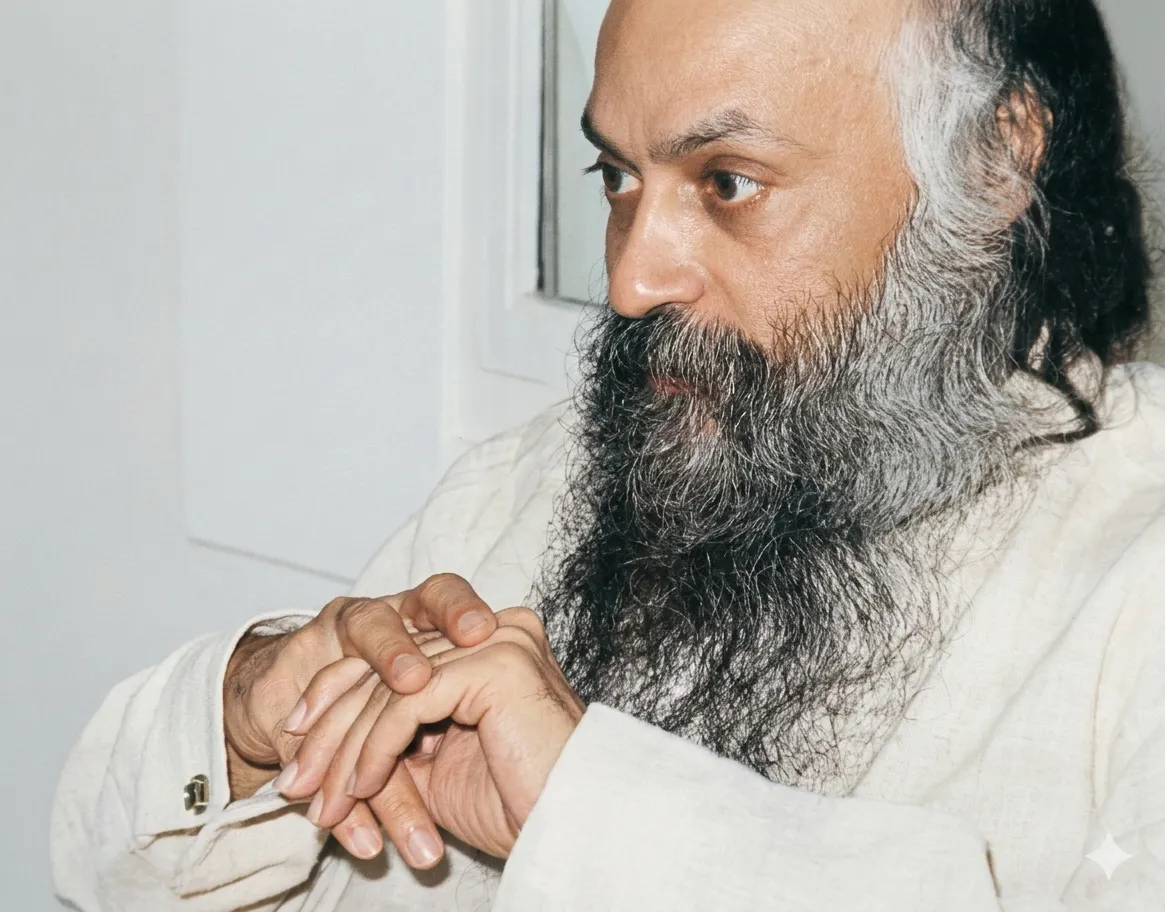
When you become one with life’s music, there’s no separate ‘me’ choosing—right action happens by itself, so good and bad no longer apply.
From the Discourses
Passages where Osho speaks to this question — each links to the complete discourse.
It is asked again: What lies beyond good and bad?
When the rhythm holds, it is auspicious; when the rhythm breaks, it is inauspicious. And when the rhythm becomes such that there is no possibility of its breaking—when you yourself become the rhythm, when the rhythm becomes your destiny, your very nature—then you are beyond good and bad. Then there is no need to worry, “What should I do, what should I not do?” Whatever happens from that rhythm is right. This is the distinction in the definitions of asadhu, sadhu, and sant. The asadhu is one who does the inauspicious. The sadhu is one who does the auspicious. The sant is one through whom the auspicious happens and the inauspicious does not—one who has gone beyond doing. In doing, one has to think—“Shall I do this or not?” One has to decide; there is choice. In choice there can be mistakes, there can be misses. After all, one is…
Utter confusion is my part. Good and bad have ceased to exist. I am neither proud nor ashamed and yet I am both. Whatever I have achieved seems lost in a fog, resolved together with my failures. Like smoke I feel, but through the smoke a tremendous sadness arises like a sharp rock with a velvet covering. Osho, I can't perceive the end of it -- or is there no end? Is it ecstasy carrying the weight of impurity? Please, Osho, give me sannyas.
This opportunity can turn into a curse too, if you fall victim to some Adolf Hitler; but this curse can become a great opening into the unknown if you are fortunate enough to be in the vicinity of a buddha. If you are fortunate enough to be in love with a buddha, your life can be transformed. People who are still rooted in tradition, and who think they know what is right and what is wrong, will never come to a buddha. They will continue to live their life -- the routine life, the dull, the dead life. They will go on fulfilling their duties as their forefathers used to do. For centuries they have been following a track and they will go on following that trodden track. Of course, when you follow a trodden track, you feel certain -- so many people have walked on it. But when you…
Osho, yesterday it was said that there is a balance of good and evil in the world. The two are always equal in measure. When one evil is erased, some good also diminishes. If this balance is never going to change, then what is the purpose of sadhana?
Arjuna too is afflicted with this same duality. What is his question, his concern, his entanglement? It is this very entanglement. He sees that this war is evil: people will die, there will only be killing, blood will flow. Who knows how many women will be widowed, how many children orphaned. Sorrow and wailing will spread from house to house. This is bad. So he says to Krishna: let me drop this evil. This does not seem like something to do. Better I go to the forest, take sannyas, become detached, renounce everything—drop the bad and hold to the good. And what is Krishna explaining to him? That is why Krishna’s message, while simple, is exceedingly difficult. Krishna is explaining: as long as you think, “This is bad, I should drop it; this is good, I should do it,” you will remain in confusion. Drop the very notion of karma.…
Osho, you said... then you will find that the devotee is God. The question arises: if one devotee prefers to be God and another wants to remain only a devotee, then which of the two is superior?
The one who wants to be God will not be able to be. And the one who wants to remain a devotee will become God. The question of superior or inferior does not arise, because only one of the two will happen. The one who does not want to be will be. The one who wants to be will be deprived. That very wanting is of the ego. But the matter is a little delicate. Sometimes humility too belongs to the ego. Beware that your humility may not be of the ego. Perhaps you are saying, “No, I don’t want to be,” because you know that those who refuse are the ones who attain. Then you are clever. Then your humility is adulterous. Your humility is not pure, not sacred, not virginal—it is like a prostitute. The one who wants to be God, whose ego says, “I must become God,”…
Osho, in this chapter of the Gita the qualities of the divine and the demonic are described. The earth seems packed with asuras, while a deva appears only once in millions. Why is this so?
There is an indispensable balance in life. As much evil as there is here, there is that much good. As much darkness, that much light. As much life, that much death. Neither can be more or less. Both are needed in equal measure, only then does life move. They are the two wheels of the cart. The world is moving, has moved, will go on moving—because its two wheels are equal. Yet the question is meaningful. Ordinarily it does look as if the earth is full of demons; where are the devas? Try to understand. We see only what we are. If the earth appears full of asuras, that is a vision of our own demonic tendency. We cannot even recognize a deva. He may appear, he may be present, yet we will not recognize him. Unless a little glimpse of divinity has been kindled within us, no relationship is…