
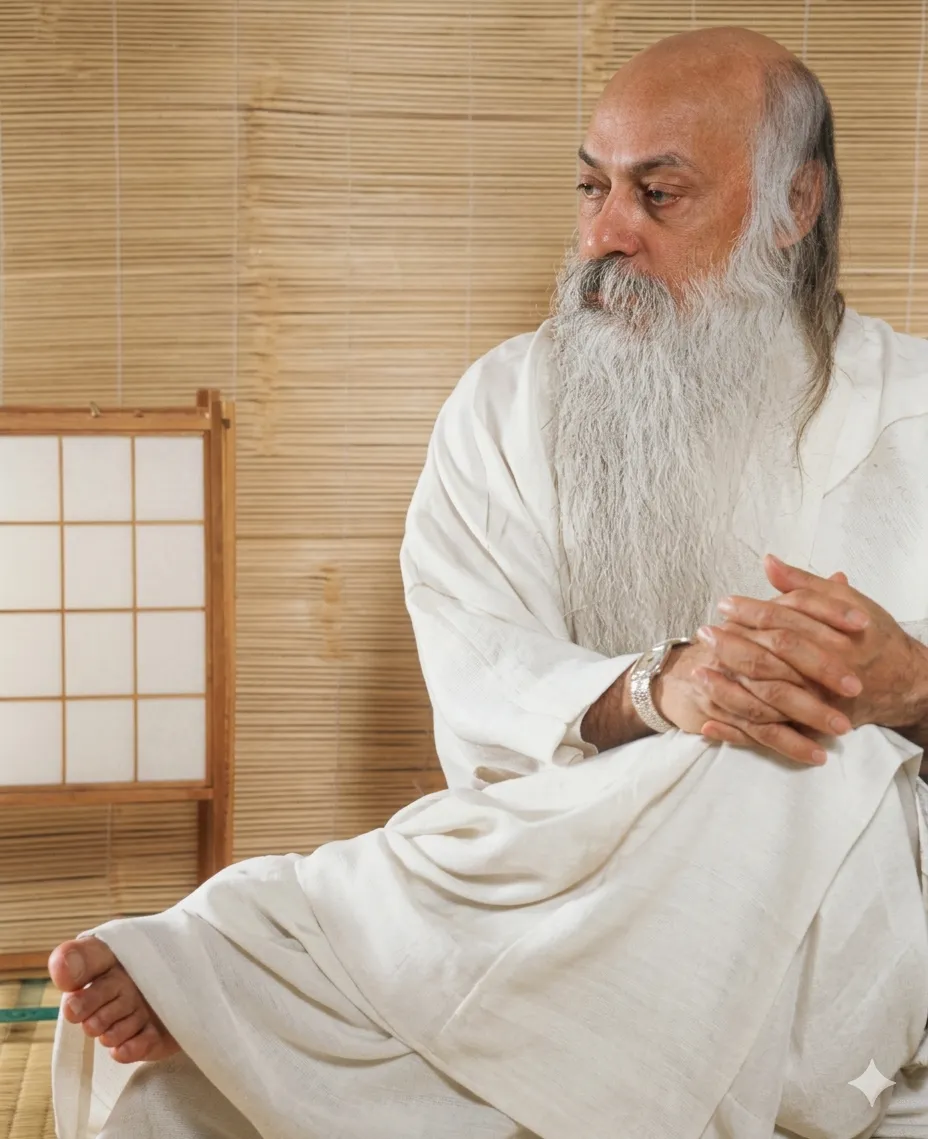
Osho's perspective on Good and Bad
When Osho Spoke About Good and Bad
Passages from the discourses where this theme comes alive.
You are often saying that this is good or bad, or this is right or wrong. Is this a language just for us as we are not able to realize the oneness of everything, or is there such a thing as good and bad?
But if you ask me, ultimately there is nothing good, nothing bad, nothing right, nothing wrong. And if you can understand this right now, then start living in a way where nothing is wrong and nothing is right -- and this is for you as far as you are concerned with others, and for others as far as they are concerned with you. Jesus says, "Do unto others as you would like them to do unto you." This is the basic principle of `one standard' and this is the whole of the teaching of all those who want to help you to come to yourself -- there is one standard where nothing is good and nothing is bad, not only for you but for everyone. It is easy to say that to steal is not bad if you are stealing, but if someone else is stealing something from you then…
Osho, then what is good and what is bad—should a person judge it for himself?
There is no other way. And judging is not very difficult. First, look at what you cannot come to rest upon. You are often more childish than a child. The body has an age; spiritual age is another matter entirely—and often it hasn’t grown at all. Then people go on doing childish things. An old man hoarding money—take him for a child, because the act is childish. What is he doing? Death stands before him, and the man is putting more locks on his safe. Pure child’s play. Little children play with dolls; a grown man carries a whole wedding procession of Lord Ram—with all the dolls arranged—parading and making a racket. He is still a child. He has made different kinds of dolls, given them big, respectable names. But his mental age has not grown. Within us there are many ages, many layers of age. My quest, my appeal,…
But what is good, what is bad? What is good, what is bad—will a person judge for himself?
Because that is not the real question. The question is not “how many?” It is that many compulsions force you to stay and suffer. I am saying: wherever the mind says, “Run, run—further, further,” and wherever you reach it gives you pain—that is bad. And wherever the mind says, “Here, not there; even if it takes time, here—here is bliss—where I am,” that is good. Where you are not, deception is possible; where you are, there is no deception. There, when you arrive, you will know. If this begins to get clear—even though the distinction is subtle—if you keep experimenting a little, keeping a small inner checking going twenty-four hours a day: “This act I just did—did it give me joy or pain? In the place I arrived at—did I want to stay or to leave?”—keep such a small test running. In two to four months it will become so…
प्रश्न: मगर क्या अच्छा, क्या बुरा? क्या अच्छा, क्या बुरा, क्या इनसान खुद ही जज करेगा?
क्योंकि यह सवाल है। सवाल यह नहीं है। सवाल यह नहीं कि कितना? मजबूरियां हैं बहुत तरह की जो, जिनकी वजह से आप रुकते हैं और दुख झेलते हैं। मैं यह कहता हूं, मन जहां से कहता है— भागो, भागो, और आगे, और आगे। और जहां-जहां पहुंचते हैं, वहीं-वहीं दुख देता है—वहां बुरा है। और जहां मन कहता है: यहां, वहां नहीं, और देर तो ठीक है। यहां, यहां आनंद है—जहां मैं हूं। अब धोखे की क्या बात है? वहां धोखा हो सकता है, क्योंकि वहां मैं नहीं हूं। जब मैं पहुंचुंगा, तब पता चलेगा। यहां, इस वक्त। अगर यह हमें साफ होने लगे, डिस्ंिटकशन तो इतना बारीक है लेकिन अगर थोड़ा हम प्रयोग करते रहें और दिन के चौबीस घंटे में जांच-पड़ताल थोड़ी सी भीतर जारी रखें, कि यह जो मैंने एक्ट किया है, यह मुझे सुख दिया या दुख दिया। मैंने...यह जो पहुंचा जिस जगह मन की मैं, यहां मैं रुकना चाहता था, कि हट जाना चाहता था, ऐसी एक छोटी परख चलती रहे। …
It is asked again: What lies beyond good and bad?
When the rhythm holds, it is auspicious; when the rhythm breaks, it is inauspicious. And when the rhythm becomes such that there is no possibility of its breaking—when you yourself become the rhythm, when the rhythm becomes your destiny, your very nature—then you are beyond good and bad. Then there is no need to worry, “What should I do, what should I not do?” Whatever happens from that rhythm is right. This is the distinction in the definitions of asadhu, sadhu, and sant. The asadhu is one who does the inauspicious. The sadhu is one who does the auspicious. The sant is one through whom the auspicious happens and the inauspicious does not—one who has gone beyond doing. In doing, one has to think—“Shall I do this or not?” One has to decide; there is choice. In choice there can be mistakes, there can be misses. After all, one is…
फिर पूछा है: ‘शुभाशुभ के पार क्या है?’
छंद बंधे तो शुभ, छंद टूटे तो अशुभ, और जब छंद ऐसा हो जाए कि टूटने की संभावना ही न रहे, तुम ही छंद हो जाओ, छंद तुम्हारी नियति हो जाए, तुम्हारा स्वभाव हो जाए, तब शुभाशुभ के पार। फिर चिंता की भी जरूरत नहीं कि क्या करूं, क्या न करूं? फिर उस छंद से जो होता है, वह सब ठीक ही होता है। साधु और संत की परिभाषा में यही भेद है। असाधु वह, जो अशुभ करता है। साधु वह, जो शुभ करता है। संत वह, जिससे शुभ होता है, अशुभ नहीं होता--करने के पार चले गए। करने में तो सोचना पड़ता है--ऐसा करूं या न करूं? निर्णय लेना पड़ता है, विकल्प होता है। विकल्प में कभी भूल भी हो सकती है। विकल्प में कभी चूक भी हो सकती है। आखिर विचार से ही किया जा रहा है, विचार में भ्रांतियां हैं। संत की दशा का अर्थ होता है: अब न शुभ की चिंता है, न अशुभ की चिंता है। छंद ऐसा बंधा है कि अब टूट ही नहीं सकता। तुम संत को नरक में भी फेंक दो तो भी वह स्वर्ग में होगा। छंद ऐसा बंधा है कि अब नरक भी उसे तोड़ नहीं सकता। …
What is good and what is bad?
definitionWhat lies beyond good and bad?
definitionProfound Quotes on Good and Bad
Explore our structured collection of meaning-mapped quotes regarding Good and Bad.