
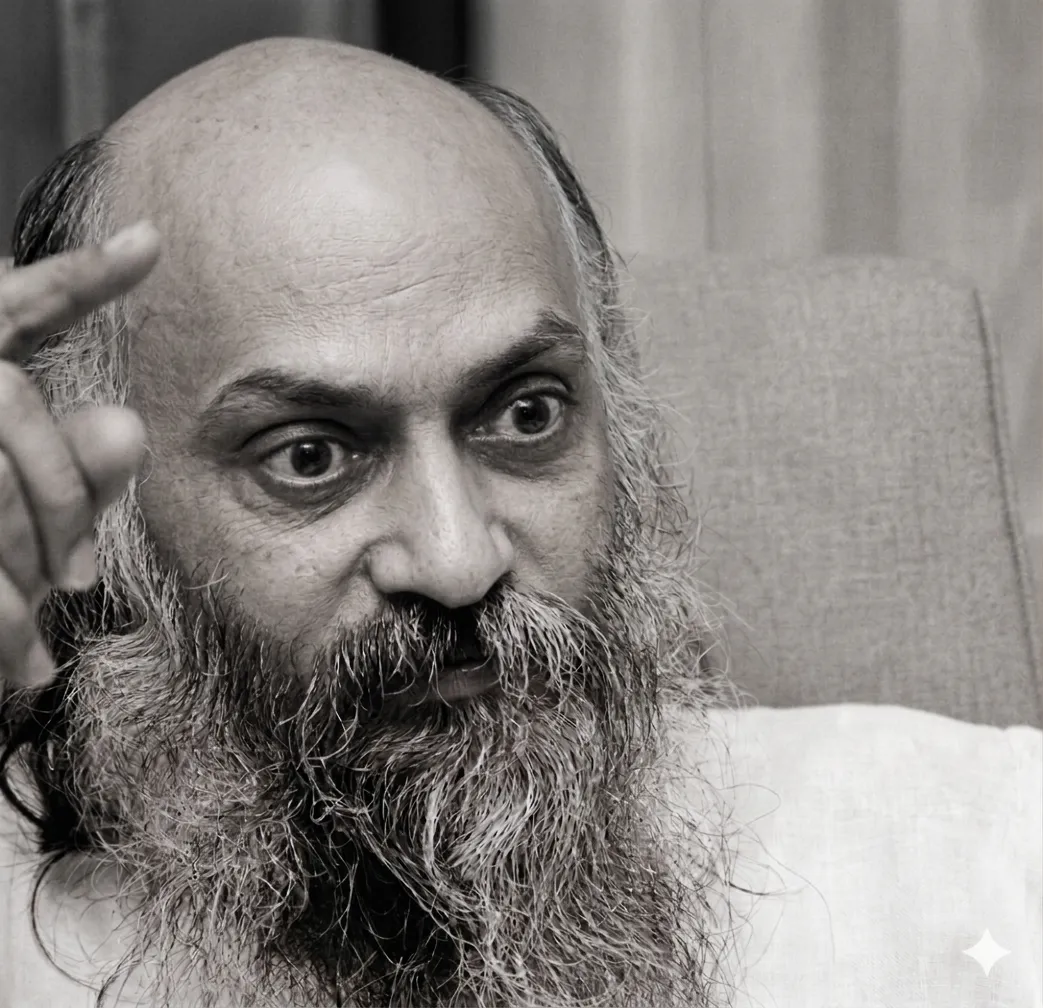
These images say: become the best, truest you—let your inner seed fully bloom—and there you meet the divine.
From the Discourses
Passages where Osho speaks to this question — each links to the complete discourse.
Osho, in chapter ten of the Gita Krishna says: among horses I am Ucchaihshrava; among elephants, Airavata; among cows, Kamadhenu; among serpents, Vasuki; among animals, the lion; among birds, Garuda; among rivers, the Ganga; among seasons, the spring, and so on. In other words, he seems to be trying to present himself as the best in everything. Then does he not represent the lower classes? Was the lowly and the ordinary not also a form of Krishna? Why did he not mention the low and the commonplace?
We have a word: Ishvara. Ishvara arises from aishvarya. When you manifest in your full aishvarya—your plenitude of powers—you become Ishvara. Ishvara is nothing but the flowering of aishvarya. But we never reflect on this. Ishvara means precisely this: Kamadhenu among cows, Airavata among elephants, spring among seasons. Whenever someone manifests in the fullness of his aishvarya, he becomes Ishvara. The meaning of Ishvara is: one in whom there is no gap between potentiality and actuality; in whom there is no difference between what is possible and what is real; whose possibility has become wholly actual—that one is Ishvara. Whoever still has a distance between possibility and actuality is journeying toward Ishvara. What is hidden within me—on the day it is fully revealed, that day I attain my Ishvara. But for now, what is within me emerges only bit by bit; it cannot become full spring. It keeps moving toward…
ओशो, कृष्ण ने गीता के अध्याय दस में अपने को घोड़ों में उच्चैःश्रवा, हाथियों में ऐरावत, गौवों में कामधेनु, सर्पों में वासुकि, पशुओं में सिंह, पक्षियों में गरुड़, नदियों में गंगा, ऋतुओं में वसंत आदि बताया है। अर्थात अपने को सर्वश्रेष्ठ बताने का प्रयत्न किया है। तो क्या वे निकृष्ट वर्ग का प्रतिनिधित्व नहीं करते? क्या निकृष्ट वर्ग कृष्ण का रूप नहीं था? उन्होंने निकृष्ट और साधारण का जिक्र क्यों नहीं किया?
शब्द है हमारे पास, ईश्र्वर। ईश्र्वर शब्द बनता है ऐश्र्वर्य से ही। जब तुम अपने पूरे ऐश्र्वर्य में प्रकट होते हो, तो ईश्र्वर हो जाते हो। ईश्र्वर शब्द तो ऐश्र्वर्य का ही रूप है। लेकिन हमने कभी सोचा नहीं। ईश्र्वर का मतलब ही यह है कि गायों में कामधेनु, और हाथियों में ऐरावत, और ऋतुओं में वसंत। जब भी कोई अपने पूरे ऐश्र्वर्य में प्रकट होता है तो वह ईश्र्वर हो जाता है। ईश्र्वर का मतलब ही यह है कि जिसकी पोटेंशियलिटी और एक्चुअलिटी में फर्क नहीं है। जिसकी वास्तविकता में और जिसकी संभावना में कोई फर्क नहीं है। जिसके जीवन में संभावना और वास्तविकता एक ही हो गई है। जो संभावना थी वह पूरी की पूरी वास्तविकता बन गई है, वह ईश्र्वर है। जिसकी संभावना और वास्तविकता में अंतर है, डिस्टेंस है, वह अभी ईश्र्वर की तरफ यात्रा कर रहा है। तो जो मेरे भीतर छिपा है, जिस दिन पूरी तरह प्रकट हो जाएगा, उस दिन मैं अपने ईश्र्वर को उपलब्ध हो जाता हूं। लेकिन अभी, जो मेरे भीतर छिपा है, वह थोड़ा-थोड़ा प्रकट होता है। …
Questioner: krishna, in chapter ten of the geeta describes himself to be the ganges among the rivers, the spring among the seasons, the lion among the beasts, the garuda or eagle among the birds, the eirawat among the elephants, the kamdhenu among the cows, vasuki among the snakes, and so on. Does it mean that he is trying to declare himself to be the best and the greatest in all creation? Does it also mean that he refuses to represent all that is lowly and base? Why does he exclude the meanest of us all? And where does the meanest belong?
It is a significant question. And there are two beautiful aspects to it. Firstly, Krishna declares himself to be the best among all things -- of all the seasons he is the spring, of all the cows he is the kamdhenu, of all the elephants he is the eirawat. And secondly -- and this is more significant -- he finds his peers even among the lowliest of creatures like cows and horses. Both things should be taken together. While he declares himself to be the best among different classes of creatures, he does not distinguish between one class and another. Even when he claims to be the eirawat among elephants, he remains nonetheless an elephant. Even when he claims to be the best among the cows he remains a cow. Similarly he is quite at home among snakes and reptiles. He does not exclude the meanest categories as you think.…
Questioner: a legend says that kalayavan believes that krishna is running away, while in fact krishna is driving kalayavan into a cave where muchkund is asleep. The legend also says that as muchkund wakes up he looks at kalayavan and kills him with his look. Please explain the significance of the legend.
These names are symbolic and they are parts of Krishna's story. They are part metaphor, part events and part metaphysics. That Krishna is driving someone into a cave is how it seems to us. Even the person concerned can think so, but I understand it differently. A person like Krishna does not drive anyone, although someone can be driven to a point on his own. And it is possible that Krishna follows him. The situation is rather complex. I have heard that a cowherd is taking his cow from one place to another. A rope is fastened around the neck of the cow and the cowherd has the other end of the rope in his hands. On his way, he meets with a group of traveling Sufis. The head of the group, the Master, halts the cowherd with his cow and asks his disciples to stand around them. This is…
Osho, the question was about the chakra—Sudarshan—and about Panchajanya. And regarding the rasa-lila—yathā arbhaka sva-pratibimba vibhramaḥ? So what is the interpretation of the rasa-lila?
In truth, those who composed the poetry labored greatly with words. The very life of poetry is the word. And they worked on words with chisel and hammer for centuries. Now, Krishna’s discus has been named Sudarshan. It is a carrier of death, and yet it is named Sudarshan—“beautiful to behold.” Death is not beautiful to see, nor is it pleasing in form. But in Krishna’s hand even death becomes beautiful. That is all it means. We could not give the atom bomb the name Sudarshan. It is as destructive as the atom itself. Its strike is unfailing; the death it brings is certain. Once released, it returns only after killing. Where death is absolutely certain, would we still call that weapon Sudarshan? And yet it has been so named. In the hands of a man like Krishna, even death becomes Sudarshan. In the hands of a man like Hitler,…
ओशो, इस प्रकार नया शरीर मिलने भर से अतीत के संस्कारों व मन वाला सूक्ष्म शरीर भी बदल जाता है क्या?
वह अपने आप नहीं बदल जाता, लेकिन कृष्ण जैसे आदमी के हाथ से मरने का मौका मिले तो उसमें बहुत फर्क पड़ता है। सभी को नहीं मिलता, बहुत पुण्य कर्मों के फल से मिलता है। साधारणतः नहीं बदल जाता। अगर एक आदमी मरता है, तो शरीर ही बदलता है, उसके भीतर का और कुछ भी नहीं बदलता। लेकिन कृष्ण जैसे आदमी के हाथ से मरना बड़ी भारी घटना है, क्योंकि कैटेलेटिक एजेंट मौजूद है। उस आदमी की मौजूदगी में यह घटना घट रही है तुम्हारे मरने की, और तुम्हारे शरीर के छूटते ही उस आदमी के व्यक्तित्व से जो सूक्ष्मतम किरणों का जाल फैलता है, वह तुममें एब्जार्व हो जाएगा, उसे तुम पकड़ पाओगी, वह तुम पी जाओगी। जो तुम्हारा शरीर बाधा दे रहा था कृष्ण से मिलने से, वह बीच से हट जाएगा तो कृष्ण से मिलना आसान हो जाएगा। उस मिलन में बहुत कुछ होगा। वह मिलन अर्जुन के लिए ऐसे ही हो पाता है क्योंकि अर्जुन इस शरीर के बाहर छलांग लगा पाता है। हम प्रेम में शरीर के बाहर छलांग लगा लेते हैं। शत्रुता में हम शरीर के बाहर नहीं छलांग लगाते, शरीर के भीतर शरीर को दुर्ग की तरह बना कर बैठ जाते हैं।
Better to take anything as God than to take nothing as God. Whether that thing is truly God is not the issue; the believer, in believing, sets out on a journey. Someone may worship the sun, another a tree, another a river. Such devotions seem primitive—but compared with the unbeliever, even these people move faster inwardly. Anywhere there is a place to lay one’s head at someone’s feet; anywhere the ego can be dissolved; anywhere one can accept something greater than oneself—there a path opens beyond oneself. To go on continually beyond oneself—that is sadhana. To rise steadily above oneself—that is the process. To rise beyond oneself until no trace of “I-ness” remains—when that is gone, know that the final destination has arrived.
परमात्मा न मानने से, किसी भी चीज को परमात्मा मान लेना बेहतर है। वह चीज परमात्मा है या नहीं, यह महत्वपूर्ण नहीं है। वह मान लेने वाला, मानने के साथ ही यात्रा पर निकल जाता है। सूर्य को भी कोई ईश्वर मानता हो, और वृक्ष को भी कोई ईश्वर मानता हो, और नदी को भी कोई ईश्वर मानता हो, तो बातें बहुत प्राथमिक मालूम होती हैं, लेकिन न मानने वाले से यह व्यक्ति भी अंतर्जीवन में ज्यादा गति कर जाएगा। कहीं भी कोई है, जहां यह सिर रख सकता है चरणों में। कहीं भी कोई है, जहां अहंकार विसर्जित हो सकता है। कहीं भी कोई है, जहां अपने से बड़ा माना जा सकता है, अपने से ऊपर देखा जा सकता है, अपने से पार जाने का रास्ता खुल जाता है। अपने से निरंतर पार होते जाना ही साधना है। …