
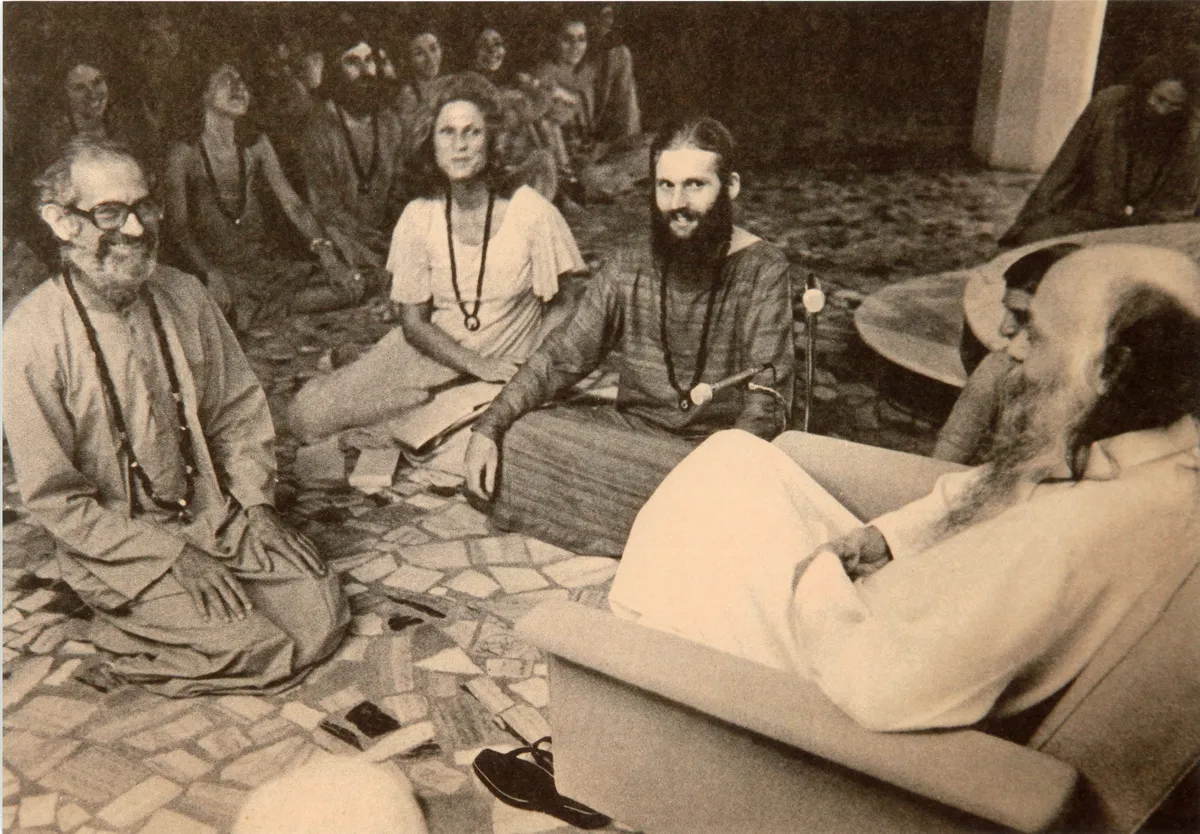
No single explanation can hold the whole Gita; you have to experience its truth yourself, not just read someone’s notes.
From the Discourses
Passages where Osho speaks to this question — each links to the complete discourse.
Osho, you said Shankar’s exposition is incomplete. There are about forty–fifty commentaries on the Gita. Is any commentary complete? Would you call Lokmanya Tilak’s commentary complete? He is not an escapist—he is an activist, but at the same time a moralist. Are you trying to bring together his activism and Shankar’s supramoralism, both at once?
No commentary on Krishna is complete. It cannot be—unless a person like Krishna himself writes it. No commentary on Krishna is complete. Each is a facet, and Krishna has infinite facets. Each commentator picks the one he finds most appealing. Shankar, in his commentary, establishes renunciation and non-action. In that very Gita, Tilak establishes action and karma-yoga. Tilak chooses precisely the opposite facet from Shankar. For a thousand years Shankar’s chosen facet prevailed; and in those thousand years his escapist emphasis weakened India’s roots in many ways. Escapism enfeebles. Whatever capacity for action India had was diminished. The experience of a thousand years swung the pendulum. It became necessary that there be a commentary on the Gita which favored action and declared loudly that the Gita speaks for action. At the opposite extreme Tilak made his statement. Shankar chose one facet—akarma, the non-action of abandoning action; Tilak chose the other…
Questioner: you say that shankara's commentary on the geeta is incomplete. There are dozens of commentaries on the geeta. Can you say if any one of them is complete? Do you think lokmanya tilak's interpretation is complete? At least it does not take an escapist view of life; it is activist and moralistic. Or are you trying to synthesize tilak's activism with shankara's supra-moralism?
Not one commentary on Krishna is complete. It is not possible, unless someone like Krishna himself comments on him. Every interpretation of Krishna is incomplete and partial. There are many sides to a single thing, and Krishna is a man of infinite dimensions. So every commentator chooses from them according to what appeals to him. Shankara establishes that sannyas and inaction form the cornerstones of the GEETA. From the same GEETA, Tilak chooses karmayoga, the discipline of action, and he brings all his arguments to prove that action IS GEETA'S central message. Now Shankara and Tilak are polar opposites. A thousand years have passed since Shankara commented on the GEETA, and in the course of time his escapist philosophy has enfeebled India to her very roots, weakened her in many ways. By its nature, escapism is enervating. Shankara's teachings sapped this country's vitality and dynamism. A thousand years' experiences were…
There are a thousand commentaries on the Gita. Strange indeed. What Krishna said to Arjuna could have but one meaning — not a thousand. Can there be a thousand? If there can be, then only if Krishna’s mind was unsound. A madman’s words have no single meaning — there can be a thousand, fifty thousand. Even he does not know what it means. But Krishna is not mad. Then how did a thousand commentaries arise? Who are these thousand meaning-makers? Why are meanings being made? Every year or two we must refashion Krishna’s picture to fit ourselves — and then a fresh interpretation is needed. Shankara interprets — his interpretation is not Krishna’s meaning; it is Shankara’s imposition. What he wants to prove, he imposes upon Krishna. Ramanuja interprets — it is not Krishna’s meaning; he thrusts upon Krishna what he wants to say.
Osho, what are the reasons for calling Krishna a complete incarnation (purnavatara)? Please give some new reasons. And shed detailed light with reference to the sixty-four arts.
No, there is no other reason to call one “complete.” Whoever becomes zero becomes complete. Emptiness is the prelude to the complete. To be precise, the zero alone is the only complete. You cannot draw half a zero—not even in geometry. If you say, “I have drawn half a zero,” it is no longer a zero. There is no such thing as half a zero. The zero is always whole, entire. The incomplete has no meaning. How will you split zero into two parts? And if it can be split, how will you still call it zero? Zero is not cut, not divided; it is indivisible. From where division begins, number begins. That is why after zero we must start with one. One, two, three—this is the world of number. All numbers arise from zero and are lost back into zero. Zero alone is the complete. Who can be zero?…
Question: JANAK ASKED: "OH LORD, HOW DOES ONE ATTAIN WISDOM? AND HOW DOES LIBERATION HAPPEN? AND HOW IS NONATTACHMENT ATTAINED? PLEASE TELL ME THIS." ASHTAVAKRA REPLIED: "OH BELOVED, IF YOU WANT LIBERATION THEN RENOUNCE THE VISHAYAS, THE PASSIONS AS VISHA, POISON, AND TAKE FORGIVENESS, INNOCENCE, COMPASSION, CONTENTMENT, AND TRUTH AS NECTAR. YOU ARE NEITHER EARTH, NOR AIR, NOR FIRE, NOR WATER, NOR ETHER. TO ATTAIN LIBERATION, KNOW YOURSELF AS THE WITNESS, CONSCIOUS OF ALL THESE. "IF YOU CAN SEPARATE YOURSELF FROM THE PHYSICAL BODY, AND REST IN CONSCIOUSNESS, THEN THIS VERY MOMENT YOU WILL BE HAPPY, AT PEACE, AND FREE OF BONDAGE. "YOU ARE NOT A BRAHMIN OR OTHER CASTE, YOU ARE NOT IN ANY OF THE FOUR STAGES OF LIFE, YOU ARE NOT PERCEIVED BY THE EYES OR OTHER SENSES. UNATTACHED AND WITHOUT FORM, YOU ARE THE WITNESS OF THE WHOLE UNIVERSE. KNOW THIS AND BE HAPPY.