
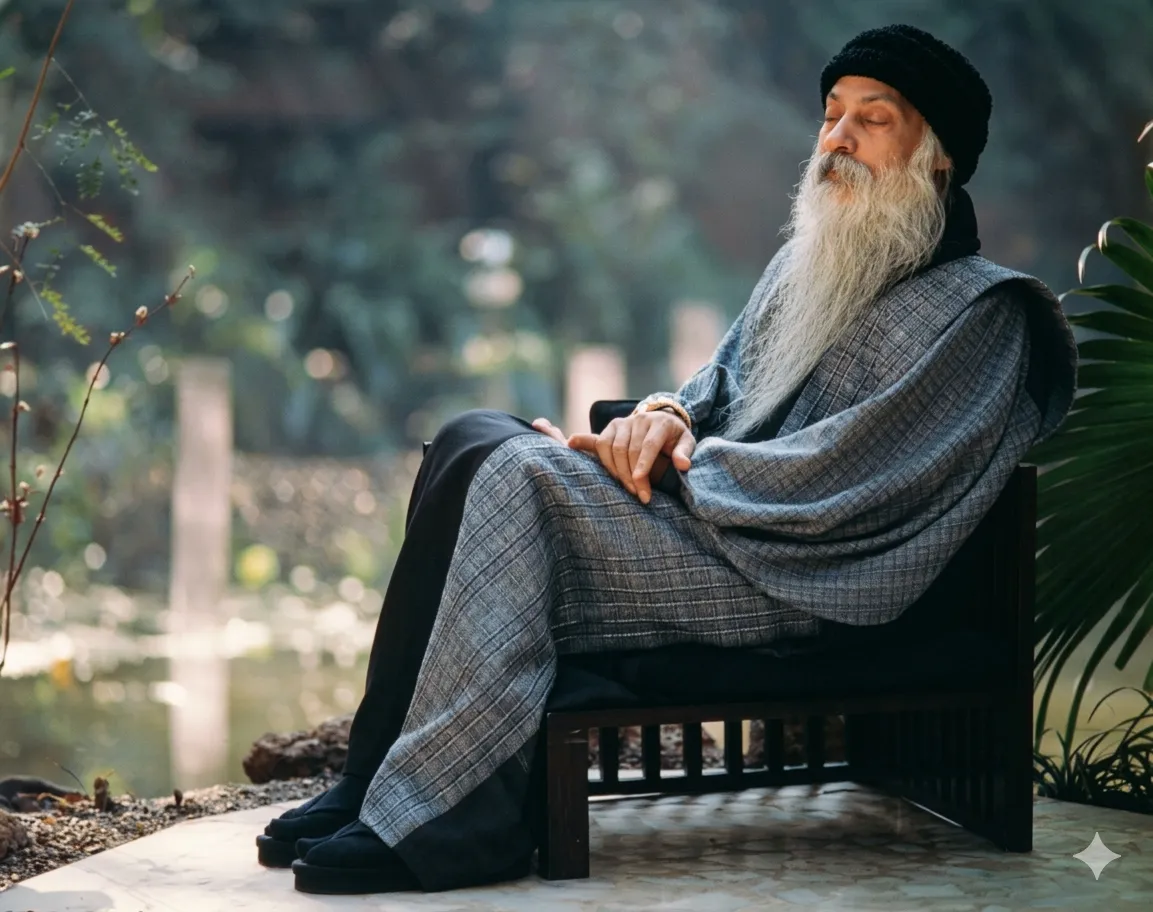
Enlightenment isn’t made by doing; it’s already here, and you notice it the instant you stop trying to get it.
From the Discourses
Passages where Osho speaks to this question — each links to the complete discourse.
Osho, yesterday you said that jealousy is included in respect. I have immense respect for you, but the jealousy inherent in it keeps poisoning it, and I feel guilt and pain. Does reverence transcend this poison-laced respect?
It needs a little explaining—it's a delicate point. Whenever you respect someone, you do so because you see in that person something you do not have. You respect because you glimpse in the other something you would also like to possess. A beggar respects an emperor because he, too, longs to be an emperor. So on the one hand he respects, and inside he also envies. Because he is not yet an emperor but wants to be. You have attained what he wants to attain. He respects you as skillful, successful: “I stand far back in the line; you have gone ahead to where I should have been.” So you are powerful, clever, intelligent, strong—he respects you. But inside a fire of jealousy also burns—if he gets the chance, he would like to be in your place and push you aside. And if the beggar gets that chance, he will…
Yesterday you said that sudden enlightenment is not bound by the law of cause and effect, but if nothing is haphazard in existence, nothing happens accidentally, then how can the highest experience like enlightenment happen this way?
Yesterday I was reading someone's autobiography. He has written that he had travelled to a foreign city and got lost there. He did not understand the language. He became very nervous. And in his nervousness he forgot the name of his hotel, and forgot the phone number too. Then his panic increased: now how will he inquire? He was looking with great anxiety as he walked along the road, looking for someone who could understand his language. It was an eastern country, in the far east, and this American! He was looking to see if any white skinned person appeared, who will understand his speech, or if he could find a store with an English sign board, so he can go ask there. He was walking along looking with such intensity, sweating, that he did not hear that a police car was coming behind him sounding the horn again and…
Osho, I have heard that enlightenment, or the natural state of man, is something acausal -- it just happens. And all our endeavours to bring about awareness, to be aware, are actually taking us away from this state since they are all mind games, and these activities for self-awareness are just a "holy business". I cannot imagine what my life would be if I gave up the search since it has permeated my life as long as I can remember. If there is no way to integrate, nothing one can do, why all this activity? Why bother? Yet what else is there to do? Please comment.
It happens only to those who are not holding anything back, when you have put all that you have at stake, when nothing is left behind, when you are utterly empty, you have emptied yourself totally, and it is not happening, then the understanding arises, "My efforts are futile. My efforts are ego efforts -- the ego is futile. My efforts are my own mind games. The mind itself is the barrier." But this has to become your own experience, Samadhi. It is not going to help if you have heard it. You can hear great truths, but unless they arise in your own being they are not true. A heard truth is a lie: only an experienced truth is a truth. And only the experienced truth liberates. How will you experience it? You would like to have it without any efforts. You would like it to happen as it…
Osho, if there were only one single method of sadhana in your ashram, wouldn’t it be more convenient for seekers?
These are two styles: either you support yourself—and then there is no need of another. Fine; the matter is finished. Support was the whole issue, and you supported yourself. Have you noticed: a mother’s love is strongest for the child who is the weakest. This is exactly the opposite of economics. But economics and the scripture of love are opposite. According to economics, love should be for the strongest, the most intelligent, the most skilled. No—mother knows the strong, the intelligent, the skilled will manage for themselves. They have no need. It is the weak who are less intelligent, who are more likely to stray, who may fall—the mother takes care of them. It often happens that the sick child becomes dearest to the mother—more than the healthy ones. The experience of God comes to those who stagger in helplessness. That is why in the religions of Buddha and Mahavira…
Osho, if there were only one single method of sadhana in your ashram, wouldn’t it be more convenient for seekers?
These are two styles: either you support yourself—and then there is no need of another. Fine; the matter is finished. Support was the whole issue, and you supported yourself. Have you noticed: a mother’s love is strongest for the child who is the weakest. This is exactly the opposite of economics. But economics and the scripture of love are opposite. According to economics, love should be for the strongest, the most intelligent, the most skilled. No—mother knows the strong, the intelligent, the skilled will manage for themselves. They have no need. It is the weak who are less intelligent, who are more likely to stray, who may fall—the mother takes care of them. It often happens that the sick child becomes dearest to the mother—more than the healthy ones. The experience of God comes to those who stagger in helplessness. That is why in the religions of Buddha and Mahavira…