
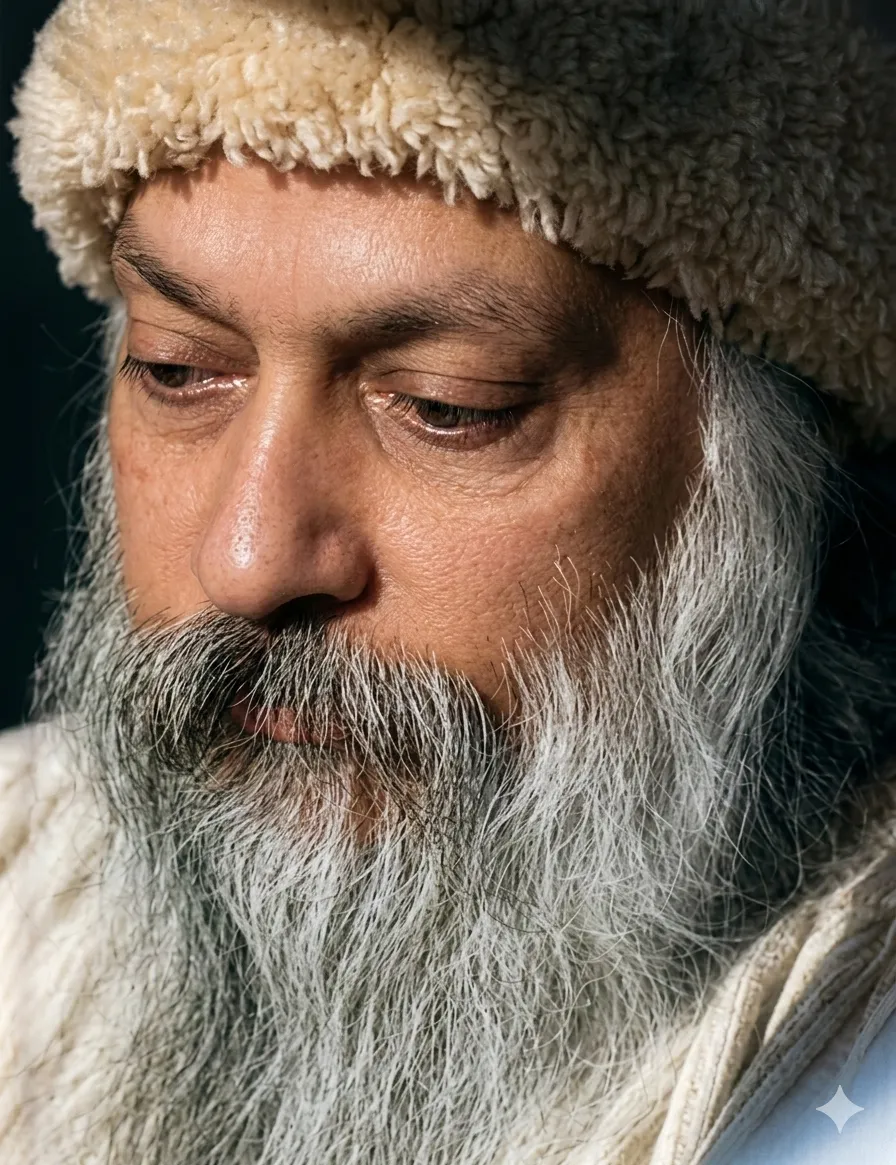
Fear shows up when we cling to things and listen to a noisy mind; quietly watch instead, and it fades.
From the Discourses
Passages where Osho speaks to this question — each links to the complete discourse.
Beloved Osho, how best to deal with fear? It affects me variously... From a vague uneasiness or knotted stomach to a dizzying panic, as if the world is ending. Where does it come from? Where does it go?
It is the same question that I was just answering. All your fears are by-products of identification. You love a woman and with the love, in the same parcel comes fear: she may leave you -- she has already left somebody and come with you. There is a precedent; perhaps she will do the same to you. There is fear, you feel knots in the stomach. You are too much attached. You cannot get a simple fact: you have come alone in the world; you have been here yesterday also, without this woman, perfectly well, without any knots in the stomach. And tomorrow if this woman goes... what is the need of the knots? You know how to be without her, and you will be able to be without her. The fear that things may change tomorrow... Somebody may die, you may go bankrupt, your job may be taken away.…
Osho, what is fear made of? It is always there behind a corner, but when I turn to face it, it is only a shadow. If it is non-substantial, how does it manage to have such a power over me?
Fear is the shadow of 'I', and because the 'I' is always alert somewhere deep down that "I will have to disappear in death".... The basic fear is of death; all other fears only reflect the basic one. And the beauty is that death is as nonexistential as ego, and between these two non-existentials -- the ego and death -- the bridge is fear. Fear is very impotent, it has no power. You say, "If IT IS NON-SUBSTANTIAL, THEN HOW DOES IT MANAGE TO HAVE SUCH A POWER OVER ME?" YOU want to believe in it -- that's its power. You are not ready to take a plunge into your inner depth and to face your inner emptiness -- that is its power. Otherwise it is impotent, utterly impotent. Nothing is ever born out of fear. Love gives birth, love is creative; fear is impotent. Mr. and Mrs. Smith were…
Osho, yesterday you told the story of Saint Peter and the three women. Please tell us what happened after that?
Saint Maharaj! Do use a little of your own intelligence. No story is ever told in full, because some trust must also be placed in your imagination—that you, too, can think a bit. You could have figured out for yourself what would happen next. The matter was so clear. My friend, what else could happen! What had to happen is exactly what happened. Saint Peter had barely dealt with those three women when three goddesses arrived. One had a white mouth-cloth tied over her face—she was a Jain nun. The second was a beautiful French model, and the third a Rajneesh sannyasin. Saint Peter first pointed toward the part below the French girl’s waist and asked, “What did you use this for?” Preening, the beauty replied, “I used it to revel with my eight wedded husbands and about a hundred and fifty lovers. I also used it to earn money…
Osho, ever since I took initiation from you, I have also begun to feel afraid of you. Earlier this fear was not in me, though I have been afraid all my life. I also know that the love and freedom I have found in your presence I never found even around my parents. And if, even in the shade of a master as utterly love-filled as you, I do not become free of fear, then where else will I? How is this freedom from fear possible?
Take this as a touchstone: if the reason for which you went to the master is the very reason he accepts and works upon, he too is standing in darkness. You have come to me because of fear—I know. But it is not my task to lessen your fear; it is to awaken abhaya. You did not come for abhaya. You came for nirbhayata, a little courage to fight—you would be satisfied with that. You are easily satisfied; your discontent is not very deep. A drowning man is content with a straw. You are looking for a straw; I know that no one is saved by a straw. Perhaps because of the straw you will drown—whoever takes a straw for a boat stops looking for a real boat. Whoever mistakes a false shore will find the true shore very far. Whatever reason you have come with is not my concern.…
Beloved Osho, what to do with fear? I am feeling very tired being led around by it. Can it be mastered or killed? How?
What is fear? First: fear is always around some desire. You want to become a famous man, the most famous man in the world -- then there is fear. What if you cannot make it? -- fear comes. Now fear comes as a by-product of desire: you want to become the richest man in the world. What if you don't succeed? You start trembling; fear comes. You possess a woman: you are afraid that tomorrow you may not be able to possess, she may go to somebody else. She is still alive, she can go. Only dead women won't go; she is still alive. You can possess only a corpse -- then there is no fear, the corpse will be there. You can possess furniture, then there is no fear. But when you try to possess a human being fear comes. Who knows, yesterday she was not yours, today she…