
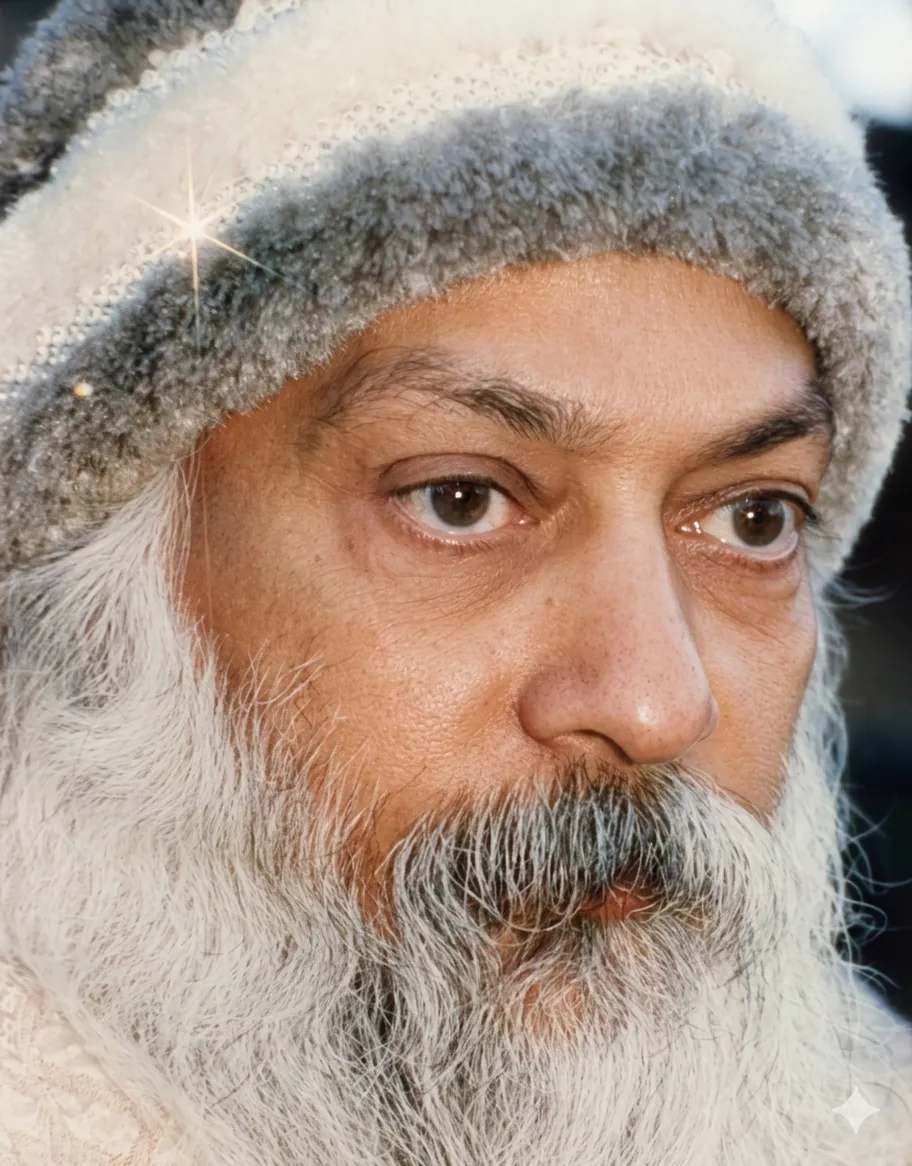
It’s loving so totally that your ‘me’ melts, a clear light appears inside, and you’re ready for life’s biggest change without fear.
From the Discourses
Passages where Osho speaks to this question — each links to the complete discourse.
Osho, for me, you are all the masters that have been before and all the masters that will come. More and more a strange knowing grows that only death is the door to this perfect union with 'I don't know what'. Loving the master -- love -- only gives us glimpses of what death can make us see. Is this not so?
Love towards the Master is the whole spectrum of love. The way you have loved your woman will be there, the way you have loved your man will be there, the way you have loved your mother will be there, and the way you have loved your child will be there. The way you have loved music, the way you have loved poetry, painting, dancing, all your loves, the whole multiplicity of loves, all the dimensions of love, will join together. Between the Master and the disciple, love comes to its whole spectrum. It becomes the whole rainbow, all the seven colors. And that love will prepare you for the ultimate quantum leap, death. In the ancient scriptures, the Master is defined as death. You will be surprised: ancient scriptures say ACHARYO MRITYU, the Master is death. If you have known the Master, you are coming closer and closer to…
Osho, kindly explain the meaning of inner closeness to the true Master.
Now the first man was making a mistake, but at least the mistake was his own. These others were making a borrowed mistake; even their mistake was not theirs. If you bow at someone’s feet because you saw someone else do it, it will be false. If you bow out of greed, it will be false. If you bow thinking you may gain something—standing in an election and hoping to win— People come to me. They touch my feet and say, “We are standing in the election; now your blessing is in your hands.” I tell them, “If you truly want my blessing, you will lose the election. Because I can only bless that God forbid you should win. It’s better to get out of this madhouse before you enter it. Once inside, getting out becomes very difficult. Once you reach Delhi, people die at Rajghat and never return. After…
It is exactly like a child in the womb of the mother. The child has lived for nine months in the womb comfortably. He will never find such comfort again -- no worry, no tension, no question of employment, no wife to nag, no children to harass, no neighbors whom you have to love, no boring friends. He is completely relaxed for nine months. Then suddenly one day he is being thrown out from his world, which was so comfortable. It seems to the child almost a death. And it is natural that it looks like a death. His world is being destroyed. His beautiful home where everything was supplied without demand is being shattered. He is being thrown out into the unknown. It is painful. The child resists to come out, that's what gives pain to the mother.
Osho, you say the same thing in countless ways. But when I listen to you, it feels as if I am hearing it for the first time. And I feel so much joy that I don’t feel like going back home. What should I do—what can I do—so that I can just keep listening to you!
You will feel as if you have been made to rise out of season, before time—as if you were not yet to go and yet had to go. And if you go in that way, your home will become even more desolate than before. I do not want to make your home desolate; I want to make your home a temple. I want that when you go home, your home’s new form is revealed. I do not want to tear you away from home, from the world, from family life. That is the newness of my sannyas: I do not want to sever you from the world; I want to join you to the world in such a way that your connection with the world becomes a connection with the Divine. Let the world no longer be a barrier between you and the Divine; let it become a means. If…
Beloved Osho, it occurs to me that the beauty of having a master is not so much that you find in him someone who really loves you, but that you have found someone who will let you really love them. Do you have anything to say about this?
Freedom is also part of the spiritual qualities; you cannot separate them. But in the beginning one has to start from very raw material, so that if one is alert one can sort out what is wrong. If people are not alert, they start doing very stupid things. Seeing that love brings a certain kind of bondage, rather than destroying the bondage and its causes, they start becoming afraid of love. After a few experiences of getting into love and getting caught in bondage, they become certain that love is going to create chains for them, an imprisonment; it is better to live without love. They harden their hearts. But they have misunderstood the whole thing. It was not love that was creating the bondage; it was attachment, it was jealousy. If you can love without jealousy, if you can love without attachment, if you can love a person so…