
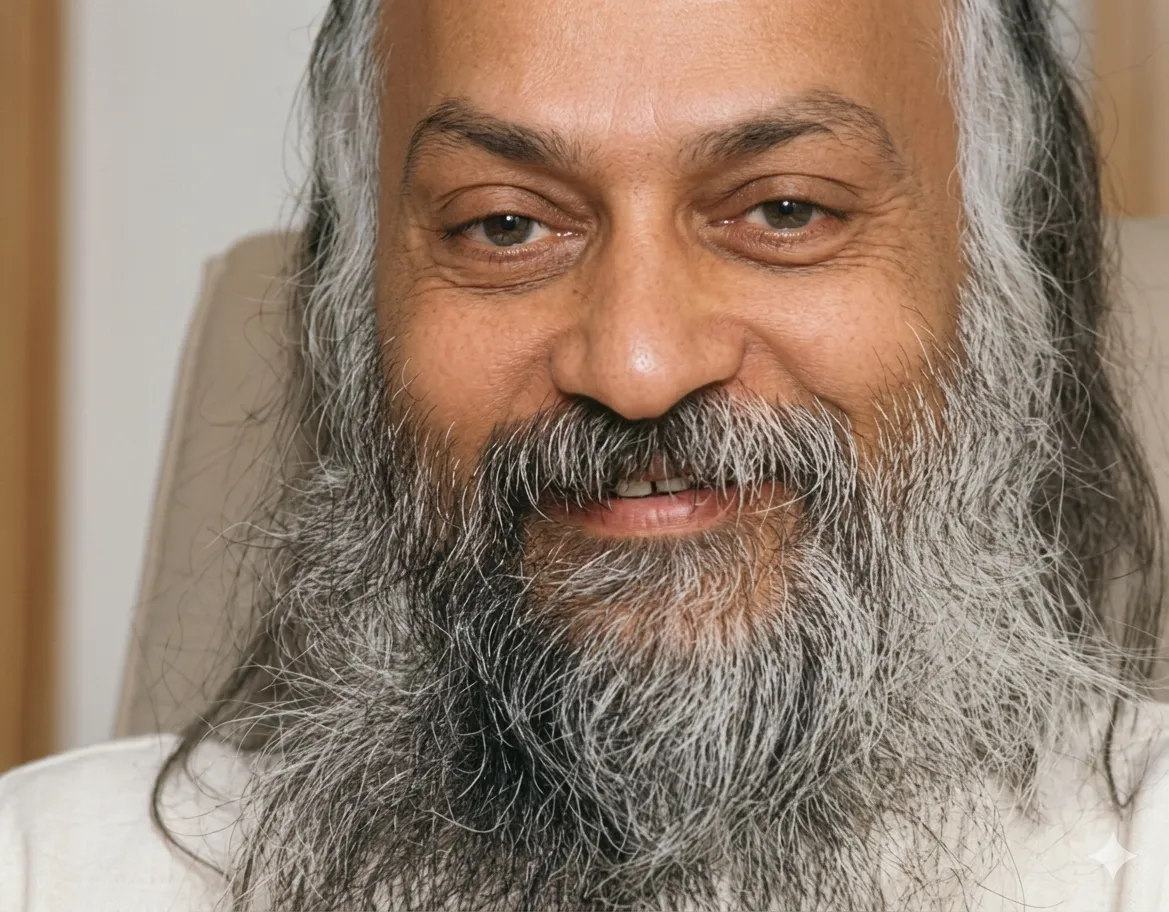
Your real center isn’t “yours”; it’s life’s center, while the ego-center is a pretend “me” that exists only in the dream of personality.
From the Discourses
Passages where Osho speaks to this question — each links to the complete discourse.
What is the difference, if any, between one's 'centre' and one's 'ego-centre?'
One's centre is not ONE'S centre, it is the centre of the whole. And the ego-centre is ONE'S centre. That is the only difference, but that is a vast difference. When you are not there the centre is there but that is not YOUR centre, it is the centre of the whole. When you are there you have a centre, a false, pseudo centre, which is not the centre of the whole, and until it is the centre of the whole don't be contented with it. Because you are in a dream, you are not in reality. And we have become so accustomed to dream that we have completely forgotten what is reality and what is a dream. In the Eastern psychology we treat the reality as a dream. In the Western psychology they treat dreams as reality. That's why Freud, Jung, Adler and the whole company, they all go…
Osho, you said last night that to realize the that, the transcendental truth everywhere, one must first realize it at one's own center of being. Then you said that a centering for this is needed. Is this centering the same as that of gurdjieff's crystallization? Please tell us how this centering or crystallization is different from strengthening one's own ego, and how does it lead to the transcendental truth, the that?
This is absolutely incorrect. If you surrender, only then can you be an individual, because the ego is not your individuality. It is false, it is just a facade. If you surrender the false, then you are bound to explode into the real. And this is the beauty of surrender: you cannot surrender the Self -- mm? -- that is impossible; you can only surrender the ego. You can give up only that which has been given tb you. You cannot give up your Self; that is impossible. There is no possibility. How can you give up your Self? You can give up something which has been put into you, which is a social penetration. Really, you can give only that which doesn't belong to you, which you are not. This will look contradictory, paradoxical. You can give only that which you are not. That which you are you cannot…
What is the ego? Remaining unenlightened, are we always functioning through the ego or are there moments when we are free of it?
Whosoever can put you in contact with power, real power, will become powerful. God is real power, the source of all power. The priest remained down the ages so powerful -- more powerful than kings. Now the scientist has taken the place of the priest, because now he knows how to unlock the doors of the power hidden in nature. The priest knew how to connect you with God, the scientist knows how to connect you with nature. But the priest has to disconnect you first, so no individual private line remains between you and God. He has spoiled your inner sources, poisoned them. He became very powerful but the whole humanity became lustless, loveless, full of guilt. My people have to drop that guilt completely. While making love, think of prayer, meditation, God. While making love, burn incense, chant, sing, dance. Your bedroom should be a temple, a sacred…
The prime minister, kuo tzu I, of the tang dynasty, was an outstanding statesman, a distinguished general, and the most admired national hero of his day. But fame, power, wealth and success could not distract him from his keen interest and devotion to buddhism. Regarding himself as a plain and humble devoted buddhist, he often visited his favorite zen master to study under him.
HE AND THE ZEN MASTER SEEMED TO GET ALONG VERY WELL. THE FACT THAT HE WAS THE PRIME MINISTER SEEMED TO HAVE NO INFLUENCE ON THEIR ASSOCIATION. THERE WAS NO NOTICEABLE TRACE OF POLITENESS ON THE ZEN MASTER'S PART, OR OF VAIN LOFTINESS ON THE PART OF THE MINISTER; THE ASSOCIATION SEEMED TO BE THE PURELY RELIGIOUS ONE OF A REVERED MASTER AND AN OBEDIENT DISCIPLE. ONE DAY, HOWEVER, WHEN HE WAS PAYING HIS USUAL VISIT TO THE ZEN MASTER, HE ASKED THE FOLLOWING QUESTION: YOUR REVERENCE, HOW DOES BUDDHISM EXPLAIN EGOTISM? THE ZEN MASTER'S FACE SUDDENLY TURNED BLUE, AND IN AN EXTREMELY HAUGHTY AND CONTEMPTUOUS MANNER HE SAID TO THE PREMIER: WHAT ARE YOU SAYING YOU NUMSKULL? THIS UNREASONABLE AND UNEXPECTED DEFIANCE SO HURT THE FEELINGS OF THE PRIME MINISTER THAT A SLIGHT SULLEN EXPRESSION OF ANGER BEGAN TO SHOW ON HIS FACE. THE ZEN MASTER THEN SMILED AND…
And a friend has asked: Osho, this matter of meditation—is it, after all, auto-hypnosis, self-hypnosis?
There is a great deal of similarity to self-hypnosis; at the final point the path diverges. For a long stretch there is a connection with hypnosis. All three stages are of hypnosis; only the witnessing state is not. That which must remain in the background the whole time—the witnessing: that I know, I see that the breath has come and gone; I know, I see that the body is trembling, spinning. I know, I see—this very sense is not of hypnosis. That is the difference. And it is a very fundamental difference. The rest is all the process of hypnosis. The process of hypnosis is very precious: if it is joined to witnessing, it becomes meditation; if it is separated from witnessing, it becomes stupor. If you use only hypnosis, you will become unconscious; if you also use the witnessing, you will become awakened. The difference between the two is…