
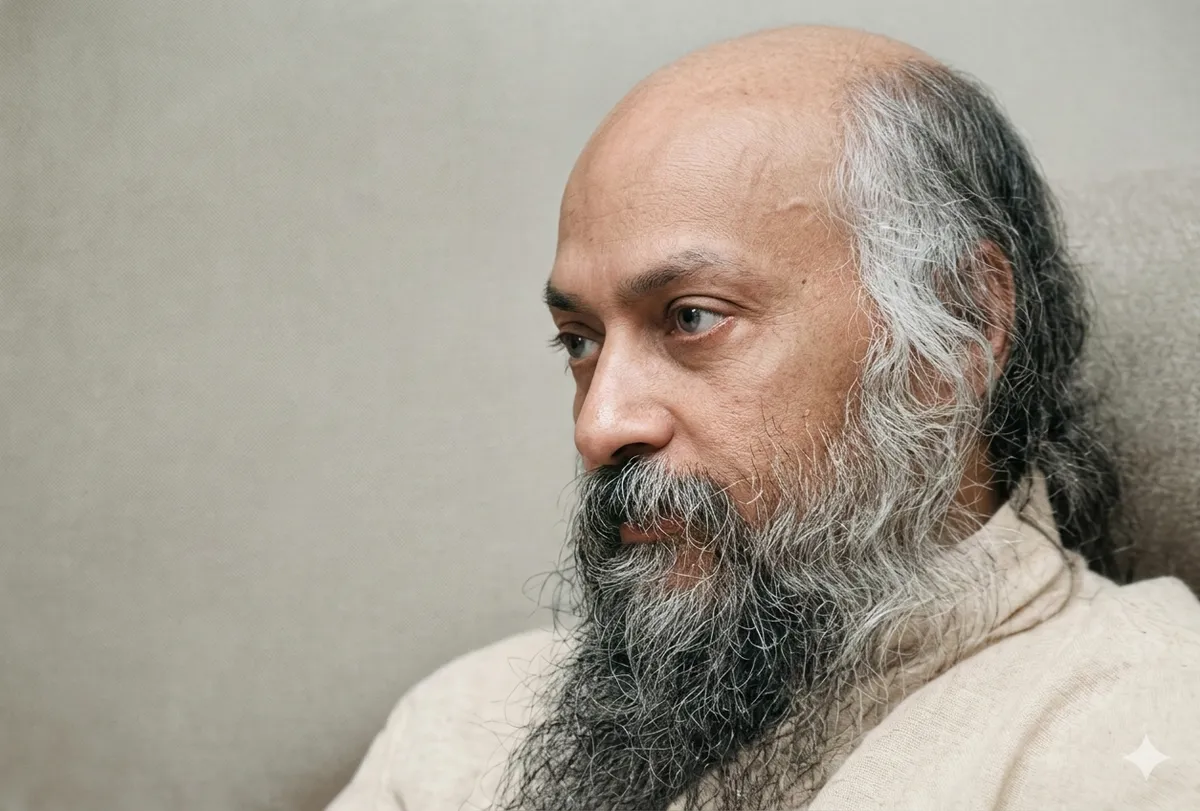
Belief is what you borrow and think; knowing is what you directly see inside yourself.
From the Discourses
Passages where Osho speaks to this question — each links to the complete discourse.
The other day you said that belief was like a lantern in the hands of the blind. May I know what faith is?
Faith is like eyes: you see yourself. Belief is like a lantern in a blind man's hand: he cannot see, he cannot even use the lighted lantern. Even that lighted lantern will be just a burden to him, to be carried. And if the light goes off he will never become aware of it. Belief is just believing what others say. It is not faith; faith is knowing. Faith is existential, belief is intellectual. Buddha says something, or I say something; you listen to me, it appeals to your intellect. It seems to be convincing to your reason and you start believing in it. Then it will be a lantern in a blind man's hand. But if you listen to me, something appeals to you and you don't stay with the intellectual understanding but you try to make that your own experience.. If I talk about love and Iistening to…
Beloved Osho, the scientific vision of objective reality and the subjective experience of existence seem to be two completely separate and unbridgeable dimensions. Is this because of the nature of things, or is it only an illusion of our mind?
The scientific approach to existence and the religious approach have been in the past separate and unbridgeable. The reason was the insistence of old religions on superstitions, belief systems, denial of inquiry and doubt. In fact, there is nothing unbridgeable between science and religion, and there is no separation either. But religion insisted on belief -- science cannot accept that. Belief is covering up your ignorance. It never reveals to you the truth; it only gives you certain dogmas, creeds, and you can create an illusion of knowledge through them. But that knowledge is nothing but a delusion. Anything based on belief is bogus. Because religions insisted continuously on belief, and the basic method of science is doubt, the separation happened. And it became unbridgeable. It is unbridgeable if religion does not arise and face the challenge of doubt. The whole responsibility of the religions has been to keep these…
Drop all beliefs, all disbeliefs. Let the mind become less cluttered. Remove all unnecessary luggage, become more unburdened. The more unburdened you are, the closer to truth. When you are absolutely unburdened, empty, when you are just there, with no idea surrounding you, truth happens. That is what Zen people call satori. It happens in a state of no-mind. And the beginning of no-mind is the dropping, slowly slowly, of all kinds of prejudices -- Christian, Hindu, Mohammedan; these are all prejudices. Communist, Catholic... these are all prejudices. And to cling to these prejudices is a very very irreverent act, very egoistic, because these beliefs are claims, and claims without any validity. You don't have any existential validity for them -- you simply believe because you have been told to believe.
Osho, there is a saying, “If you believe, it is a god; otherwise, it’s a stone.” Is it all just a matter of believing?
I tell you: do not believe in God. There is no need to believe. If you believe in God, then what will you know? To believe in God means you have declared defeat in knowing—you are tired, you have thrown down your arms. You have said, “The search is over; there is nothing to know, so let us believe.” You don’t believe in the sun or the moon; you know them. You don’t believe in this world; you know it. And you believe in God? If your believed God is repeatedly defeated before your known world, it is no surprise. God should also be known. The day God is known, this world becomes insipid—maya, a dream. Experience is wealth; empty beliefs are not. So I make a small change in the saying: “Know, and it is God; otherwise, it’s a stone.” But to know, a great journey is required. To…
पहला प्रश्न: ओशो, कहावत है, ‘मानिए तो देव, नहीं तो पत्थर।’ क्या सब मानने की ही बात है?
मैं तुमसे कहता हूं: परमात्मा को मानना मत। मानने की जरूरत नहीं है। परमात्मा को मानोगे तो फिर जानोगे किसको? परमात्मा को मानने का मतलब तो यह हुआ कि तुमने जानने में हताशा प्रकट कर दी, तुम हार गए, तुमने अस्त्र-शस्त्र डाल दिए। तुमने कहा, खोज समाप्त हो गई; जानने को तो है नहीं, माने लेते हैं। सूरज को तो नहीं मानते हो, चांद को नहीं मानते हो; जानते हो। इस संसार को मानते तो नहीं, जानते हो। और परमात्मा को मानते हो? यह माना हुआ परमात्मा अगर तुम्हारे जाने हुए संसार के सामने बार-बार हार जाता है तो कोई आश्चर्य तो नहीं है। परमात्मा भी जाना हुआ होना चाहिए। जिस दिन परमात्मा जाना हुआ होता है उस दिन यह संसार फीका पड़ जाता है, माया हो जाता है, सपना हो जाता है।
Lao tzu says: without stepping outside one's doors one can know what is happening in the world. Without looking out of one's windows one can see the tao of heaven.
THE FURTHER ONE PURSUES KNOWLEDGE THE LESS ONE KNOWS. THEREFORE THE SAGE KNOWS WITHOUT RUNNING ABOUT UNDERSTANDS WITHOUT SEEING, ACCOMPLISHES WITHOUT DOING. Religion is not knowledge, it is knowing. Knowledge is of the mind, knowing is of the being, and the difference and the distance, is tremendously vast. The difference is not only quantitative, it is also qualitative. Knowledge and knowing -- they are as different as heaven and hell, earth and the sky, so the first thing to understand is the difference between knowledge and knowing. Knowledge is never of the present, it is always of the past. The moment you say you know it is already a dead thing, it has already left its marks on the memory, it is like dust clinging to you. You have already moved away from that. Knowing is always immediate, knowing is here and now. You cannot say anything about it, you…