
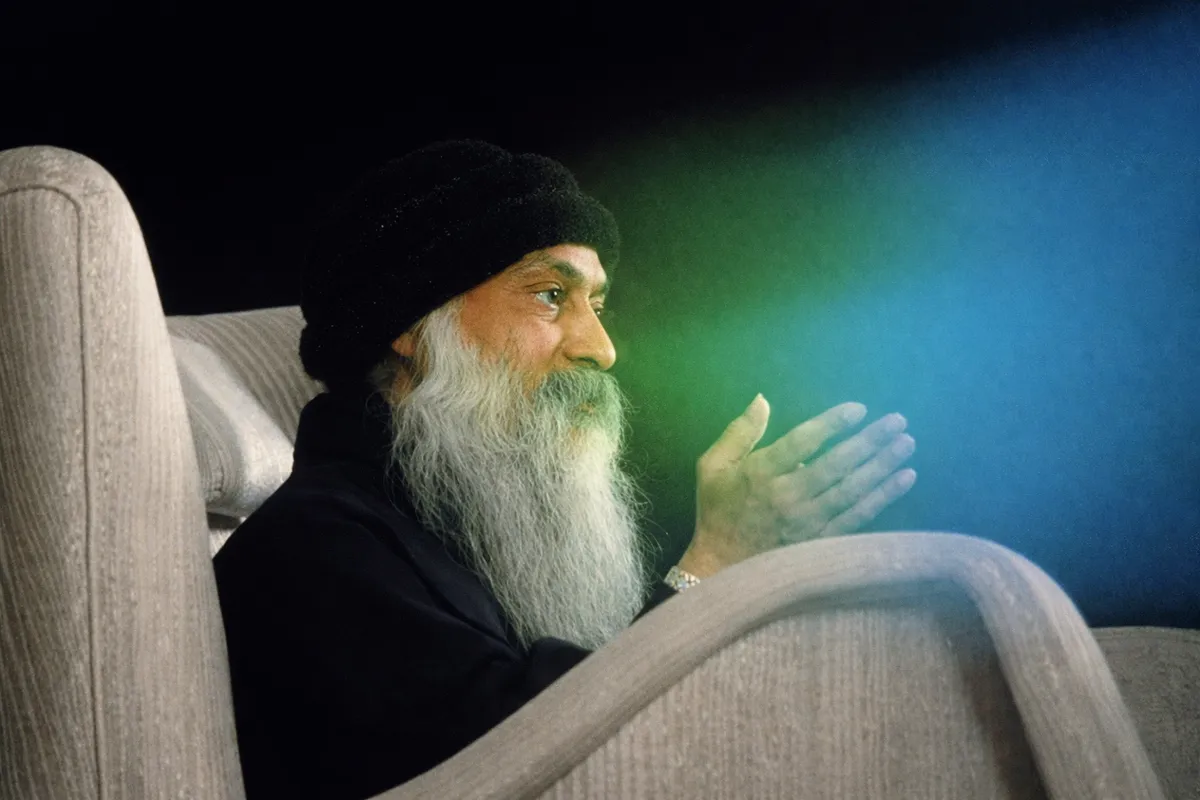
Truth isn't true because many say so; it's true because you see it for yourself.
From the Discourses
Passages where Osho speaks to this question — each links to the complete discourse.
Verse (Sanskrit): Chapter 49 THE PEOPLE'S HEARTS The Sage has no decided opinions and feelings, But regards the people's opinions and feelings as his own. The good ones I declare good, The bad ones I also declare good; That is the goodness of Virtue. The honest ones I believe, The liars I also believe; That is the faith of Virtue. The Sage dwells in the world peacefully, harmoniously. The people of the world are brought into a community of heart, And the Sage regards them all as his own children. Transliteration: Chapter 49 THE PEOPLE'S HEARTS The Sage has no decided opinions and feelings, But regards the people's opinions and feelings as his own. The good ones I declare good, The bad ones I also declare good; That is the goodness of Virtue. The honest ones I believe, The liars I also believe; That is the faith of Virtue.
‘संत संसार में शांतिपूर्वक, लयबद्धता के साथ जीते हैं। संसार के लोगों के बीच--ऐसे संतों के माध्यम से--हृदयों का सम्मिलन होता है। दि पीपुल ऑफ दि वर्ल्ड आर ब्रॉट इनटु ए कम्युनिटी ऑफ हार्ट।’
Lieh tzu was studying archery, and hit the target. He sought advice from kuan-yin who asked him: 'do you know why you hit the target?' 'no.' 'it won't do yet.' he went away to practice and after three years again reported to kuan-yin. 'do you know why you hit the target?' 'I know.' 'it will do. Hold onto this awareness and do not lose it.' this applies not only to archery but to ruling oneself. Therefore the sage scrutinizes not the fact of survival or ruin, but its reasons.
Watch these moments of let-go, because they are messages from God. Watch these moments of let-go, cherish them, taste them more. Welcome them so that they become more and more available to you. Receive the guest gratefully so that it starts coming more and more often. Tao says that the real happens only when you are in such a state of diffused relaxedness that you cannot say I am. 'I am' means you are tense. <q>LIEH TZU WAS STUDYING ARCHERY, AND HIT THE TARGET. HE SOUGHT ADVICE FROM KUAN-YIN WHO ASKED HIM, 'DO YOU KNOW WHY YOU HIT THE TARGET?'</q> This Kuan-yin is a Taoist Master and an archer. Lieh Tzu asked him about his archery and he said, 'I have become an expert; technically, technologically, I have attained my goal. I have hit the target.' The Master asked, 'DO YOU KNOW WHY YOU HIT THE TARGET? From where? Who…
And someone has asked: Osho, who is it that thinks when one is witnessing?
As it is now, whenever we know, three things are present: the one who knows—the knower; that which is known—the known; and the relationship between the two—knowledge. Knowledge is bound and burdened by the knower and the known. Keval-gyan means the known dissolves—the object disappears. And when the known dissolves, where will the knower be? He was bound to the known. When the known dissolves, the knower dissolves. What remains then? Only knowledge remains. In that moment of pure knowing there is the sense of liberation and of freedom. So keval-gyan means to experience pure knowledge. What I have called samadhi is the experience of pure knowing. These are different names in different traditions: what Patanjali called samadhi, the Jains called keval-gyan, and Buddha called prajna. Keval-gyan does not mean telling what is going on in your head. That is very easy—a simple thing. That is ordinary telepathy, thought-reading; it…
और पूछा है, ओशो, साक्षी होकर कौन विचार करता है?
अभी जब भी हम कुछ जानते हैं, तो जानने में तीन चीजें होती हैं--जानने वाला होता है, वह ज्ञाता होता है; जिसको जानते हैं, वह होता है, वह ज्ञेय होता है; और इन दोनों के बीच जो संबंध होता है, वह ज्ञान होता है। तो ज्ञान जो है, ज्ञाता और ज्ञेय से दबा रहता है, उनसे बंधा रहता है। केवल-ज्ञान का अर्थ है कि ज्ञेय विलीन हो जाए, आब्जेक्ट विलीन हो जाए। और अगर ज्ञेय विलीन हो जाएगा, तो फिर ज्ञाता कहां रहेगा! वह तो ज्ञेय से बंधा हुआ था। जब ज्ञेय विलीन हो जाएगा, तो ज्ञाता विलीन हो जाएगा। तब क्या शेष रह जाएगा? तब मात्र ज्ञान शेष रह जाएगा। उस ज्ञान की घड़ी में मुक्ति का बोध होता है और स्वतंत्रता का बोध होता है। तो केवल-ज्ञान का अर्थ है, शुद्ध ज्ञान को अनुभव कर लेना। जिसको मैंने समाधि कहा है, वह शुद्ध ज्ञान का अनुभव है। यह अलग-अलग संप्रदायों के अलग-अगल सत्य हैं। जिसे पतंजलि ने समाधि कहा है, उसे जैनों ने केवल-ज्ञान कहा है, उसे बुद्ध ने प्रज्ञा कहा है।
Lao tzu says: without stepping outside one's doors one can know what is happening in the world. Without looking out of one's windows one can see the tao of heaven.
THE FURTHER ONE PURSUES KNOWLEDGE THE LESS ONE KNOWS. THEREFORE THE SAGE KNOWS WITHOUT RUNNING ABOUT UNDERSTANDS WITHOUT SEEING, ACCOMPLISHES WITHOUT DOING. Religion is not knowledge, it is knowing. Knowledge is of the mind, knowing is of the being, and the difference and the distance, is tremendously vast. The difference is not only quantitative, it is also qualitative. Knowledge and knowing -- they are as different as heaven and hell, earth and the sky, so the first thing to understand is the difference between knowledge and knowing. Knowledge is never of the present, it is always of the past. The moment you say you know it is already a dead thing, it has already left its marks on the memory, it is like dust clinging to you. You have already moved away from that. Knowing is always immediate, knowing is here and now. You cannot say anything about it, you…
Ascending to the high seat, dogen zenji said: "zen master hogen studied with keishin zenji. Once keishin zenji asked him, joza, where do you go?' hogen said. 'I am making pilgrimage aimlessly.' keishin said, 'what is the matter of your pilgrimage?' hogen said, 'I don't know.' keishin said, 'not knowing is the most intimate.' hogen suddenly attained great enlightenment."
Beware of getting lost in philosophy and religion if you really want to know what truth is. Beware of being Christian, Hindu, Mohammedan, because they are all ways of being deaf, blind, insensitive. Three deaf British gentlemen were traveling on a train bound for London. The first said, "Pardon me, conductor, what station is this?" "Wembley, sir," answered the conductor. "Good Lord!" exclaimed the second Englishman. "I am sure it is Thursday." "So am I," agreed the third. "Let us all go into the bar car and have a drink." That's how it goes on between professors, philosophers, theologians. They can't hear what is being said. They have their own ideas and they are so full of them, so many thick layers of words, that reality cannot reach them. ZEN SAYS: IF YOU CAN DROP PHILOSOPHIZING, there is a hope for you. The moment you drop philosophizing you become innocent…