
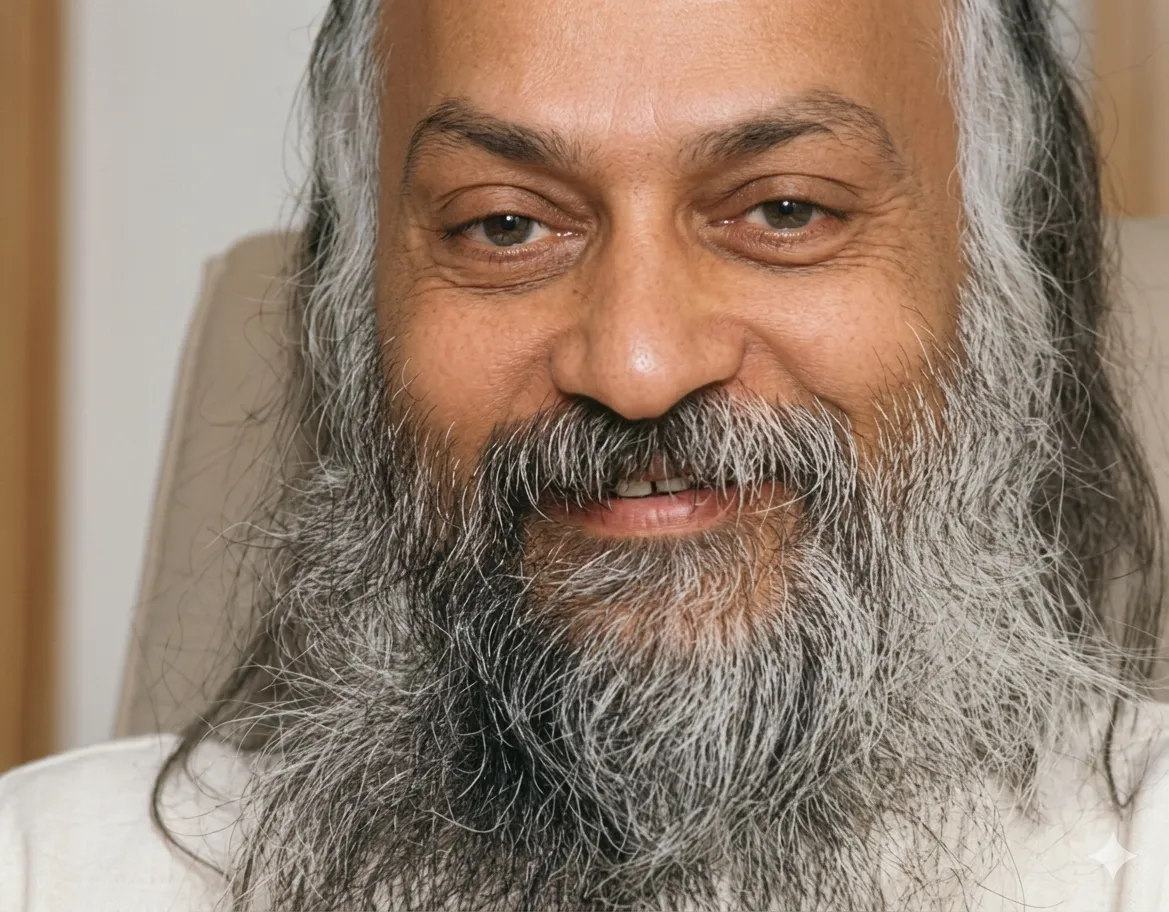
If your ego enjoys your holy crying, it turns those tears into its food—only letting go of “me” actually melts it.
From the Discourses
Passages where Osho speaks to this question — each links to the complete discourse.
Osho, while listening to your talks, at times I am so overwhelmed with love that my eyes begin to shed tears. But then, unconsciously, the ego seems to take delight, too, thinking, “I am weeping tears of adoration.” Doesn’t this make the dry path of Advaita better—the path where the one who sheds tears does not remain at all?
It’s a fine, delicate question; it needs a little understanding. Reflect a little: if even in devotion the ego survives, then in nonduality it certainly won’t be destroyed. If even tears cannot carry it away, on a dry path it will only stiffen and stand more rigidly. If tears cannot melt it, and it even feeds on tears, then where there are no tears at all there will be no means left to dissolve it. Understand this. Ego is opposed to tears. That is why we tell men, “Don’t cry. Why are you behaving like a woman?” We make men egoistic. Even when a small boy starts to cry, we say, “Quiet! Are you a boy or a girl?” It’s a man’s world; men have been in control, so they kept ego for themselves. To be a man has come to mean: “Don’t cry.” That is the stiffness. “Women cry.…
Yesterday Dhabbu-ji was saying, Osho, I finished my worship and then saw my little niece, a while later, sitting on the same seat with eyes closed, hands folded, swaying and singing: “Do bechaare, bina sahaare, phirte maare-maare!” (Two poor fellows, without support, roam around hounded!)
Dhabbu-ji told me this, and I burst out laughing. I asked, “Ninu, what’s this?” She said, “Please be quiet, I’m doing puja, Uncle!” Dhabbu-ji said, “Puja? But that’s a film song, not a hymn!” She quickly shot back, “In puja you and Grandma also sing ‘Om Jai Jagdish Hare’—that’s a song from the pictures too.” What difference does it make what you’re singing? Whether it’s a bhajan or a film song—within your sleep, all is equal. Even if you dream of heaven, it makes no difference. Even if gods appear in your dream, nothing changes. When you wake up, you’ll find all dreams were false. Some people are lost in worldly dreams; others are lost in dreams of renunciation. And these renouncers you’ve kept calling “great souls.” Their sleep is just like yours—no real difference at all. Even their dreams are like yours, because a dream is a dream; what…
Osho, you have earlier said, “Live moment to moment, live in the present.” Now you are saying, “Return to the past.” What should we do?
So it is with the mind—there are ruts. The past means endless grooves. However much you understand, your intellect agrees, you make decisions, you resolve—at the moment of resolve you feel something is going to change. But not even an hour passes before your decision breaks. Then only self-condemnation is produced, nothing else. Your saints, your fakirs, your priests and pundits—most of the time they only succeed in producing self-condemnation in you, nothing else. Their words are logically correct. You cannot even say they are wrong; you have to admit they are right. In that admission you take a decision. But against what are you deciding? Inside are grooves carved since who knows when, deep tracks. Walking in them has become a habit. It is easy to walk in them. They will pull you again and again. The meaning of returning into the past is: these grooves must be erased.…
Osho, does the ego have some elixir of life? Even on the verge of dying it seems to revive—who knows from where, how, and why?
Haven’t you seen that the harder it is to obtain the woman you fall in love with, the more your love seems to grow? Had Majnu got his Laila, you would never even have heard his name. The whole crux of the Majnu-Laila story is that he never got her. Quite possibly, had he got her, they would have ended in divorce. Stories proceed in strange ways. Because he did not get her, he kept weeping, aching, wandering deserts and mountains, calling “Laila, Laila!” Have you ever seen any husband doing that? Ask a husband and perhaps he hasn’t even properly looked at his wife’s face in twenty years. You too are a husband or a wife—try this: close your eyes and try to recall your spouse’s face. You will find it difficult. The faces of film actresses will come, but your wife’s face will not come clearly. And if…
Osho, in the general feeling about the ego, it seems as if one is an egoist or egoless. One moment it feels there is ego; the next moment it feels egoless.
Yes, yes, that’s how it goes. That’s how it goes. In fact, all our thinking is in degrees. It’s like this: at 98 degrees we say, “This person is perfectly fine,” and at 99 degrees we say, “There’s a fever.” 98 is also a “fever,” but it is the normal fever. At 99 it becomes abnormal. Then when it returns to 98, we say, “All right, normal again.” There is still fever—meaning the same fever that everyone has. As long as it is where everyone else’s is, we call it normal; just a little this side or that, and trouble starts. It is the same with the ego. It is our fever. As long as it is at the same degree as in everyone, we say, “He is perfectly humble, a good man.” If, compared to us, his degree goes to 99, we say, “He seems very egoistic.” If it…