
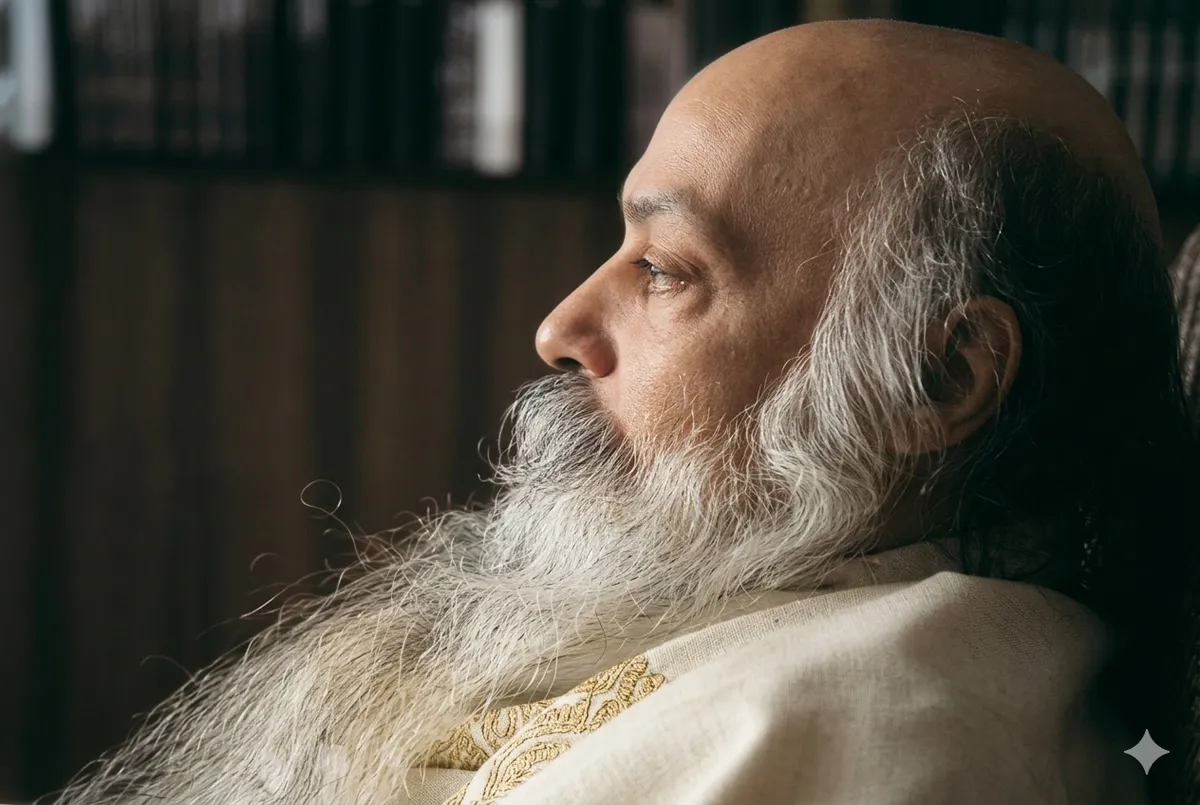
According to Osho, love and meditation are two doors to the same inner shrine; you need only one at first. Choose the door aligned with your nature—love for the extrovert heart, meditation for the introvert mind. Walking either path fully, you arrive at egoless, timeless transcendence, where love reveals meditation and meditation flowers into love.
Pick one path—loving others or sitting quietly—and if you go all the way, they meet in the same peaceful place inside you.
From the Discourses
Passages where Osho speaks to this question — each links to the complete discourse.
Osho, you have titled this series of talks “Sahaj Yoga.” Do “sahaj” and “yoga” not seem mutually opposed?
Anand Maitreya! They don’t just seem opposed, they are opposed. But no ultimate truth of life can manifest without contradiction. Life is made of opposites—darkness and light, day and night, woman and man, negative electricity and positive electricity, birth and death. The very structure of life is woven of opposites. Hence the opposites are not only opposed; they are complementary to each other. If you have labored hard all day, you will be able to sleep deeply. Labor and rest are opposites, yet only the one who has worked can rest deeply—and the one who has not worked cannot. So the opposites are not only opposed, they complete each other. And only the one who has rested deeply at night can rise in the morning and engage in work again. One who has not rested through the night will not be able to work in the morning. Look closely at…
Meditation fulfils something, love fulfils something else. It is like telling a person 'Either you can eat or you can drink. If you eat, then you cannot be allowed to drink anything; if you want to drink anything then you cannot eat. Choose one -- whatsoever you want.' Now, you will drive that man crazy! He needs both. You tell somebody 'Either you can remain awake or you can go to sleep -- choose.' These are opposite activities, and you cannot choose opposite things because that will create troubles for you, so either be awake or be asleep.' Now, nobody can choose one. You will need a certain rhythm between waking and sleeping; you will have to move from one to the other. Waking you will create the necessity for sleep, sleep will create the necessity for waking.
Osho, please explain the interrelationship of meditation, samadhi, and love. When do the three become one?
I say to you as well: Life is a veena. But you must tune your own veena. Do not imitate others. They must tune theirs. There are many kinds of veenas. Every person has a veena of his own and a hidden music of his own. Svadharme nidhanam shreyah. If you die while playing your own veena, you will attain the great life. If you die carrying others’ veenas—no matter how beautiful a music they produce—you will come empty and go empty. There will be no treasure in your hands. You will have wasted your life. And the greatest danger in this world is that you may fall under someone else’s influence. You are all too ready to be influenced because tuning your own veena is a hard task. Borrowing another’s veena is easy. Seeking for yourself, practicing swadhyaya, is full of risk—mistakes can happen. Borrowing knowledge from another is…
Ordinarily psychologists don't think that meditation can do anything because they are not aware of the roots -- and meditation's whole function is to cut the roots. Once the roots are cut the tree withers away by itself. Love makes man an ocean, an infinity. It gives a kind of unboundedness. It helps you to know that you are not defined by any limits, that you are not confined by the body or the mind, that you are not confined at all, that you are as vast as the sky; in fact, even the sky is not the limit. There is no limit to you. This is the beauty of love, it makes you aware of vastness. That is the first experience of godliness. And if the first experience happens, then other things follow in their own time. The first experience triggers a process.
Love is a path unto itself, and so is meditation. One can follow either love or meditation; both lead to the same goal. But there are a few people who can follow both, and of course their journey is far richer. And that is going to be the work for you: love as deeply as possible and meditate as deeply as possible and go on moving between the two. Remain fluid, flexible. The lover finds it difficult to meditate because he needs the other and meditation means to be alone. The meditator finds it difficult to love because he becomes accustomed to being alone and the freedom of being alone. The very presence of the other seems to be a transgression, an interference, a disturbance. So ordinarily it is simple to follow one, but if you can manage both then your life will have more richness.