
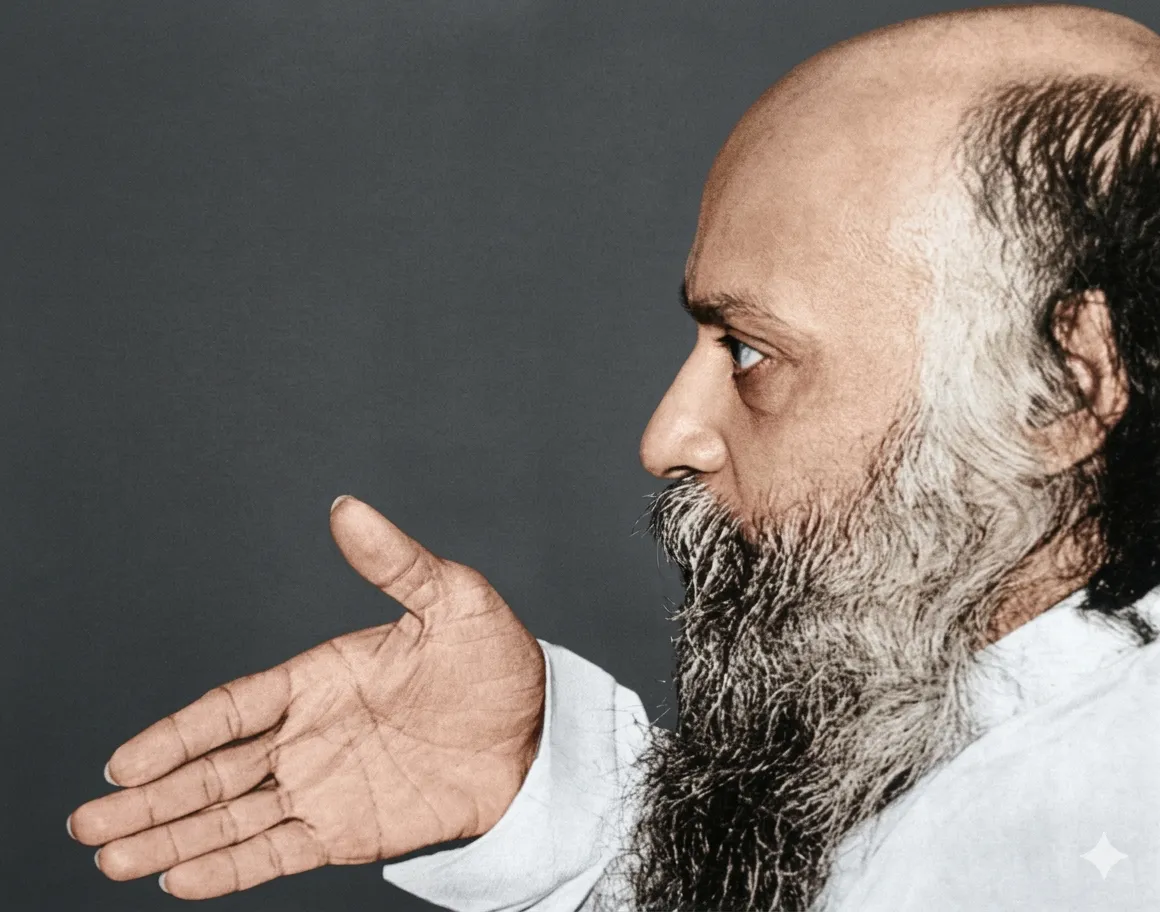
If you push down your real feelings and truths, you get twisted inside and they burst out worse; being open and natural makes you peaceful and real.
From the Discourses
Passages where Osho speaks to this question — each links to the complete discourse.
What is repression?
But repression makes you false. It is not by repression that anger, sex, greed are destroyed, no. They are there -- just the labels are changed. They go into the unconscious, they start working from there: they go underground. And, of course, when they are underground, they are more powerful. The whole psychoanalytic movement tries to bring what is underground to the surface. Once is becomes conscious, you can be freed of it. A Frenchman was staying in England, and a friend asked him how he was getting on. He said he was doing very well, except for one thing. 'When I go to a party, the hostess, she does not tell me where is the 'pissoir"...' 'Ah, Georges, you mean she does not tell you where the toilet is? That's just our English prudery. Actually, she will say "Do you want to wash your hands?" and that means the…
Osho, what do those people mean who say that, so that there is no explosion, one should search within with a subtle, refined vision...
But the effortless awakening I speak of—once it arrives, there is no question of its departure, because you did not bring it; it came. Gradually you and awakening are not two; you are the awakening. You did not make even anger “the other,” so how would awakening be “other”? It becomes you. There is no question of its return. Whatever we have truly known cannot be unknown. You cannot undo knowing. Yes, what we have merely learned by rote can wobble. But what is known—like a child who comes to know love; once he knows, he cannot un‑know it. Knowing becomes part of you; it cannot fall away. Reading four books about love is different; that can be forgotten. Through the experiment of awakening, whatever happens in us reveals itself gradually. Awakening is not something that comes from outside; it is your inner being uncovering itself. If it were an…
ओशो, उन लोगों का कहना क्या है कि वह जो विस्फोट न हो, उसके लिए सूक्ष्म दृष्टि से भीतर जो लोग खोज करते हैं...
हां, जो मैंने यह कहा कि जो सहज-सहज जागते चले जाना है। यह जागरण जैसे ही आ जाता है, इसके लौटने का कोई सवाल ही नहीं है। क्योंकि इसको आप लाए नहीं हैं, यह आया है। और धीरे-धीरे-धीरे-धीरे जागरण और आप दो चीजें नहीं रह गए हैं, आप ही जागरण हो गए हैं। आपने क्रोध तक को दूसरा नहीं माना, तो जागरण को दूसरा मानने का क्या सवाल है! वह धीरे-धीरे आप ही हो गए हैं, आप ही हैं। उसके लौटने का कोई प्रश्न नहीं है, उसके लौटने का कोई सवाल नहीं है। जो भी हमने जान लिया है--जान लिया है--उससे पीछे लौटने का सवाल नहीं है। उसको फिर अनजाना नहीं किया जा सकता। उसे अनजाना करना मुश्किल है। हां, जो हमने न जाना हो, ऐसे ही सीख लिया हो जबरदस्ती, वह कल फिर डांवाडोल हो सकता है। लेकिन जो मैंने जान लिया है--जैसे एक बच्चे ने प्रेम जान लिया, नहीं जाना था अब तक, अब उसने प्रेम जान लिया। अब वह प्रेम को अनजाना नहीं कर सकता। उसका अनजाना होना अब असंभव है। जानना जो है, चूंकि वह हमारा हिस्सा ही हो जाता है, वह हमसे कहीं अब छूट सकता नहीं। …
Osho, when more of the existential happens in a person than can be absorbed and digested at one time, is it not then wise to repress until trust and innocence grow? My body is in had shape because of repression but it feels as though I have bought much, needed time.
REPRESS and resist, how out of repression and resistance can trust and innocence grow? You will be making it more and more impossible. Innocence means a state of total nudity, of utter non-repressiveness. Repressed persons become complex, they cannot become innocent. Everything in them becomes crippled, paralyzed, devious. They start becoming split; in fact they become many, not just two They have one door to show themselves to the world and another door, a back door, through which they live. They say something, they do something -- and they think something else. They are always in a chaos, they cannot be innocent. Innocence does not need repression, it needs spontaneity, it needs naturalness. Whatsoever you repress will become your problem. If you repress anger, anger will become your problem. Then in everything anger will be hiding. In fact, if there is too much repressed anger you will be angry twenty-four…
Another friend has asked in this connection: you say that revolution can only be nonviolent. But he says that revolution is always violent; a nonviolent revolution never happens.
In Russia, those who gained power were good men; before a revolution, everyone looks good. After power comes into hand, then it is revealed who is truly good and who is not. There is even the possibility that Stalin poisoned Lenin. And there is the possibility that one by one, all who had led the revolution were eliminated. Trotsky was killed in Mexico. Those who made the revolution were picked off by Stalin, one after another—because now the game of power had begun. In India, many fine, innocent-looking people made revolution with Gandhi—white as freshly washed garments they appeared. But once power came into their hands, we saw they had changed; they proved to be different men. Only their clothes were white; within, they were not. What happened the moment power was in their grasp? The real man inside showed himself. As long as there is no power, the real…
एक दूसरे मित्र ने इसी संबंध में पूछा है कि आप कहते हैं कि क्रांति अहिंसक ही हो सकती है। लेकिन उन मित्र ने पूछा है कि क्रांति तो सदा हिंसक होती है, अहिंसक क्रांति तो कभी नहीं होती।
रूस में जिन लोगों के हाथ में ताकत आई, वे लोग अच्छे थे; क्रांति के पहले सभी लोग अच्छे होते हैं, क्रांति के बाद जब ताकत हाथ में आती है, तब पता चलता है कि कौन आदमी अच्छा है, कौन आदमी बुरा है? संभावना इस बात की है कि स्टैलिन ने ही लेनिन को जहर देकर मारा। और इस बात की संभावना है कि जितने लोग क्रांति के अग्रणी थे, धीरे-धीरे करके एक-एक मारे गए। मैक्सिको में जाकर ट्राटस्की की हत्या की गई। जिन लोगों ने क्रांति की थी, स्टैलिन ने चुन-चुन कर एक-एक को मारा। क्योंकि अब सत्ता का खिलवाड़ शुरू हो गया। हिंदुस्तान में कितने अच्छे लोगों ने गांधी के साथ क्रांति की थी; कितने अच्छे और भोले लोग मालूम पड़ते थे, एकदम सफेद धुले हुए मालूम पड़ते थे। फिर जब सत्ता हाथ में आई, तो पता चला कि वे लोग बदल गए, वे दूसरे आदमी साबित हुए। वे कपड़े ही सफेद थे, वे आदमी भीतर सफेद नहीं थे।
A second friend has asked: Osho, in the practice of awakening, of awareness, fear arises, and there is a constant worry that the routine of life may fall into disorder. It also seems that when anger, sex, etc., arise, if one acts on them, they are finished in five to seven minutes—one feels free of them. If you don’t act, their after-echo, their waves, keep resounding within for days. Then it feels as if it would have been better to have done it and been done with it. So what should one do? Is such awakening not repression?
Two things. First, if through “awakening” your anger—which would otherwise be over in five minutes—goes on for two days, understand it is not awakening; it is repression. Repression makes things spread. It creates even more disturbance than indulgence. If sexual desire arises and is over in a moment, but with your so-called awakening it drags on for days, grows dense, and becomes a burden on the mind, know that it is not awakening, it is repression. Many of us don’t rightly understand the difference between awakening and repression. Understand it. Repression means: what has arisen inside, you press it down inside; you don’t allow it to come out. Indulgence means: you let it out on someone. Get the difference clear. Repression means: you force it down upon yourself; indulgence means: you unload it onto the other. Awakening is a third thing—letting it out into the void: neither pressing it down…
एक दूसरे मित्र ने पूछा है: ओशो, जागृति की, होश की साधना में भय का जन्म हो जाता है, और हर समय डर लगता रहता है कि जीवन-चर्या अस्त-व्यस्त न हो जाए। फिर ऐसा भी लगता है कि क्रोध, काम आदि उठते हैं, तो कर लेने से पांच-सात मिनट में निपट जाते हैं। उनसे मुक्ति हो जाती मालूम पड़ती है। न करो तो दिनों तक उनकी प्रतिध्वनि, उनकी तरंगें भीतर गूंजती रहती हैं। और तब ऐसा लगता है कि इससे तो कर ही लिया होता तो निपट गए होते। तो क्या करें? ऐसी जागृति दमन नहीं है?
दो बातें हैं, एक तो, अगर, जागृति से क्रोध--जो पांच मिनट में निपट जाता है, दो दिन चल जाता है, तो समझना कि वह जागृति नहीं है, दमन ही है। क्योंकि दमन से ही चीजें फैल जाती हैं। भोग से भी ज्यादा उपद्रव खड़ा हो जाता है। अगर कामवासना उठती है और क्षण भर में निपट जाती है। और जागृति से दिनों सरकती है और सघन होने लगती है और मन पर बोझ बन जाती है, तो समझना कि जागृति नहीं है, दमन ही है।