
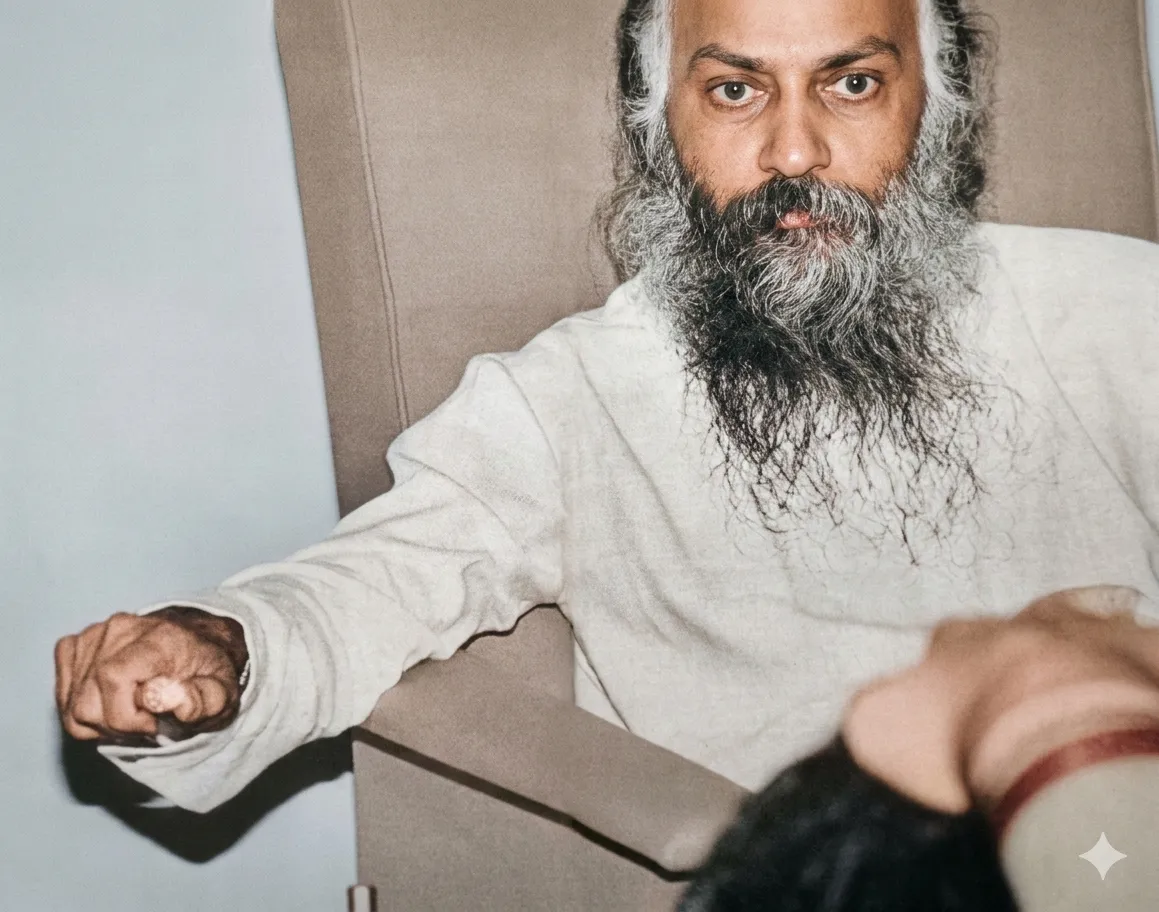
Don’t choose a “true” identity; just watch your thoughts quietly until the pretend masks fall off and what stays by itself is you.
From the Discourses
Passages where Osho speaks to this question — each links to the complete discourse.
Repression has become an automatic reaction in our bodies and minds which we do not even recognize or want to change any more. How can we learn to tell between a false image and a real one in ourselves?
So do not be for and do not be against. Allow the thoughts to move, let them go wherever they are going, be in a deep let-go, and simply witness. Whatsoever is passing, witness. Do not judge; do not say, "This is good, this is bad." If the thought of a divine being comes, do not say, "Beautiful!" The moment you say this you are identified with it, and you are cooperating with the thought process. You are helping it, you are giving energy to it, you are feeding it. And if you are feeding it, it can never drop. Or if there is a thought, a sexual thought, do not say, "This is bad; this is sin." Because when you say, "This is sin," you have created another series of thoughts. Sex is a thought, sin is a thought, God is a thought. Be neither for nor against. Simply…
Osho, using the example of the onion you said that each person has many faces, masks—stolen masks. And these masks will be there, under all circumstances they will be there. One only needs to distinguish between good masks and bad masks. I hate someone, but when he comes to me I welcome him with a smile. This is an artificial face I present before him. Yet at the same time my mind is filled with immense pain, with sorrow, and still I smile. So this face, this mask, would be my good mask. A mask there will certainly be.
By “mask” I mean: the false faces we impose upon ourselves—do not impose them. That does not mean faces will not change in life. Your face will change every day, but it should be your own face. When darkness spreads, tears will come to the eyes; tomorrow a friend may die—tears will come. And tomorrow a long-lost companion may return—then the heart will throb with joy and songs will arise. Your face will change moment to moment; it should. One should be responsive. But the face must be your face. I am not saying keep one face fixed. That would be a stone face; life cannot move like that. Then you would need a single face of stone. I have heard that an American multimillionaire was approached by a man asking for a small donation. The millionaire said, “I have a rule: one of my eyes is artificial—made of stone—and…
Regard most earnestly your own heart. For through your own heart comes the one light which can illuminate life and make it clear to your eyes.
That is the reason why Shankara calls the world illusion. The more you move away from yourself, the more you are moving into illusion; and the more you go inward, the more you are moving into reality. Your personality is the gateway toward illusion, toward an unreal dream world. Throw that gate, throw that bridge completely. At least in meditation. I am not saying for you to go and move in society and be authentic. You will be in difficulty. If you feel happy to do it you can do it, but I'm not saying that; don't put the blame on me. The society will create troubles for you. It doesn't want your real faces, it wants your unreal faces. And it is okay as far as the society is concerned. Use an unreal face when you go out, but when you go within, throw that face completely. Don't get…
Osho, Zen Master Hogen of Seiryo Monastery was just about to give his discourse before the evening meal when he noticed that the bamboo screen hung for meditation had not yet been put away. He pointed to it, and immediately two monks rose from the assembly and began to put it away. Observing that very moment, the Master said: “The first monk’s state is good, but the second’s is not.” Osho, please explain the purport of this Zen enlightenment story.
A Marwari, dying, told his lawyer: “To every servant who has served me for five years, I bequeath fifty thousand rupees.” The lawyer couldn’t believe it—he knew the man; he never gave five paise. Fifty thousand to each—and there were many servants. He asked, “Are you in your senses?” The Marwari said, “More than you. There is no servant in my house I let stay for five years! I’ll give nothing—but the news of my charity will spread.” Even at death, the relish is in reputation. The mask doesn’t drop, not even in the last moment. What people say after you die is important; what you are is not. You have no taste for being—only for others’ opinions. That is the mark of the householder. The sannyasin’s mark is: what I am is my relish. What people say—what is the use? That is their business. What I am—that is mine,…
Osho, I feel I can lovingly understand you, and I can even make others understand. Then why does that very understanding fail to bring authenticity into life—whose absence keeps a constant disintegration going inside and out? Where is the mistake being made? Kindly shed your light.
But how does authenticity arise? If you tie it to “how,” you will be stuck—because authenticity is not something you can produce. Whatever you produce will be inauthentic. Keep this well in your heart: whatever you manufacture will be false. How can what you put on be authentic? The authentic has already been created by the divine. You ask, “How do I wear my original face?” The original face is not worn; it is. Only masks are worn. Anything you can put on will be false. Don’t say, “Fine, I won’t wear the false; I will wear the true.” Can the true be worn? The true is that which is on you without your putting it on—which even if you tried, you could not remove. That which you never miss, never lose, from which you are never separate—that is authentic. So what to do? Only see the false as false.…