
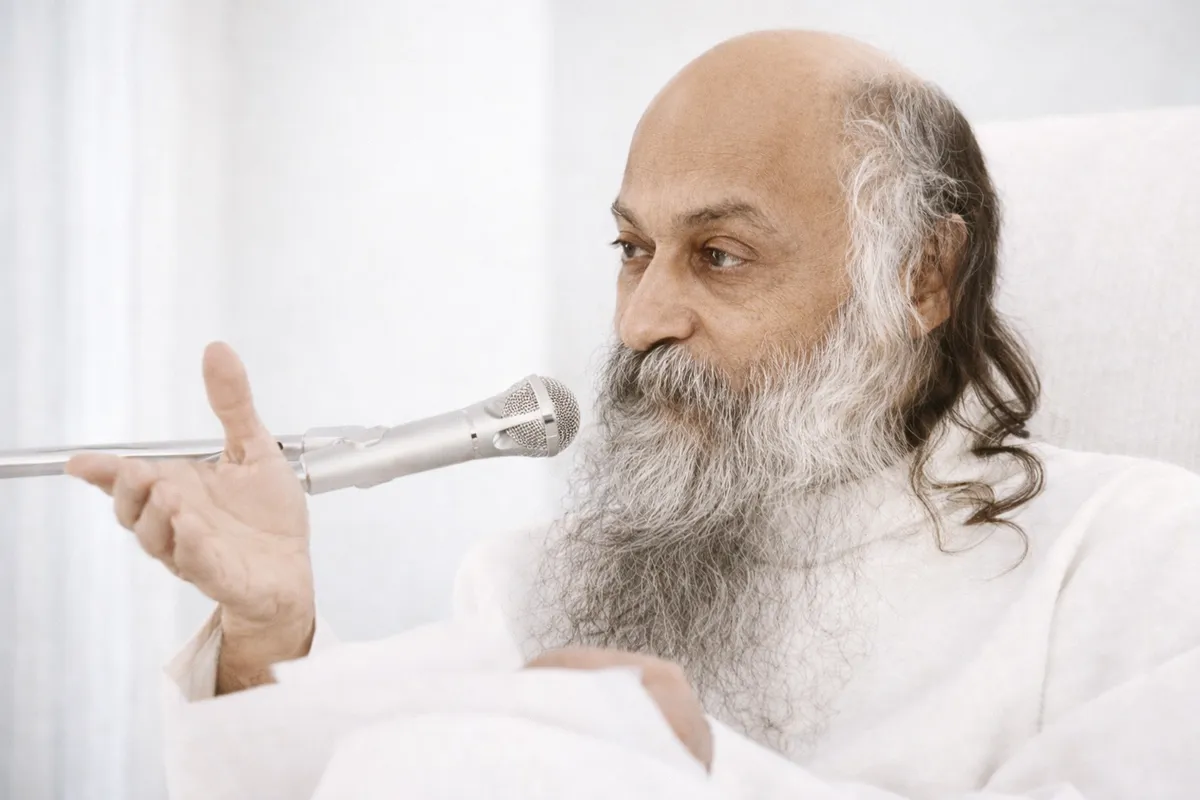
True love makes you see a sparkle of God in the one you love, as if they are a window to something holy.
From the Discourses
Passages where Osho speaks to this question — each links to the complete discourse.
Osho, you said—see only the Divine even in your lover, your beloved. I did not understand this. I too have loved, but to see the Divine in my beloved seems impossible. Where is the Divine in relationships based on the body? Where is the Divine in relations of lust?
You have not loved; you must have done something else and called it love. You have not known love. The label may have been “love,” but inside it was something else. For when love happens, the Divine becomes visible in the one you love—it must; that is the very proof of love. In the one you love, a glimpse of the Divine has to appear. If it does not, then it is lust, it is desire; it is not love. Love is the doorway through which the Divine shimmers. If love happens even for a stone, the stone becomes an icon. If love happens for a person, the Divine begins to glimmer in that person. If love happens for your child, you will see little Krishna dancing in your own house. With anklets on his feet you will see him playing and frolicking. The same play that Yashoda saw in…
Someone has asked—the second question: Osho, yesterday you said that the other can never make anyone happy. But the joy, the bliss, and the sense of awe one experiences when one is immersed in love with a beloved—what is that?
I have heard: Mulla Nasruddin was sitting with a friend. He told his son, “Go to the cellar and bring the bottle of wine.” The boy went and returned. He had poor eyesight and a condition in which one thing appears as two. He said, “Shall I bring both bottles, or just one?” Nasruddin was troubled: there was only one bottle. If he said in front of the guest, “Bring just one,” the guest might think him stingy. If he said, “Bring both,” where would the boy find a second—there was only one. And if he told the guest, “My son sees double,” it would be needless disgrace; he still had to marry the boy off. So he said, “Do this—bring one and break the other. Smash the one on the left and bring the one on the right; the left one is useless anyway.” The boy went and smashed…
Osho, what is the relationship between meditation and patience?
If you sit to meditate to remove mental restlessness, you will keep looking back again and again: “Has it gone yet?” And the irony is that when you begin to meditate, restlessness will increase. Because what has been repressed will start surfacing; catharsis will begin. The rubbish you have kept hidden within and never allowed to express—meditation will break open those doors too. It will clean the house. Dust piled up for years, for births, will rise again; there will be gusts and storms. For a while even the little peace you had will be lost. Then you will panic: “I came for peace, and even what I had is gone.” Without patience, you could even become unhinged, because meditation brings such a great storm. The disease is not from a day or two; it’s from lifetimes. Meditation will break through all the layers to reach your innermost core. In…
Osho, more or less all saints have praised love. But you have enthroned love upon Gaurishankar, the highest peak! Is love truly worthy of such a supreme place? And does love really occupy as much of existence as you give it?
So your fugitive sannyasin flees sorrow, but does not attain bliss. In your monks’ lives you will not find sorrow perhaps; they have withdrawn from the entire arrangement that produces sorrow. But have you found happiness in them? Have you seen streams of peace flowing in their eyes? Have you seen ecstasy in their hearts? Have you heard songs of joy upon their lips? Have you seen them dance? And until a renunciate can dance, there remains something lacking in his renunciation. He left the world, but did not find the divine. Those who live in the world sometimes dance; but your renunciate never dances. Those in the world sometimes get a fleeting glimpse of happiness; if they did not, they would never remain in the world. It comes for a moment—true. But it does come. Your renunciate does not get even that fleeting moment. Sometimes a little light spreads…
When the longing to see the Divine arises in one’s eyes, spring begins to dance all around. The month of honey has come! Then it is spring upon spring! One immersed in the remembrance of the Beloved knows but one season—spring. His seasons do not change. Time’s alterations vanish for him. Within him begins the song of the changeless eternal. He knows one season only—spring. Flowers alone fall within him. Honey alone he drinks. “My gaze is brimming with the splendors of Beauty. How could there not be spring wherever I am?” And you can glimpse the Beloved’s beauty reflected in his eyes. His eyes overflow with beauty; they are glazed with beauty’s tears. “My gaze is brimming with the splendors of Beauty. How could there not be spring wherever I am?” Wherever such a one sits, there is spring; wherever he sits, there is the wine-house.