
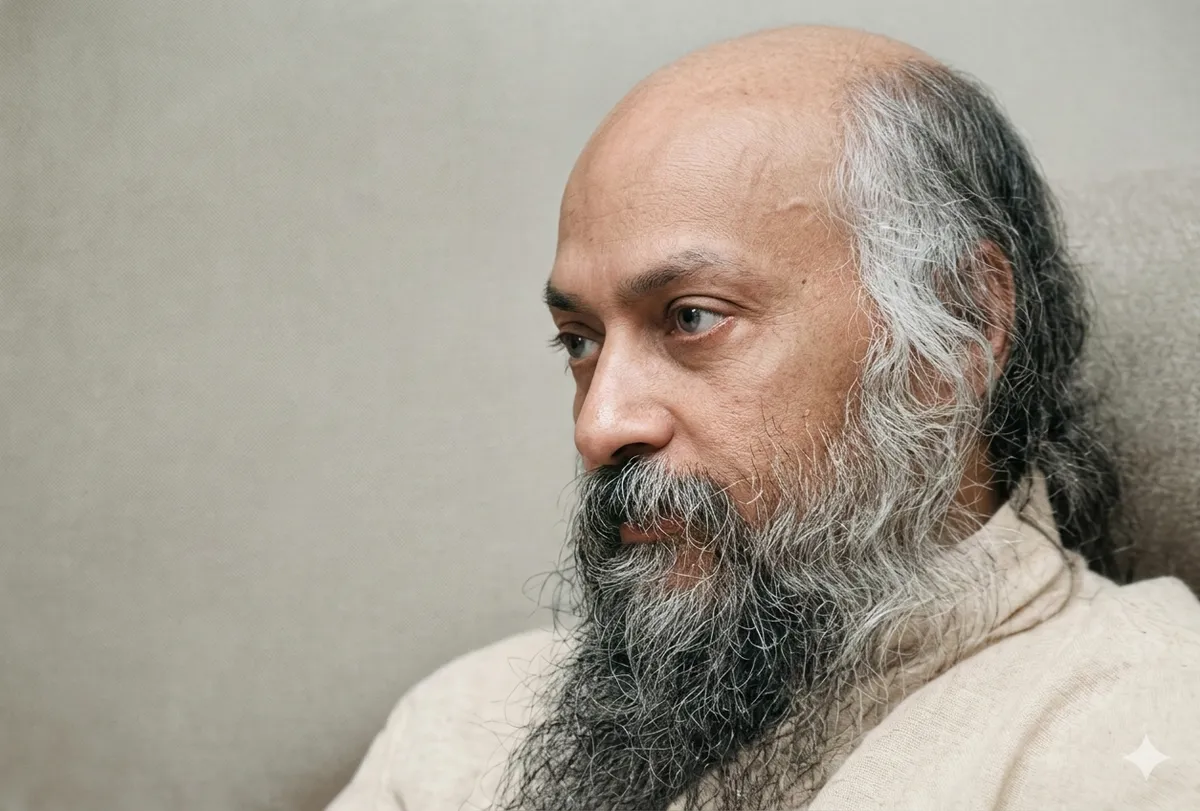
According to Osho, your fear arises because what you call “nectar” is still only borrowed belief, not your own tasted truth. Words can enchant but don’t illuminate; until it becomes your experience, hesitation remains. First, see clearly that what you now drink—anger, greed, ego, sorrow—is poison. When you truly recognize nectar yourself, you will drink instantly; fear disappears.
You’re afraid because you haven’t tasted it yourself—once you see your current drink is poison and truly taste the real sweetness, the fear goes away.
From the Discourses
Passages where Osho speaks to this question — each links to the complete discourse.
Osho, I am very afraid to drink the nectar you are offering. What could be the reason? Why am I afraid? And what should I do?
Look carefully: what you have attained in life—is it poison or nectar? If it is nectar, my blessings—then don’t trouble yourself here. If it is poison, the journey can begin. The one who has seen poison as poison has already completed half the work; half the journey toward nectar is done. To see darkness as darkness is the first step toward seeing light as light. If “I am ignorant” becomes visible, the first ray of knowledge has dawned. If “I do not know” is known, the beginning has happened. The pilgrimage has begun. The first step is taken. And only the first step is difficult. The second is easy, for it is like the first. The third is easy, again like the first. Then all steps are easy. You say: “What you are offering is nectar, but I am afraid to drink.” For you it is not yet nectar. What…
Osho, the fruit of sannyas is sweet; then why does not everyone taste it? Please tell.
Therefore Paltu says: Even if you get a boat, what will you do with it? You need a boatman. Where is the ferryman? Even if you have the scriptures, what will you do? You need a master. Where is the one who will take your hand? A scripture you can hold—but you yourself are going to drown; the scripture will drown with you. You need someone who can hold you—then perhaps you can be saved. Someone who can swim himself can save you. And once you spend a little time with him, you’ll gain the feel of swimming. Swimming is not a very difficult thing. The truth is, in swimming we don’t really learn anything; only self-confidence grows. That’s all; we learn nothing else. It isn’t learning in the usual sense. That’s why, if you learn to swim once, even if you don’t swim for fifty years you won’t forget.…
Osho, you are offering nectar, and the blind are determined to make you drink poison. What kind of injustice is this?
We lived in mirages; you lived in mirages too. Why did we? Let us at least think—thinking is good, even so. People have lived in mirages and are living in mirages; they have even forgotten how to think. I am saying only this to them: think once again, reconsider. I am reawakening the problems. People are angry because they believed the problem had been solved. They thought, We have the solution—what is there to do now? Now spread your sheet and sleep. We found the solution in the Upanishads, in the Vedas, in the Gita, in the Dhammapada. We already have the solution—what remains to be done? But the solution in religion is not a solution like the solutions in science. Understand this distinction well. In science, if something is discovered once, everyone need not discover it again, because science is outer and its knowledge can be imparted from the…
Osho, there is an intoxication in your words; it frightens me.
There is intoxication, yes—but in the words themselves there is nothing, only a slight glimmer of it. If you are frightened by the words, you will miss the real intoxication, because the real intoxication is in the experience. If my words carry some intoxication, it is only because they come drenched in the inner wine; they bring a little news, they leave you a bit unsteady. I am a celebrant of wine. A wine merchant! And I understand your fear, because you suspect that this wine is such that your ego will drown in it—you will be lost in it. And you are afraid of losing yourself.
A yogi cannot be a deserter. The deserter is a coward. To see poison and run away is to refuse the challenge; to show your back; to flee the battlefield of life with tail tucked. Therefore I tell my sannyasin: be a sahaj-yogi; do not renounce, do not run. Whatever Paramatma has given in life can be transmuted into nectar. Right in your shop, temple can arrive. And the true joy is precisely this—that you need not go to the temple, the temple comes to you. The true relish is that you need not go to the Himalayas; the Himalayas surge within you. Your inner being becomes calm as the Himalayas, lush and green; springs bubble up in your soul. Go sit upon the Himalaya—surely a little peace will be felt, because the marketplace’s clamor will not be there.