
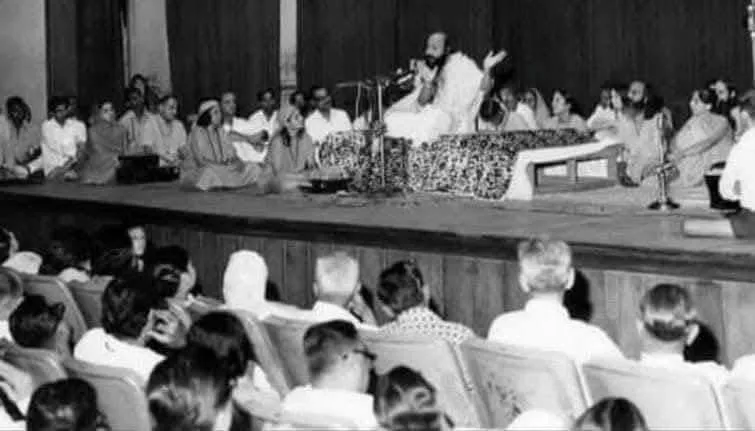
When you catch yourself judging, just notice that too and gently come back to watching—don’t fight it, and it will fade with patience.
From the Discourses
Passages where Osho speaks to this question — each links to the complete discourse.
Before I know it my watcher turns into my judger. What to do?
Don't judge it. If your watcher becomes a judger, okay. Don't judge the judger -- watch it. If again the judger comes, watch it. Always go on falling back on the watcher; don't be defeated by the judger. And don't be disturbed. It is not a question that you have to not judge. If you force it you will not be happy -- you will be suppressed. And whatsoever you will do, the judger will be there -- no matter how you force, suppress. No! Release it I If a thought comes, and another thought follows and becomes a judgment, watch the judgment also. Always go on falling into the watcher -- that's the whole thing. If again the judger comes, let it come. Don't be afraid. You are always free to become a watcher again. The whole method of watching is not to be deceived and not to be…
Osho said that there was no need to try to still the mind, to stop the thoughts. He said that just as the traffic goes by and one remains on the sidewalk, unaffected, just a watcher, so one should simply witness the thoughts as they went by. We are not our thoughts, and recognising that we are the witness is enough. The very acceptance of the thoughts makes one more relaxed. The relaxation helps to create a distance, to separate oneself. To evaluate a thought as good or bad means that you are attached to your thoughts -- so one should not put labels on them.] ... put yourself aside, sit under a tree, and just watch the traffic. Soon, one day, the traffic disappears and the road is empty. Suddenly there is an interval and in that interval is meditation. But that interval cannot be created or cultivated.
Beloved master, you talk so much about the witness, but what is the witness and what is the judge? How can we tell which is which -- the witness or the judge?
Out of that witnessing a response arises -- a response which is total because your whole heart is behind it, a response which is total because it is your own response, not a repetition of somebody else's teachings; a response which you will never regret, a response which will not make you feel guilty, that "I have done something wrong," which will not make you feel egoistic, that "I have done something great." A response is a simple response, it neither makes you feel inferior nor superior. It is simply the requirement of the moment. It comes out of your witnessing and it is finished. It leaves no trace behind. The witnessing soul is like the sky. The birds fly in the sky but they don't leave any footprints. That's what Buddha says, that the man who is awakened lives in such a way that he leaves no footprints. He…
Beloved Osho, how can I tell the difference between one part of the mind observing another part of the mind, and the watcher? Can the watcher watch itself? One time I thought I had got it and then that same day I heard you say in a discourse, "if you think you've got the watcher, you've missed." since then I try watching feelings in the body, thoughts, and emotions. Mostly, I'm just caught in them. But, once in a while, rarely, I feel tremendously relaxed and nothing stays -- it just keeps moving. Is there anything to do?
Deva Waduda, one has to start watching the body -- walking, sitting, going to bed, eating. One should start from the most solid, because it is easier, and then one should move to subtler experiences. One should start watching thoughts, and when one becomes an expert in watching thoughts, then one should start watching feelings. After you feel that you can watch your feelings, then you should start watching your moods, which are even more subtle than your feelings, and more vague. The miracle of watching is that as you are watching the body, your watcher is becoming stronger; as you are watching the thoughts, your watcher is becoming stronger; as you are watching the feelings, the watcher is becoming even more strong. When you are watching your moods the watcher is so strong that it can remain itself -- watching itself -- just as a candle in the dark…
Question: Third question: Osho, how can one control thoughts? He came back dancing. He placed his head at Buddha’s feet and said: You have given me a very deep message. Today I have found a sutra. I will use this same sutra with the mind. Today a great thing has become clear within me. Your great compassion sent me back. I was not willing to go—but a revolution has happened—just sitting on that bank. Sitting by that spring I understood: had I stepped into the water—had you not told me otherwise—I would have tried to purify it, and in doing so I would only have made it more impure. The moment I stepped in, more mud would have risen. You spoke rightly: sit on the bank and wait. Do nothing; just keep watching. The spring will clear by itself. So too I will do with my mind.