
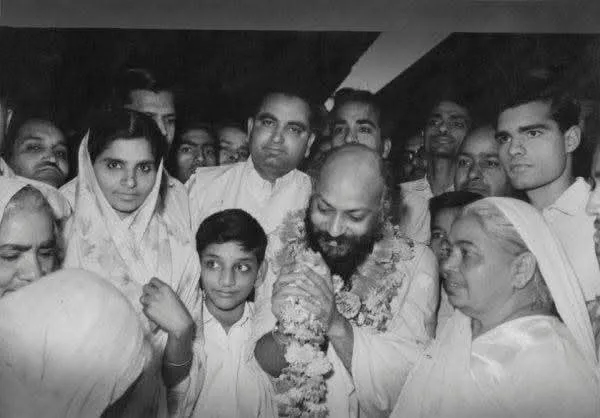
According to Osho, your personality toward God is split by the mind’s inbuilt duality: one part bows in reverence, worship, devotion; the other simultaneously carries irreverence, doubt, even denial. Seeing both at once dissolves the conflict; then neither reverence nor irreverence remains, and what flowers is surrender—compassionate, cool, beyond the storm of love-versus-hate.
Inside you, one side believes and bows while another side doubts and resists; noticing both lets them drop, leaving quiet trust.
From the Discourses
Passages where Osho speaks to this question — each links to the complete discourse.
Osho, there are two parts to my personality: one lies down on the ground every day and offers you full prostrations and feels happy doing so; and the other, almost every day, blurts out, “How do you know that this is God!” Are both of these parts of my ego, and is reverence born only in egolessness?
Where does the mistake happen? If you get entangled in whether this person is God or not—whether this stone image is truly God’s image or not. If you obsess over this, gradually you will find that you have let go of faith’s hand and grasped doubt’s. Doubt is within you, and faith is within you; you hold the hand of faith—yet you have firmly taken doubt’s hand and are walking with it. And remember, do not hold faith’s hand so tightly that it becomes a prison. Do not tie knots, do not take binding vows. Do not turn it into a bondage that cannot be shaken off. This too is to be left—sooner or later it must be left. And if you keep this in mind—that sooner or later this too will go—then when doubt itself has gone, what will you do with faith? Faith was a medicine for the…
Osho, what is more important in your religion -- to be thyself or to know thyself?
Gurdjieff calls them "selves; it is the same. You can call personalities selves or egos, and you can start looking for them -- it is a tremendously charming game to look at them. In the evening, you decide that tomorrow morning you are going to get up at five. This you have been deciding for many years, and you know it -- that every evening you decide.... But this night is different! -- that too, you know. Every night you have been saying, "This night is different; tomorrow I am going to get up. There is a limit to everything!" But all these things you have been saying every night. You are not saying a single new thing, but you are not aware of it. And at five o'clock when the alarm goes, you just press the button; and you are angry at the clock. You may throw the clock,…
Osho, what is god?
God has to be freed from all concepts of personality. Personality is a prison. God has to be freed from any particular form; only then he can have all the forms. He has to be freed from any particular name so that all the names become his. Then a person LIVES in prayer -- he does not pray, he does not go to the temple, to the church. Wherever he sits he is prayerful, whatsoever he is doing is prayerful, and in that prayerfulness he creates his temple. He is always moving with his temple surrounding him. Wherever he sits the place becomes sacred, whatsoever he touches becomes gold. If he is silent then his silence is golden; if he speaks then his song is golden. If he is alone his aloneness is divine; if he relates then his relating is divine. The basic, the most fundamental thing is to…
That which brings us together sets us apart
For them there is no short-cut. And all that is great belongs to that category. Only small things can be attained quickly. Coffee can be instant -- -- love cannot be. Instant love cannot be love. Instant simply means you are not even ready to pay the little patience for it. One should learn to be patient -- to be ready to wait with open doors, with a welcoming heart, but not in a hurry, not demanding, not forcing things. And the miracle, the paradox, is that the less you force things, the more quickly they happen. The more you force them, the longer it takes. Because meditation has to be learned -- and meditation only means stilling of the mind, the silencing of the mind -- you cannot be in a hurry. If you are in a hurry your mind will remain in a turmoil. You will be jumping…
(God is less a personality and more a presence, a perfume, Osho reminds us.) The flower has a form, a personality. The fragrance is formless, it has no personality. It is there, it exists, but it exists not in a fixed form, it exists in a formless way. And that's what god is, a godliness. And the experience of this fragrance comes through meditation. There is no other way, there never has been, there never will be. The really religious person has only one thing to do, and that is to become meditative. And by using the very word 'meditation' there is a possibility of moving in a wrong direction -- because English has no exact word for 'dhyana'; meditation only comes close to it. English has three words: concentration, contemplation, meditation. Concentration is of the mind.