
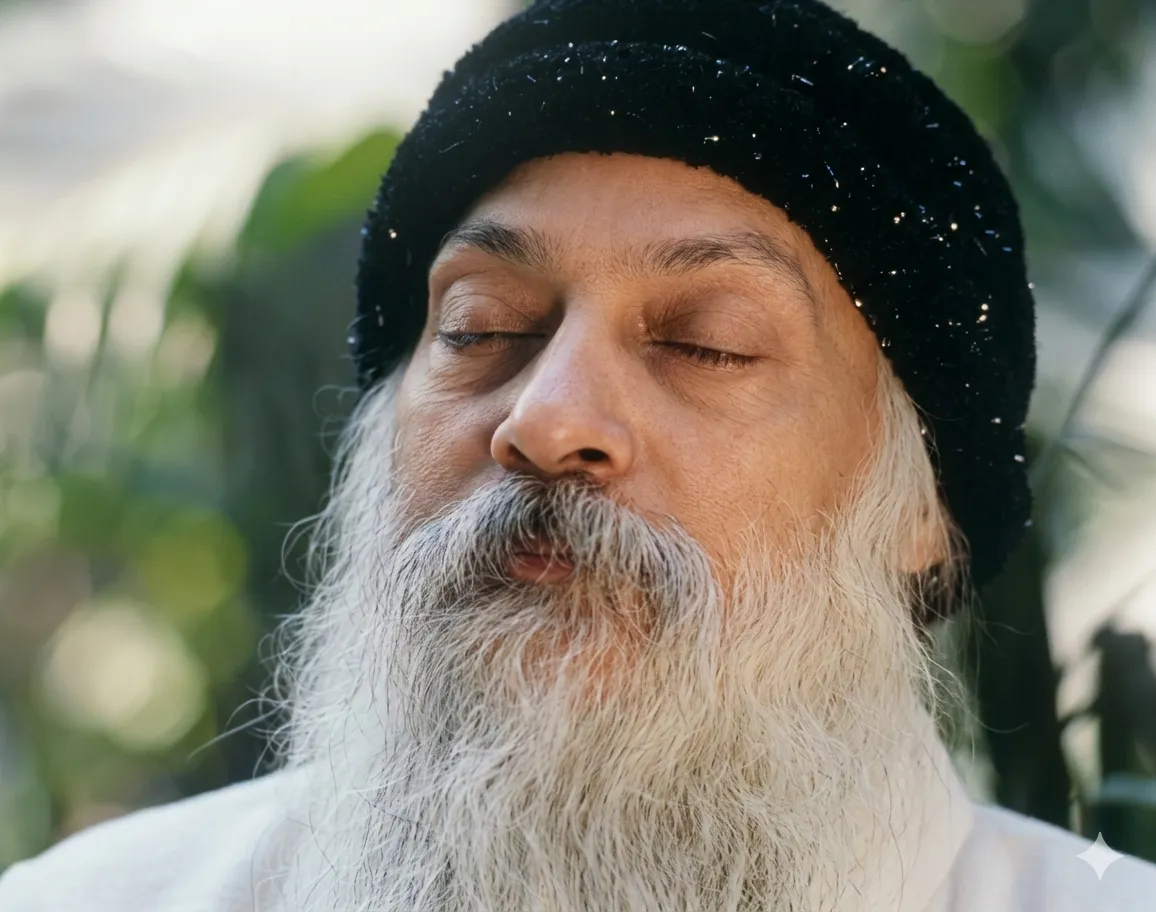
According to Osho, religion offers no benefits when taught as doctrines; it can’t be taught—only caught. Preaching myths or rote mantras dulls intelligence and breeds cynicism. Instead, let children witness a lived religiousness—love, prayerfulness, gratitude, celebration. In such a vibrant atmosphere they naturally imbibe the spirit, keeping their minds sharp and hearts open to an authentic, experiential reverence for life.
Don’t cram kids with religious stories; be loving, joyful, and prayerful yourself, and they’ll copy the feeling, not the words.
From the Discourses
Passages where Osho speaks to this question — each links to the complete discourse.
Osho, is it not good to teach the children something of religion? Will it not benefit them fo help them know something about jesus christ?
Yes, when you are praying, let the child be present there. When you are dancing, let the child be present there. And the child will soon join you -- how can the child resist joining a dance? Let the child know that life has grace in it; let the child know that life is not only suffering but much ecstasy too. Let the child know that laughter is good, divine, that love is good, godly. And these things are not to be taught: they have to be imbibed by the child. You have to create the vibe. And then sooner or later the child will start becoming aware of many more things which cannot be seen just by the physical eyes. Because you will have given him more sensitivity. Otherwise you can go on teaching him, and nobody even remembers. How much do you remember that was taught to you?…
Question: OSHO, HOW CAN WE TEACH CHILDREN TO BE MORAL AND RELIGIOUS? Watch the intelligence of the children. And whenever you find intelligence, rejoice in it and help them and tell them that "This is the way you should go on moving." Dad criticized the sermon, Mother thought the organist made a lot of mistakes. Sister did not like the choir's singing. But they had second thoughts when the young son piped up, "Still, it was a pretty good show for twenty pence." The owner of a chicken farm wanted to make his son behave better, so he devised an object lesson. "Do you see, my son? The chickens that were bad were eaten by a fox." "So?" replied his son. "If they had been good, we would have eaten them!" Two six-year-olds were examining an abstract painting in a gift shop.
Yet we all collect borrowed knowledge. And we mistake this collecting for something religious. What do we do with the Gita or the Koran or the Bible? We read them, memorize the words. Those words get stored in our memory. When life throws questions at us, answers come from memory. Those answers are utterly false. Recently I went to an orphanage. The organizers told me, “We impart religious education here.” I said, “I am amazed—I have never heard that religion can be taught! Spiritual practice can be done, but religious education has never been and never will be. If religion could be taught, we would have made the world religious long ago. What was the difficulty? Science can be taught; the world is becoming scientific. But there can be no education in religion.” Do you think love can be taught?
Many questions have come before me. First of all, this morning I said: what we do not know, we should know well that we do not know. In this connection someone has asked: should we not tell our children that God exists? Should we say nothing to them about religion? Should we not give them any belief about the Atman? Such questions have been asked. What we do not know—if we wish to give it, will we be able to give it? And that which is unknown even to us—will teaching it, coming from us, create reverence for us in the child’s mind? Will this not be the beginning of untruth? And can the knowing of God ever be erected upon untruth? Can we imagine that upon untruth a child will ever become religious? This is exactly how the world has become irreligious.
The education of the young man who has just completed his university training these days is thoroughly incomplete. He is absolutely unaware of what throbs at the core of his being, at the heart of life itself. He has no understanding of truth or of beauty; he is totally unacquainted with love. He enters the world with certain trivial facts he has learned and these are all he has to live with, all he has to live by. This kind of a life never brings him peace, and his consciousness gradually becomes suffocated by a sense of purposelessness, of superficiality, of futility. The living creativity that is life is lost in a desert of pointlessness -- and his reaction to this is anger and frustration towards the world in general. This is what happens to a non-religious mind.