
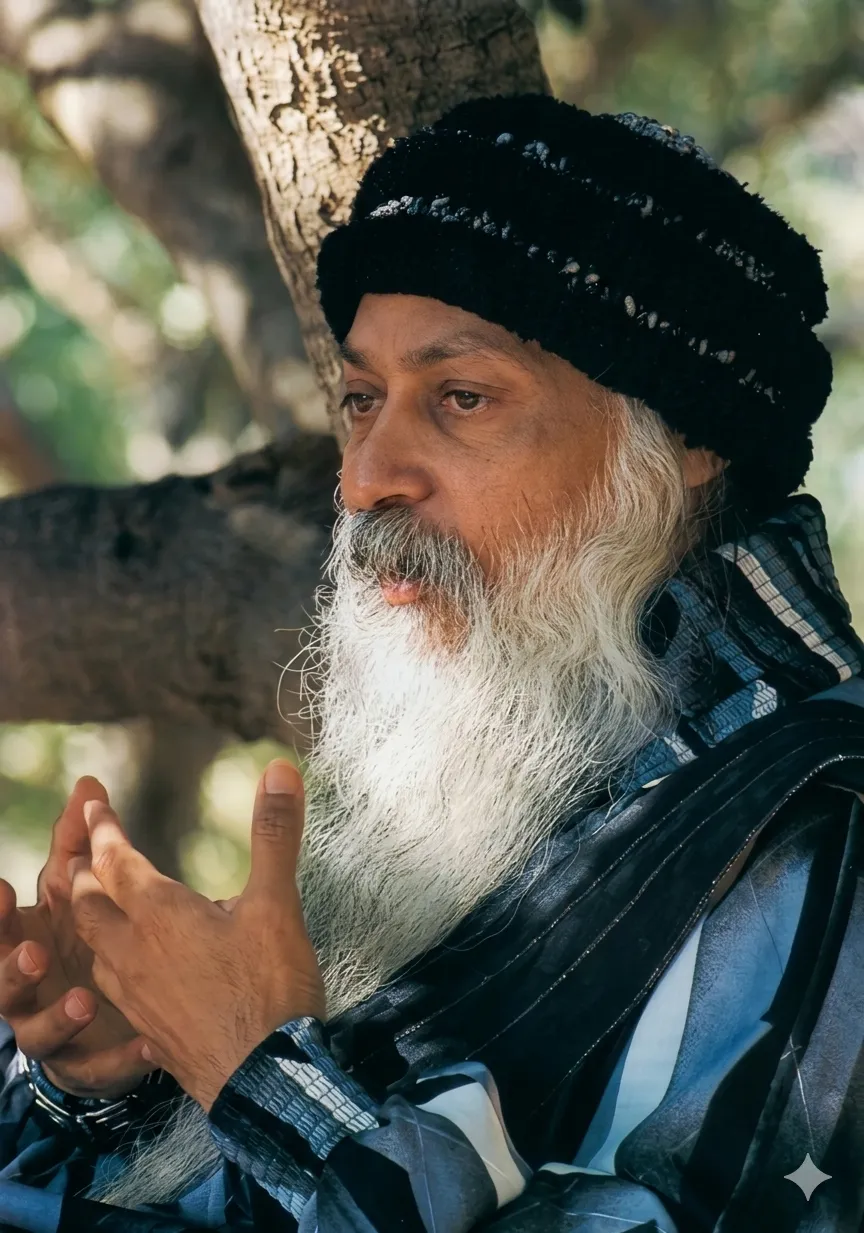
Osho's perspective on Mantras
When Osho Spoke About Mantras
Passages from the discourses where this theme comes alive.
Osho, you told the story about the parrot-like rote chanting of the Gayatri Mantra and the Namokar Mantra. You want to stop this parrot-chanting. Is that what the Gayatri Mantra is? Is that what the Namokar Mantra is?
Achyut! Exactly so. Where all mantras fall silent, there the real mantra is born. The mantra you repeat has no value. If it is repeated by your tongue, it cannot be worth more than the tongue that repeats it. The Om you hum will be smaller than you. There is another Om that does not arise from your humming—the humming from which you arose. There is another Om whose resonance envelops the whole universe, from which the world is fashioned. To hear that Om, you don’t need to hum. To hear that Om, all humming must cease; speech must fall utterly silent; thoughts dissolve; no ripple remains in the mind—then suddenly, in amazement, you will hear: a music is playing within! It has been playing forever. But you were filled with your own noise and could not hear it. And sometimes, when you slip out of worldly noise, you fill…
दूसरा प्रश्न: ओशो, आपने गायत्री मंत्र और नमोकार मंत्र के तोता-रटन की कहानी सुनाई। इस तोता-रटन को आप बंद करवाना चाहते हो। क्या यही गायत्री मंत्र है? क्या यही नमोकार मंत्र है?
अच्युत! ऐसा ही है। जहां सारे मंत्र शांत हो जाते हैं, वहीं असली मंत्र पैदा होता है। जो मंत्र तुम दोहराते हो, उस मंत्र का कोई मूल्य नहीं है। तुम्हारी जबान से दोहराया गया, तुम्हारी जबान से ज्यादा मूल्यवान हो भी नहीं सकता है। जिस ओंकार को तुम गुनगुनाते हो, तुम्हारा ओंकार तुमसे छोटा होगा। एक और ओंकार है, जो तुम्हारे गुनगुनाने से पैदा नहीं होता--जिसकी गुनगुनाहट से तुम पैदा हुए हो। एक और ओंकार है, जिसका नाद सारे जगत को घेरे हुए है; जिससे जगत निर्मित हुआ है। उस ओंकार को सुनने के लिए गुनगुनाने की जरूरत नहीं है। उस ओंकार को सुनने के लिए सब गुनगुनाना बंद हो जाए, वाणी मात्र शांत हो जाए, विचार लीन हो जाएं, मन में कोई तरंग न रहे, तब अचानक तुम चकित होकर सुनोगे--एक संगीत बज रहा है भीतर! सदा से बजता रहा है। …
Beloved Osho, different religions have different mantras, such as: om namo shivaya namo, arihanta nam, allahu akbar, om mani padme hum. In what state of being were such great mantras born? How and in what way are they related to our various inner centers? How should a seeker select a mahamantra most appropriate to him?
The search for power brings religion into the confines of the world. And it makes no difference whether it is Jainism, Hinduism, Buddhism or Mohammedanism. As long as your interest is in the miracles, understand well that the quest for religion has not arisen in you yet. You are in awe when some sadhu, some baba, some holy man, creates ashes in the palm of his hand. What are you going to do with the ashes? There are plenty of ashes lying on the roads, or you can make ashes at home for little cost by burning coal. But if someone creates ashes in his palms, and this so impresses and delights you that you are moved to become his follower, then you are mad! It is worth understanding the nature of this fascination. That nothing is going to change from this creation of ashes is something that you also…
Osho, different religions have discovered different great mantras—like Om Namah Shivaya, Namo Arihantanam, Allahu Akbar, Om Mani Padme Hum. In what state did such great mantras descend, and how are they related to the inner centers? And how should a seeker choose the mantra suitable for himself?
It happened that when Vivekananda came to Ramakrishna, his household was in dire straits. His father had died—and, being a worldly, whimsical man, had left many debts. There was not even food enough. If somehow there was food, it was not enough for both mother and son. Vivekananda would tell his mother, “A friend has invited me today,” so that she would eat; otherwise she would feed him and remain hungry. Saying so, he would wander the lanes, then return home cheerful, belching, as if well-fed—no friend had invited him—but to make his mother feel at peace that he had eaten well so she could eat without worry. Ramakrishna came to know and said, “You are a great fool. You come daily to Mother Kali’s court—why don’t you ask? Such a small matter—why suffer needlessly?” At Ramakrishna’s insistence, Vivekananda said, “If you say so, I will ask.” Ramakrishna sat outside…
प्रश्न: ओशो, अलग-अलग धर्मों ने अलग-अलग महामंत्र पाए हैं, जैसे ॐ नमो शिवाय, नमो अरिहंताणं, अल्लाहो अकबर, ॐ मणि पद्मे हुम्। तो ऐसे महामंत्र कौन सी अवस्था में उतरे हैं और इनका भीतर के कौन-कौन से केंद्रों से कैसा संबंध है? और साधक इनमें से अपने लिए योग्य महामंत्र कैसे चुने?
… पिता चल बसे थे। और पिता संसारी मनमौजी आदमी थे, तो बड़ा कर्ज छोड़ गए थे। घर में रोटी का भी इंतजाम न था। किसी तरह रोटी जुटती थी, तो मां और बेटे दोनों के लिए काफी नहीं होती थी। तो विवेकानंद मां को कहते कि मुझे किसी मित्र ने निमंत्रण दिया है आज, ताकि मां रोटी खा ले, अन्यथा विवेकानंद को खिला देती और खुद भूखी रह जाती। तो ऐसा कहकर आस-पास की गलियों में चक्कर लगाकर वहां से बड़े प्रसन्न और डकार लेते लौटते थे। न किसी मित्र ने निमंत्रण दिया है, लेकिन मां को दिखाने को कि भोजन कर आया हूं, बड़ा प्रसन्न हूं, बड़ा अच्छा भोजन था, ताकि मां भी निश्चिंतता से भोजन कर ले। रामकृष्ण को पता लगा तो रामकृष्ण ने कहा, तू भी बड़ा मूर्ख है। यहां रोज काली के दरबार में उपस्थित होता है तो मांग क्यों नहीं लेता? …
I always thought that you were against politicians, so I was very much surprised to know that you have blessed indira gandhi. Beloved master, would you like to say something about it?
I am against the political mind. The political mind means the cunning mind, the political mind means the murderous, violent mind. The political mind means the mind that is only interested in dominating others, that is only interested in being in such a position where millions of people's lives are in his hands, this way or that. The politician's mind is the mind of the perfect egoist. I am certainly against the political mind. I would like a world which does not go round and round the political mind. I would like a world which has the religious quality, not the political quality. At least I would like the political quality of the mind to recede into the background. At the center should be the creative mind. Politics is destructive. But this cannot happen right now. For millions of years politics has been in the center, so this cannot happen…
In what state of being were great mantras born and how are they related to our inner centers?
definitionWhat is the state in which great mantras descend and how are they related to the inner centers?
definitionProfound Quotes on Mantras
Explore our structured collection of meaning-mapped quotes regarding Mantras.