
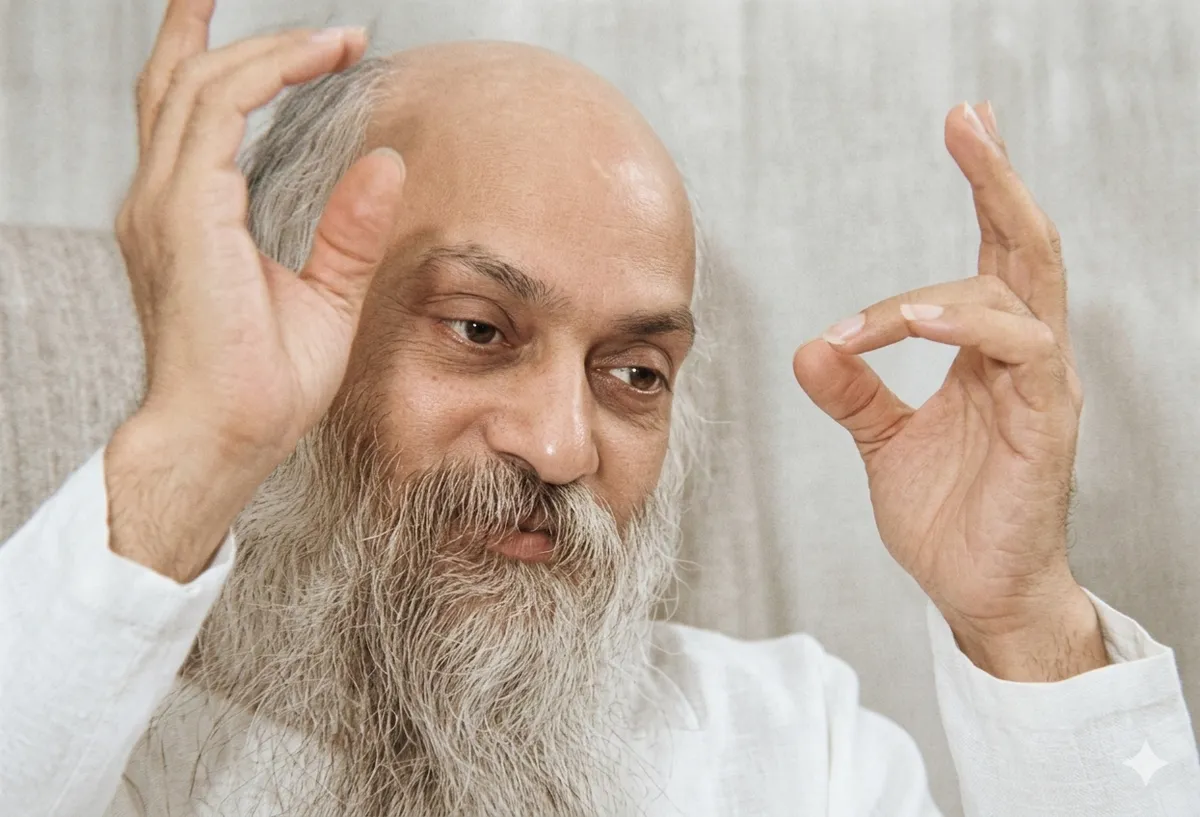
Yes—besides watching your mind, you can also reach God by loving so totally that you forget yourself.
From the Discourses
Passages where Osho speaks to this question — each links to the complete discourse.
Osho, practicing witnessing is difficult. Is there no other way to reach the divine besides witnessing?
There is. We speak of it every day. This very language of compassion, this way of grace, is the other means. Bhakti, devotion, is the other way. There are two ways: sakshi—sakshi means meditation; and bhakti—bhakti means feeling. Sakshi means: stay awake and watch. And bhakti means: drown—drop all watching, and the rest. Bhakti means: to sink into utter forgetfulness. To be so absorbed in prayer, in dance, in song, as if drunk; you forget; there is self-forgetfulness. Self-forgetfulness is one means; self-remembering is the other. The processes are different, but the end is one. The paths differ; the destination is one. Self-remembering means witnessing. Keep remembering yourself—do not forget for even a moment. Keep yourself separate, remain apart from everything. Whatever appears before you, remember: it is other than me. Do not let identification form. No matter what it is—even if the divine appears before the witness—the witness remains…
Osho, witnessing and absorption appear mutually opposed. Are they really opposed?
And if you begin with absorption, at first it feels, “I am becoming absorbed. Ah, how I am descending into rapture!” But so long as the I is there, what absorption is there? You are only persuading yourself. The I will return again and again. Slowly, as absorption deepens, the I melts. Then absorption remains—you are drowned, but there is no one left who is drowned. The I-sense is gone. And where the I-sense is gone, witnessing is born; it cannot but be. Therefore, Jagdish Dave, choose one of the two and start. And remember, this is not an intellectual question; it is existential. The secret opens only through experience; it has always opened that way. Say what you like, explain as you wish—this is not a matter of explanation. Choose whichever is dear to you. Know yourself a little; observe your inclinations, your temperament. And whichever attracts you… If…
ओशो, साक्षीभाव और लीनता परस्पर-विरोधी दिखाई देते हैं। क्या वे सचमुच विरोधी हैं?
और अगर तल्लीनता से शुरू करोगे तो पहले ऐसा लगेगा, मैं तल्लीन हो रहा हूं। अहा, कैसी तल्लीनता में उतर रहा हूं मैं! शुरू-शुरू में लगेगा मैं तल्लीन हो रहा हूं; लेकिन जब तक मैं है, क्या खाक तल्लीन हो रहे हो! भुला रहे हो अपने को, समझा रहे हो अपने को। लेकिन मैं लौट-लौट आएगा। धीरे-धीरे जैसे तल्लीनता बढ़ेगी, मैं पिघलेगा। फिर तल्लीनता रह जाएगी। डूबे तो रहोगे, लेकिन कोई बचेगा नहीं जो डूबा है। मैं-भाव गया। और जहां मैं-भाव गया वहां साक्षी पैदा हो जाता है, साक्षी बच नहीं सकता। इसलिए जगदीश दवे, दो में से कोई एक चुन कर चल पड़ो। और खयाल रखो, यह प्रश्र्न बौद्धिक नहीं है, यह प्रश्र्न अस्तित्वगत है। अनुभव से ही राज खुलेगा, अनुभव से ही खुलता रहा है। कितना ही कहो, कितना ही समझाओ, कहने और समझाने की बातें नहीं हैं। दो में से कोई एक चुन लो, जो प्रीतिकर लगे। अपने को पहचानो थोड़ा; अपने लगाव, अपने रुझान परखो थोड़ा। और जो प्रीतिकर लगे...। …
Osho, last night you spoke about witnessing as a method; other times I have heard you speak about becoming a thing totally, being totally involved in any given situation. Usually I am at a loss as to which of these two to follow: whether to stand back and witness in a detached why or to become something totally -- for example, when there is anger or love or sadness. Are these not two opposite paths? Are they both for different kinds of situations or for different types of people? When should one do which?
There are only two deep things in the body -- sex and food. Nothing is more than these two, because food is needed for individual survival and sex is needed for race survival. Both are survival mechanisms. The individual cannot survive without food and the race cannot survive without sex. So sex is food for the race and food is sex for the individual. These are the deepest things because they are concerned with your survival -- the most basic things. You will die without them. So if you are fasting and just witnessing, then you have touched the deepest sleep. And if you can witness without being identified or bothered -- the body is suffering, the body is hungry, the body is demanding and you are just witnessing -- suddenly the body will be different. There will be a discontinuity between you and the body; there will be a…
Osho, if there were only one single method of sadhana in your ashram, wouldn’t it be more convenient for seekers?
These are two styles: either you support yourself—and then there is no need of another. Fine; the matter is finished. Support was the whole issue, and you supported yourself. Have you noticed: a mother’s love is strongest for the child who is the weakest. This is exactly the opposite of economics. But economics and the scripture of love are opposite. According to economics, love should be for the strongest, the most intelligent, the most skilled. No—mother knows the strong, the intelligent, the skilled will manage for themselves. They have no need. It is the weak who are less intelligent, who are more likely to stray, who may fall—the mother takes care of them. It often happens that the sick child becomes dearest to the mother—more than the healthy ones. The experience of God comes to those who stagger in helplessness. That is why in the religions of Buddha and Mahavira…
Someone has asked, “Is there an inner relationship between shraddha and witnessing?”
Certainly. Shraddha is the door; the witness—the image enthroned in the temple. Without shraddha no one has ever reached the witness, nor reached truth. Without shraddha you can be a pundit, not a knower. Without shraddha you can be a believer, not one who has experienced. So there are two kinds of wanderers in the world. One we call atheists; the other we call theists. Both wander. Both are filled with belief—one for, one against. Neither the atheist knows that God is, nor the theist knows that God is. That is why I place the religious apart from both; he is neither atheist nor theist. He has slowly attempted to see. Your notions are not needed at all for seeing. Your notions become obstacles; your prejudices bring hindrances. You set out having assumed something in advance; because of that, seeing does not remain pure. If you have already assumed, you…
पूछा है, ‘श्रद्धा और साक्षित्व में कोई आंतरिक संबंध है?’
निश्चित ही। श्रद्धा द्वार है; साक्षी--मंदिर में विराजमान प्रतिमा। श्रद्धा के बिना कोई कभी साक्षी तक नहीं पहुंचा, न सत्य तक पहुंचा है। श्रद्धा के बिना तुम पंडित हो सकते हो, ज्ञानी नहीं। श्रद्धा के बिना तुम विश्वासी हो सकते हो, अनुभवी नहीं। तो दुनिया में दो तरह के भटकते हुए लोग हैं। एक, जिनको हम नास्तिक कहते हैं; एक, जिनको हम आस्तिक कहते हैं। दोनों भटकते हैं। दोनों विश्वास से भरे हैं--एक पक्ष में, एक विपक्ष में। न नास्तिक को पता है कि ईश्वर है, न आस्तिक को पता है कि ईश्वर है। इसलिए मैं धार्मिक को दोनों से अलग रखता हूं; वह तो न नास्तिक है, न आस्तिक है। उसने तो धीरे-धीरे देखने की चेष्टा की। तुम्हारी धारणाओं की कोई जरूरत ही नहीं है देखने में। तुम्हारी धारणाएं बाधा बनती हैं, तुम्हारे पक्षपात अड़चन लाते हैं। तुम कुछ मान कर चल पड़ते हो, उसके कारण ही देखना शुद्ध नहीं रह जाता।