
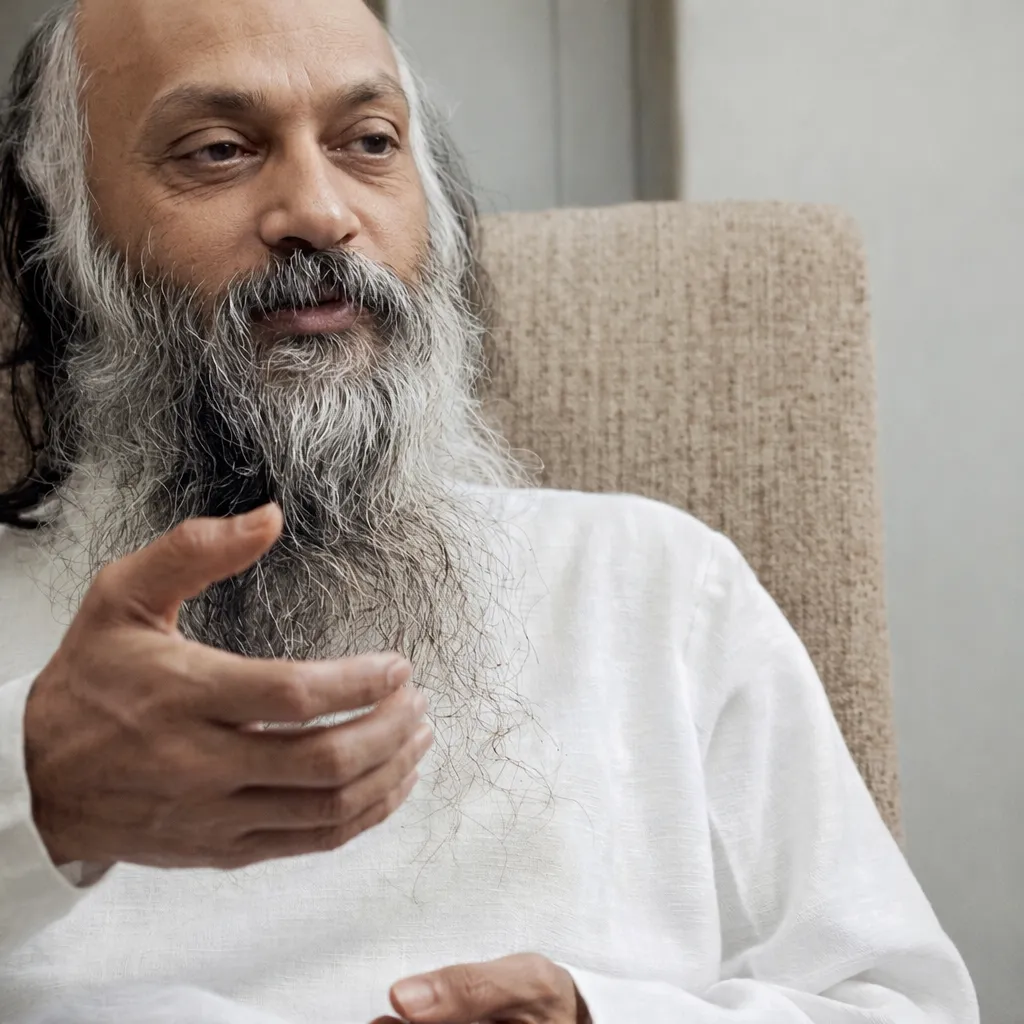
Don’t copy yoga poses to become calm; become calm inside and your body will naturally sit the right way.
From the Discourses
Passages where Osho speaks to this question — each links to the complete discourse.
Is the practicing of traditional asanas helpful for meditation?
Why was Mahavira sitting in that position? Buddha's posture is all right, but Mahavira's posture is very absurd. He was not practicing it; it came. Something happened within him and his body took on a certain posture -- although a very absurd posture. If he had been practicing asanas he would have been sitting just like Buddha, because that was the traditional meditation posture. But he was in an attitude of letgo, and samadhi came and created a posture that was particularly required for his body and his individuality. Everyone will need to express himself individually. No person is like any other and no one can be. An individual is unique so that everything that flowers in him will flower in an individual and unique way. If you impose something from without, then it will be a generalized conception; it can never be fitting and harmonious to your situation. So…
Osho, at the Nargol camp you said that yogic asanas, pranayama, mudras and bandhas were discovered in meditative states, and that in different states of meditation different postures and gestures arise by themselves, from which one can tell the seeker’s inner condition. Conversely, if those postures and gestures are done deliberately, the same meditative mood can be created. Then can meditation be attained through the practice of asanas, pranayama, mudras and bandhas? What is their importance and use in meditation practice?
Then, if it begins within, it can be understood. Suppose a seeker is sitting in meditation and I feel that his crying wants to burst forth, but he is holding it back. I can see that if he cries for ten minutes, a movement will happen—a catharsis, a cleansing. But he is restraining himself so that the crying does not come out. If we tell this seeker, “Now don’t hold back—cry from your side; cry,” then for two minutes he will cry as if acting, but from the third minute his crying will become right and authentic, because crying wanted to pour out from within and he was preventing it. His act of crying will not bring crying; it will break the suppression, and what was flowing within will flow out. Similarly, a seeker may be in a state to dance but is standing stiffly. If we say to him,…
In the nargol meditation camp you said that the practices of yoga -- asanas, pranayamas, mudras and bandhas -- were discovered in the state of meditation. In different states of meditation, different postures are formed by the body from which the depth of meditation of the meditator could be told. Conversely, can the same inner state be brought about by forming the necessary postures? In that case, can meditation be attained by the use of various asanas, pranayamas, mudras and bandhas? What is their use and significance?
First came the experience of meditation. With the experience of meditation it was found that the body assumed many postures. Actually, whenever the mind is in a particular state the body takes an appropriate corresponding posture. For instance, when you are filled with love your face, your expression, is one way, and when you are angry your expression becomes altogether different. In anger you grind your teeth and clench your fists and the body is ready for fight or flight. When you are in a forgiving mood the eyes are soft and the palms of the hand open. When a man is filled with forgiveness his fists will never clench. Just as clenching the fist is a preparation to fight, opening the fist and spreading out the palm is an indication of freedom from the urge to fight; it is an assurance of protection. To clench the fist is to…
Those who want to enter the domain of energy, those who want to go on a pilgrimage to the temple of the supreme energy, they will have to shed all fear, and if the body begins to tremble and shake or begins to dance, allow it to happen with ease and spontaneity. You will be surprised to know that all the techniques of yogic asanas -- body postures -- were discovered accidentally in meditation, in the various states of meditation. It is not that someone created them through thinking and deliberation. They were not created independently. In the state of meditation the body took different positions first, and then they were recognized as yogic postures. And gradually an association between the body and mind was revealed which said that when the mind is in a particular state, the body follows it with a particular posture of its own.
Oh yogi, assume the posture of contentment and modesty.
PICK UP THE CARRYING BAG OF DIGNITY AND HONOR, AND APPLY THE SACRED ASH OF MEDITATION. ESTABLISH DEATH AS YOUR BEDROLL; MAKE A MAIDEN OF YOUR BODY. LET EXPERIENCE BE YOUR STAFF OF LIBERATION, AND CONSIDER THE UNITY OF ALL AS YOUR FIRST PRINCIPLE. TO CONQUER THE MIND IS TO CONQUER THE WORLD. IF YOU MUST BOW, BOW TO HIM. HE IS THE PRIMAL BEING, PURE, WITHOUT BEGINNING OR END. HE IS THE UNSTRUCK SOUND. HE IS IMMUTABLE THROUGH ALL TIME. MAKE KNOWLEDGE YOUR PLEASURE AND COMPASSION YOUR STOREHOUSE. MAKE A CONCH SHELL OF THE ETERNAL MUSIC PLAYING IN EVERY BEING. HE ALONE IS A MASTER IN WHOM ALL BEINGS ARE INTERTWINED, WHILE THE SEARCH FOR SUPERNATURAL POWERS IS A FALSE PATH. THE LAW OF UNION AND SEPARATION GOVERNS ALL THINGS, AND DESTINY DETERMINES OUR JUST INHERITANCE. IF YOU MUST BOW, BOW TO HIM. HE IS THE PRIMAL BEING, PURE,…