
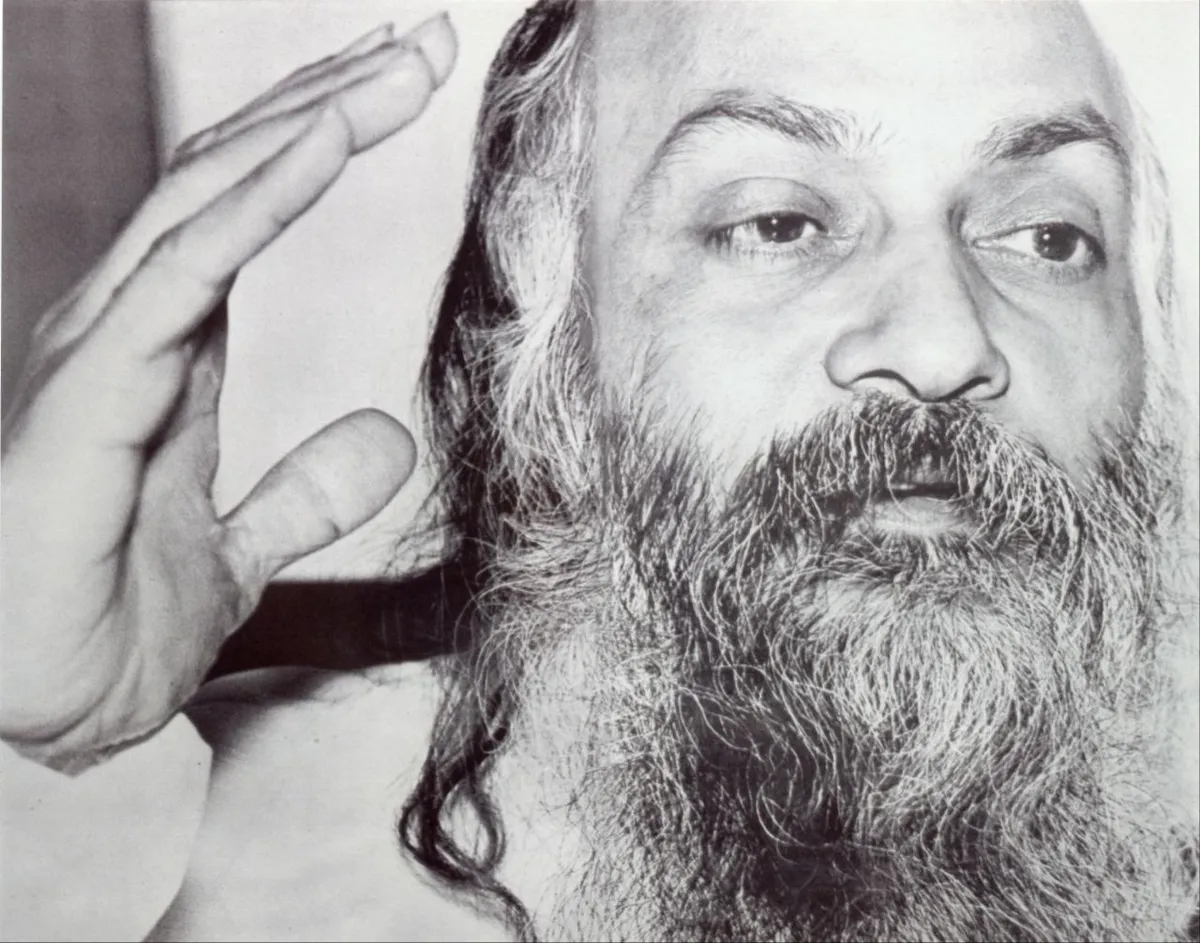
Osho's perspective on Meditativeness
When Osho Spoke About Meditativeness
Passages from the discourses where this theme comes alive.
Osho, meditativeness and science are difficult to reconcile. Yet painting a picture, writing a poem, and solving a scientific problem all bring the same joy. The same joy! Why is it so difficult to be meditative and a scientist? Why has there never been a society in which the inner and the outer sciences, the science of gentleness and love and the science of aggression and death, live in harmony?
Mahavira, twenty-five centuries ago, used to make each of his statements with a 'perhaps'. If you asked him, "Is there a God?" he would say, "Perhaps." In those days it was not understood at all -- because how can you say, "Perhaps"? Either God is or is not. It seems so simple and so logical: "If God is, God is; if he is not, he is not. What do you mean by 'perhaps'?" Now it can be understood. Mahavira was using the same language in religion that is being used by Albert Einstein in physics. Albert Einstein calls it the theory of relativity. Mahavira has called his philosophy exactly the same: SAPEKSHAWAD -- the theory of relativity. Nothing is certain, everything is flexible, fluid. The moment you have said something, it is no longer the same. Things don't exist, Mahavira says, but only events. That's what modern science is saying,…
Science has developed tremendously in this last century, but science often seems so heartless. You talked about meditation as the inner science. Can you please talk about science and meditation. Shouldn't they go hand in hand?
They should go hand in hand, but you have to understand that neither science can become meditative nor meditation can become just science. They are two dimensions of human existence. A man can be both: he can be a scientist in his lab, and he can be a meditator in his home. While he is meditating, he has to forget all about science; while he is doing scientific research, he has to forget all about meditation. Only then can they go hand in hand. There are very complex and subtle problems in it. The problem is that science has to be objective and meditation has to be subjective. Science can experiment; in meditation you cannot experiment, you can only experience. In science the method is observation; in meditation the method is witnessing. And there is a great difference. Science has an object before it. It can dissect it, it can…
Osho, why have we not been able to create a society which combines both polarities -- philosophy and poetry, science and religion? Is there a possibility of the total meeting of these polarities? Which land is more fertile for this meeting -- east or west? Is this meeting possible only in an individual, or can it exist simultaneously in the society also? In which way can meditation be useful for this meeting? What are the factors which can help man to grow in both the dimensions -- science and religion?
But we are all identified. We go on saying, "I cannot believe, I cannot have faith, because I am a sceptic." Or someone says, "I cannot doubt because I am a religious man." This shows that your consciousness has become fixed, stone-like. It is not river-like, moving, flowing. Flow? Move! So the second point: the mind has to be trained not to be identified with instruments. Then you can use them. You can use a sword -- but if you so are identified that your hand has become the sword, then how can you have a rose-flower in your hand? Then you will say, "It is impossible! How can I have a rose-flower in my hand? My hand is a sword!" And there is no relationship between a sword and a flower. You can take the sword, you can take a flower. If your hand is free from identification, only…
Osho, what is meditation?
One would think that scientists would be very open-minded. That is not the case. As far as their subject is concerned, they are absolutely open-minded: they are ready to listen to anything contrary to their theory, and with absolute fairness. But except in that particular matter, they are more prejudiced, more bigoted than the ordinary, common man, for the simple reason that they have never bothered about anything else: they have simply accepted whatsoever society believes in. Many religious people brag about it: "Look, he is such a great scientist, a Nobel prize-winner," and this and that, "and yet he comes to church every day." They forget completely that it is not the Nobel prize-winning scientist who comes to the church. It is not the scientist who comes to the church, it is the man without his scientific part who comes to the church. And that man, except for the…
Profound Quotes on Meditativeness
Explore our structured collection of meaning-mapped quotes regarding Meditativeness.