
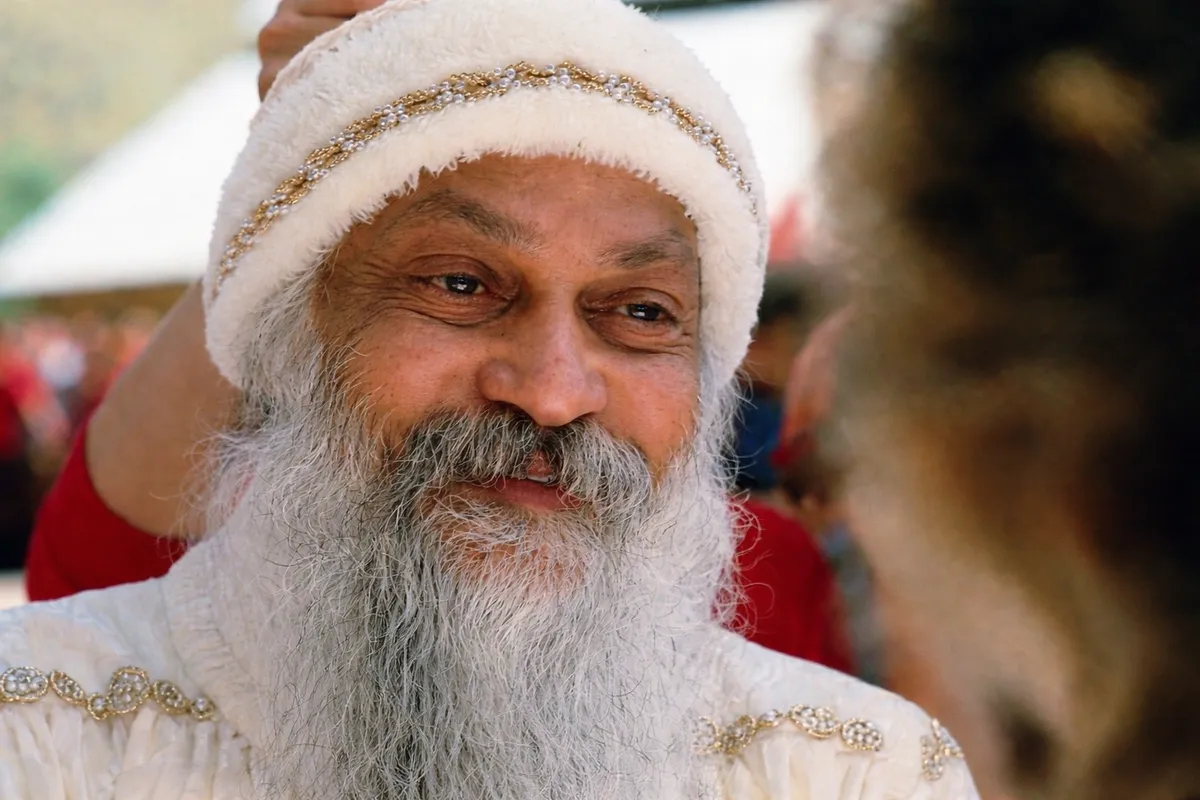
Be happy and whole by yourself first; then you can be with someone without needing them to fill your emptiness.
From the Discourses
Passages where Osho speaks to this question — each links to the complete discourse.
Should one first come to terms with one's own loneliness before entering into relationship?
Two lonely people are always facing each other, confronting. Two people who have known aloneness are together, facing something higher than both. I always give this example: two ordinary lovers who are both lonely always face each other; two real lovers, on a full moon night, will not be facing each other. They may be holding hands, but they will be facing the full moon high in the sky. They will not be facing each other, they will be together facing something else. Sometimes they will be listening to a symphony of Mozart or Beethoven or Wagner together. Sometimes they will be sitting by the side of a tree and enjoying the tremendous being of the tree enveloping them. Sometimes they may be sitting by a waterfall and listening to the wild music that is continuously being created there. Sometimes, by the ocean, they will both be looking to the…
Osho, you have said that to be a Hindu, a Jain, a Christian—this is all following behind some person, so it is all theft. But are “Hindu,” “Jain,” “Christian,” “Buddhist” merely borrowed personalities? And are these not distinct cultures grounded in eternal laws? Can there not be an auspicious flowering of life among these diverse cultures? Where do you see theft in this?
And so every religion keeps cutting man into fragments. Today on earth there are roughly three hundred religions. Man stands cut into three hundred pieces. Religion should unite; religion is not for division. But who divides? Does Mahavira divide? Does Muhammad divide? Only one of two can be true: either Mahavira is the divider, or the Jain is; either Muhammad divides, or the Muslim does; either Jesus is the disturbance, or the Christian is. It is my understanding that Mahavira, Jesus, and Muhammad are not the disturbance. Those whose own lives have found the peace beyond disturbance cannot become a disturbance in another’s life; they are a message of peace for others too. But when the follower steps in behind them… And there is a secret with the follower, a scientific formula worth understanding. It is a very amusing matter: often it is the opposite type who becomes the follower—often.…
ओशो, आपने कहा है कि हिंदू होना, जैन होना, ईसाई होना, यह सब किसी व्यक्ति के पीछे अनुगमन है, इसलिए यह सब चोरियां हैं। लेकिन हिंदू, जैन, ईसाई, बौद्ध क्या ये सब उधार व्यक्तित्व हैं? और क्या ये शाश्वत नियमों पर आधारित विभिन्न संस्कृतियां नहीं हैं? क्या इन विभिन्न संस्कृतियों के बीच जीवन का शुभ फलित नहीं हो सकता है? इसमें आप चोरी कैसे देखते हैं?
और इसलिए हर धर्म आदमी को खंडों में काटता चला जाता है। आज पृथ्वी पर कोई तीन सौ धर्म हैं। आदमी तीन सौ खंडों में कटा हुआ है। धर्म तो जोड़ना चाहिए, धर्म तोड़ने के लिए नहीं है। लेकिन कौन तोड़ता है? महावीर तोड़ते हैं? मोहम्मद तोड़ते हैं? दो में से एक ही बात हो सकती है--या तो महावीर ही तोड़ने वाले हैं, और या फिर जैन तोड़ने वाला है। या तो मोहम्मद ही तोड़ते हैं, या फिर मुसलमान तोड़ता है। या तो जीसस ही उपद्रव हैं, और या फिर क्रिश्चियन उपद्रव है। मेरी समझ है कि महावीर और जीसस और मोहम्मद उपद्रव नहीं हैं। क्योंकि जिनके अपने जीवन में उपद्रव की शांति हो गई, वे किसी दूसरे के जीवन में उपद्रव नहीं बन सकते हैं; वे दूसरे के जीवन में भी शांति का ही संदेश हैं। लेकिन उनके पीछे आने वाला अनुयायी जब खड़ा हो जाता है...। और अनुयायी के साथ एक रहस्य है। एक साइंटिफिक सूत्र अनुयायी का समझ लेना चाहिए। और यह बड़ा मजेदार मामला है, अक्सर विपरीत आदमी अनुयायी बनते हैं--अक्सर। …
I have come across Jaina monks who have renounced everything, even clothes -- naked they live -- but they are still Jainas. And when I say to them, "This is something! If you have renounced society why have you not renounced the knowledge that society, the same society, gave you? If you have renounced the family why have you not renounced all the conditionings that the same family imposed upon you? Why are you still a Jaina? That means nothing has been renounced; deep down you are the same person. The Christian becomes a monk, he leaves the home and goes to the monastery; somebody becomes a Buddhist, somebody takes the path of a Hindu or a Mohammedan -- but they remain the same people. By changing outer circumstances nothing is changed; the change has to happen inside. And the first step is to put the mind aside.
Why is it difficult? It is difficult because to feel your aloneness and yet be loving seems to be contradictory to the mind. The mind feels perfectly right: if you are loving, then forget about your aloneness, then be lost in togetherness. According to the mind that's what love is, it is the meeting with the other. But if you don't know what aloneness is, who is going to meet whom? Two empty shells will be meeting, two bodies will be meeting. But unless two souls meet and merge love never reaches to its ultimate crescendo. And one becomes a soul only when one knows the beauty of being alone. The mind is ready to say that if you want to be alone then be alone, forget all about love. The mind seems to be absolutely logical.
Osho, never before have I felt so much love and never before so alone. Thank you, Osho...
Carl Gustav Jung has made these words very famous. He divided people basically into two types: the introverts and the extroverts. That is a wrong division. People cannot be categorized that way. People cannot be pigeon-holed this way. I have never come across anyone who is just introvert -- he will die immediately, because he will have only the in-breath. I have never come across a person who is just extrovert -- he will die too. People are both. It is possible that one is more of an extrovert than an introvert, and vice versa. And that's what brings imbalance to your personality. One should be both simultaneously. One should be balanced. My sannyasins have to be extrovert introverts, introvert extroverts -- both together. This is one of the most important things to be understood, because in the past the monks have tried to be just introverts. They were called…