
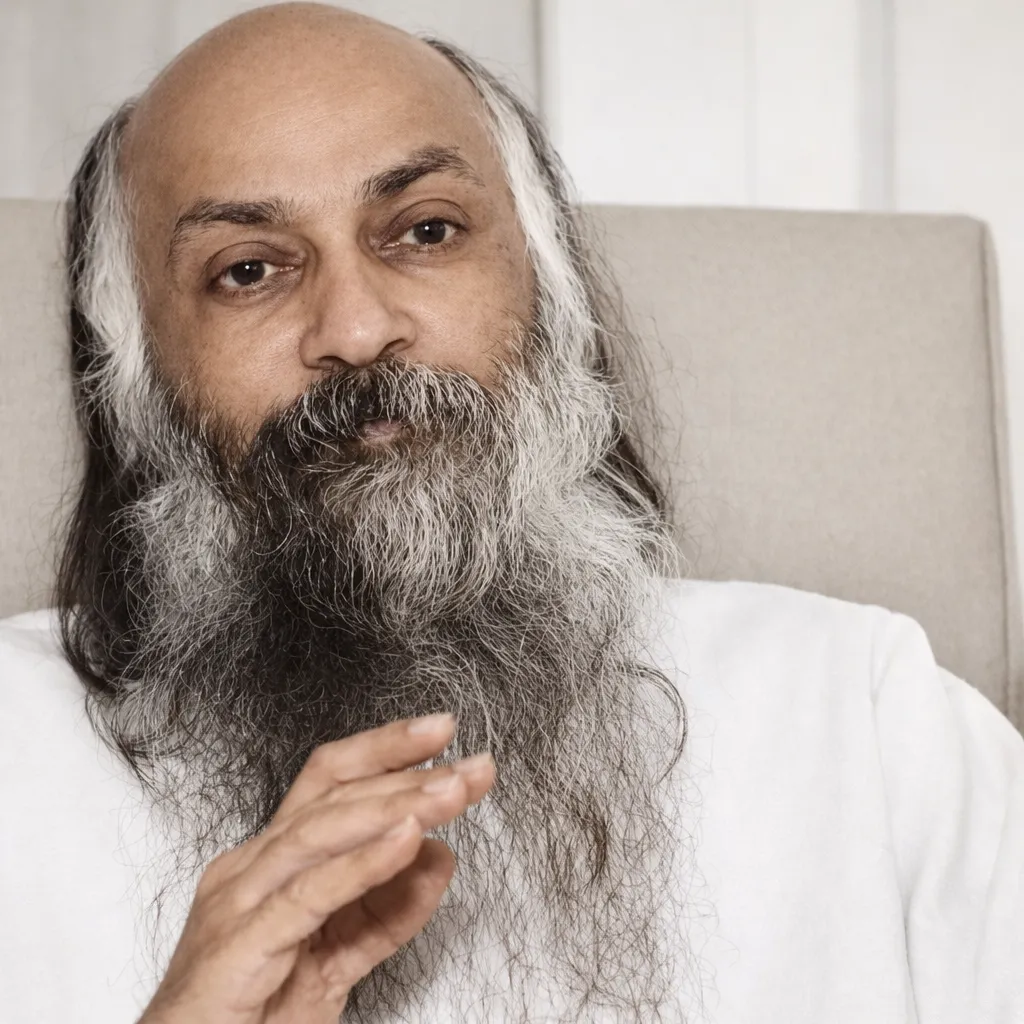
Don’t wait to be 100% sure about a teacher; be sure about your own longing for truth and take a brave step even with some doubt.
From the Discourses
Passages where Osho speaks to this question — each links to the complete discourse.
Beloved Osho, need one be absolutely sure about a guru to become his disciple?
Alan Watts has written about Gurdjieff and has called him a rascal saint -- because sometimes he would behave like a rascal, but it was all acting and was done knowingly to avoid all those who would take unnecessary time and energy. It was done to send back those who could only work when they were certain. Only those would be allowed who could work even when they were not certain about the master, but who were certain about themselves. And to surrender to a Gurdjieff will transform you more than surrendering to Ramana Maharshi, because Ramana Maharshi is so saintly, so simple, that surrender doesn't mean anything. You cannot do otherwise. He is so open -- just like a small child -- so pure, that surrender will happen. But that surrender is happening because of Ramana Maharshi, not because of you. It is nothing as far as you are…
Osho, to whom should one surrender? How can one be sure whom to surrender to? And until then, what should one keep doing?
Assurance will never come. Because the very mind that asks for assurance is, by nature, never satisfied. It will always find a flaw. You have passed by Buddha, by Krishna, by Mahavira. You are not on the earth for the first time. No one has ever been able to give you assurance. Had anyone ever satisfied you, you would not be here. You found faults in all—not because faults were there, but because you are adept, skilled at finding them. You can see errors even where there are none. Then the interpretation is in your hands. Facts are seen only by those whose mind is gone; you interpret the facts. And you see only what you want to see, what you can see. A friend of mine was a drawing teacher in a high school. For some reason he landed in jail. When he returned and I went to the…
How can I find a guru, a master? How am I to be certain that someone is the right master for me? What are the criteria to judge? How am I to know whether this is the man to lead me? How can I be certain? And if one is not certain, then how can one surrender?
Remember, no harm is going to happen to you if you surrender. Surrendering, in itself, is a miracle. Even if you have surrendered to a false master, you may learn many things from him. In this existence, nothing is a wastage. Even living with a false master is a learning. You are growing, you are becoming aware of certain things that you would never become aware of with an authentic master. You are maturing, you are becoming adult. And now, after learning from a false master, no false master will ever appeal to you again. At least you will now be able to judge who is false. You may not be able to judge who is true, but the other half has already been learned: you can now judge who is false. And this is something worth learning! Now you can eliminate the false teachers, and the true teacher will…
Osho, a master can always know the spiritual state of a seeker longing for liberation, but how can the seeker know whether the master has attained truth or not? And if the disciple ever feels he has lost the gamble in his choice, can he go to another master? Please clarify your view.
The scripture says: eat once a day—so they eat once. Two garments—so two garments. Don’t travel after sunset—so they don’t. Don’t drink water at night—so they refrain. Rise before dawn—so they rise. They rehearse what the scripture prescribes; through this, they match your idea and seem suitable. If your conception springs from the same scripture, the match is exact. Hence the odd spectacle: the guru of one sect does not seem like a guru at all to another sect. But to his sect he appears the supreme guru. Their conceptions match. Understand the trick. You study the same shastra… Consider an actress who came to see me: “What do you say about the Bhrigu Samhita?” I asked why. She said, “In Delhi they read my Bhrigu. I noted what they said of my past lives, and future too. Some things about this life were true. Others aren’t yet, but the…
What is the guru/disciple relationship?
Wittgenstein has said somewhere that what cannot be said can be shown. Saying needs no patience, but showing needs much patience. If I want to say something to you, I can say it this very moment. Your patience, your preparation is not needed. I can say it, and you will hear it. But if I want to show you something then you will have to make great preparations in order to see it. I cannot show it to you unless you have the capacity to see. The guru is basically not saying anything but trying to show something; and if the disciple is aware, then things become clear by not intervening. Things are always clear, but the mind is confused -- and a confused mind confuses things. As far as worldly things are concerned your mind cannot distort them too much because they are so objective that they do not…