
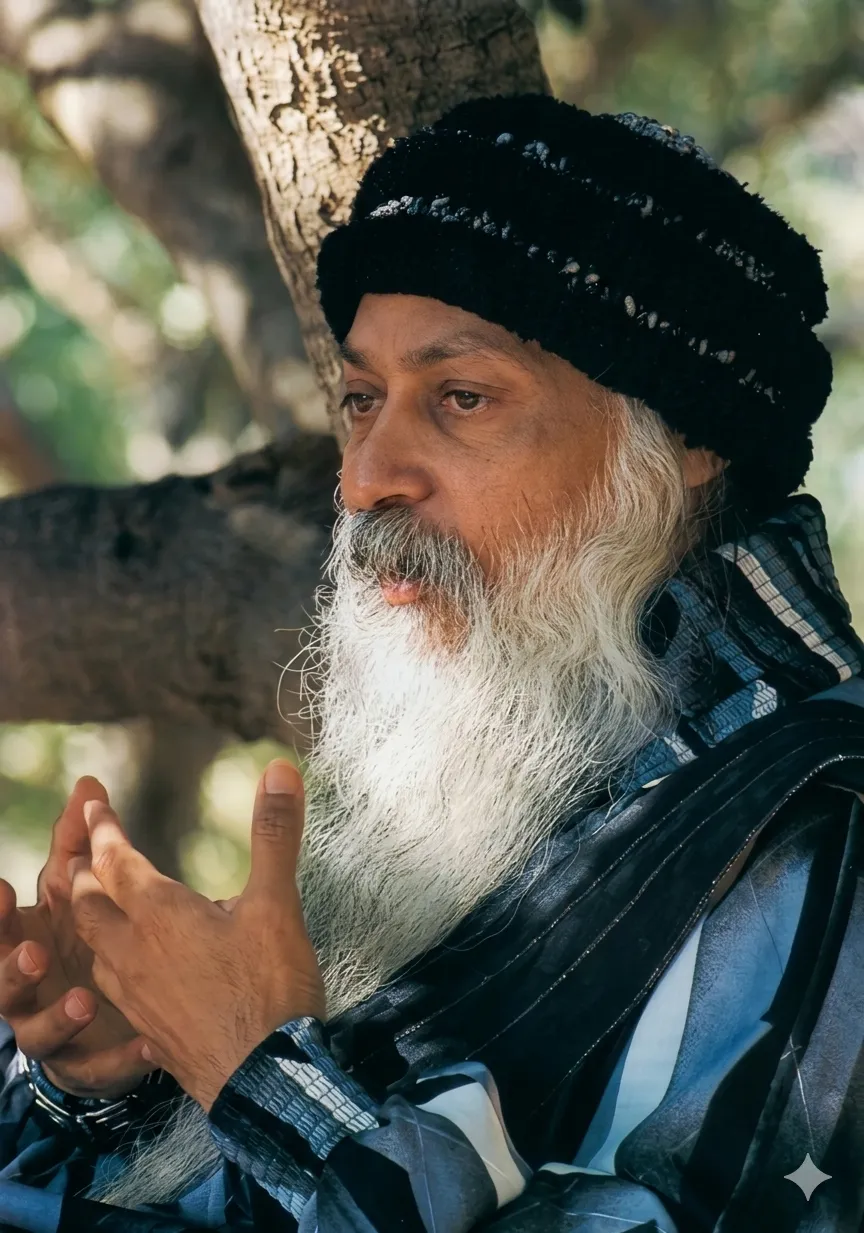
According to Osho, ‘guru’ is a neutral term—any teacher, true or false. A sadguru is the true guru: one who speaks from direct seeing, not borrowed scriptures; whose inner lamp is lit and whose words carry living nectar. The pseudo-guru repeats tradition, shows pictures of light but gives none. Choose the one whose presence illumines and transforms.
A sadguru is the real teacher who has seen truth and shares his own light, while an ordinary ‘guru’ might just repeat others’ words.
From the Discourses
Passages where Osho speaks to this question — each links to the complete discourse.
What is the reason there are two different words, ‘guru’ and ‘sadguru’, when the guru is, in fact, the sadguru?
Mukesh Bharti, ‘guru’ is a neutral word. A guru can be a false guru or a true guru. A guru can be spurious or genuine. So the word ‘guru’ by itself does not suffice. ‘Sadguru’ means: the true guru. What is the difference between a pseudo-guru and a sadguru? The pseudo-guru may speak beautifully, but all his words are borrowed—secondhand, not his own, not from his own experience. The pseudo-guru is the one who is a Hindu, a Muslim, a Christian; who keeps repeating the Quran, the Bible, the Vedas. He thumps some tradition. The sadguru speaks from his own innermost being, whose inner consciousness has blossomed, in whose inmost core spring has arrived; who does not quote any Veda, any Dhammapada, any Quran; whatever he says, he says on his own strength; he himself is the proof and the witness of his words. “Not what is written, but what…
Osho, you spoke of the inner Sadguru. Please shed light on what it means. And kindly tell us when and how that Sadguru awakens.
Samadhi! The Sadguru is a symbol. It means that meditation awakens in you, awareness awakens in you; that you do not live in a stupor—just that much. In your getting up, sitting down, walking, there is wakefulness, discernment. Within you a lamp of alertness keeps burning. Whatever you do, do it with awareness. If someone abuses you, let anger not arise in unconsciousness. Let it not happen that afterward you have to repent—“Oh, what did I do? Why didn’t I remember?” If someone abuses you, respond to that too with awareness—calm, cool, descending within, seated in your inmost core, respond. And you will be amazed: then the response to abuse cannot be anger; it will be compassion. Wherever awareness comes, the embers of anger are extinguished. The very embers of anger become flowers of compassion. Right now, whatever you are doing is in unawareness. Walking, getting up, sitting—everything is mechanical.…
Osho, yesterday you said that when anger is watched consciously, it dissolves. But why is it that when sexual desire arises, even in awareness its intensity persists? Why is it so?
There is no entanglement in the breath. If you try to practice on anger… Anger is not happening every moment; it happens sometimes. And when it happens, it happens with such intensity that you are already going deep into it; so much is at stake in those moments that you may think, “We will look into awareness later; first let’s settle this now.” Lust is very deep, because existence has made it so deep; life depends on it. If lust were so easy that you decided and were freed, perhaps you would not even have been born—because many before you would have become free, and the possibility of your being would have been almost nil. But your parents, and their parents, did not become free; therefore you are. You too will not get free so easily, because your children are also to be—they are waiting: “Do not run away midway.”…
Verse (Sanskrit): गुरु मानुष करि जानते, ते नर कहिए अंध। महादुखी संसार में, आगे जम के बंध।। तीन लोक नौ खंड में, गुरु ते बड़ा न कोय। करता करै न करि सकै, गुरु करै सो होय।। गुरु समान दाता नहिं, जाचक सिष समान। तीन लोक की संपदा, सो गुरु दीन्हा दान।। गुरु कुम्हार सिष कुंभ है, गढ़-गढ़ काढ़ै खोट। अंतर हाथ सहार दै, बाहर बाहै चोट।। गुरु को सिर पर राखिए, चलिए आज्ञा माहिं। कहै कबीर ता दास को, तीन लोक डर नाहिं।। गुरु गोविन्द दोउ खड़े, काको लागूं पाय। बलिहारी गुरु आपने, जिन गोविन्द दियो बताय।। हरि रूठै गुरु ठौर है, गुरु रूठै नहिं ठौर।। Transliteration: guru mānuṣa kari jānate, te nara kahie aṃdha| mahādukhī saṃsāra meṃ, āge jama ke baṃdha|| tīna loka nau khaṃḍa meṃ, guru te bar̤ā na koya| karatā karai na kari sakai, guru karai so hoya|| guru samāna dātā nahiṃ, jācaka siṣa samāna| tīna loka…
You also know: I am. The Guru also knows: I am. The difference is only this: he knows who he is; you do not know who you are. In being there is no difference. Being is equal, alike. The inheritance is equal for all. To all consciousness is given equally. Turn your consciousness around, look at yourself… You are so absorbed in looking at others that you cannot return to yourself. You are so full of relish for running outward that you cannot come inside. You are entangled in the 'other' and do not awaken to the 'self.' Guru means: one who has awakened to the Self. And one who has awakened to the Self alone can awaken you. Guru does not mean teacher. Teacher means: he has read scriptures. Ask him scriptural questions, he will answer — consistent answers, according to scripture.