
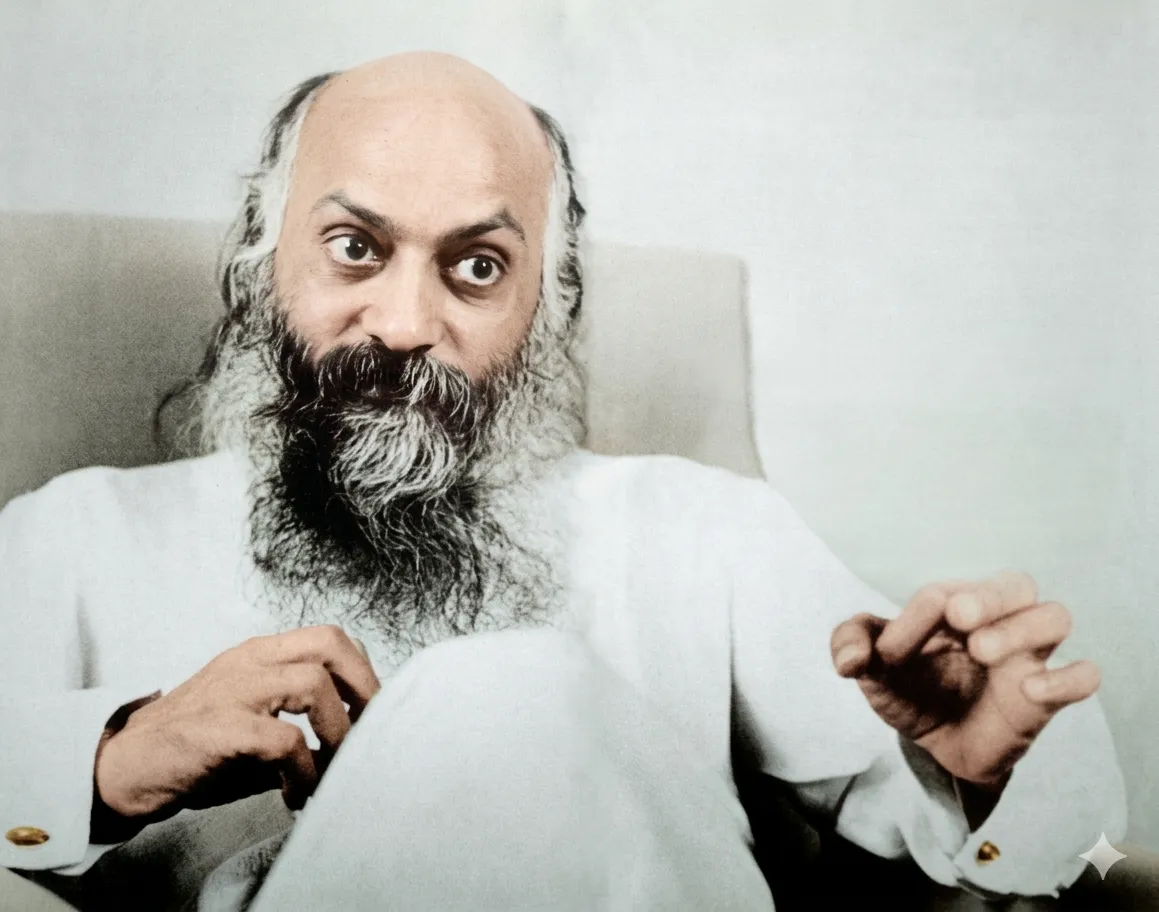
According to Osho, a true guru is one whose ego has dissolved into 'absence'—utterly uninvolved, non-projecting, and non-reactive. Like a mirror, the master imposes nothing, concludes nothing, and simply responds. Their silent presence reveals you to yourself if you are open; they do not 'do' or mold you. Help arises from their emptiness, not from disciplines, commands, or moral violence.
A real master is like a quiet mirror with no ego—being near them helps you see yourself because they don’t try to change or control you.
From the Discourses
Passages where Osho speaks to this question — each links to the complete discourse.
What makes someone a guru, a spiritual master?
When you are not there, when you have completely disappeared, the other becomes an open book to you. The more other-oriented you are, the less you can know what is happening to the other. The more you become self-oriented, the more possibility there is of knowing what is happening within someone else. A moment comes when you are completely dissolved. Then you know the other totally. Then the other is not the other; he is not something separate from you. You don't react him; there is no need. There is a response, not a reaction. Only in this way can one become a guru and help others, otherwise not. To me, a spiritual master needs this capacity of being totally uninvolved, of being totally unrelated -- just being an absence: with nothing to impose, nothing to project, no need to react. Then he can help you. He cannot come to…
Gurudas. Guru means the master, and das means the servant -- the servant of the master. And it is very significant in the east. The very concept of guru is eastern; the word cannot even be rightly translated. When we translate it as 'master' much of its meaning is lost, because a master means a teacher -- the guru is not a teacher. In the western consciousness nothing like the guru ever existed. That phenomenon is eastern... it is something basically eastern. It has to be understood. We call 'guru' the person who can impart to you the truth. Not that he can teach -- truth cannot be taught; it can be caught. The guru is a person whose presence can help you to catch it... a catalytic agent. He is not going to do anything in fact, he is not a doer.
Disciples need a guru, does a guru need disciples?
A flower opens in a deep forest. Nobody will ever pass. The fragrance will still continue to spread around. It does not wait for a traveller, does not wait for somebody to come and appreciate -- that's not the point at all. If somebody comes and appreciates -- good; if nobody comes and nobody appreciates, it is as good as the other. There is no distinction. no difference. The Master and the disciple both exist in the disciple. When the disciple's mind becomes awakened, he will laugh and he will come to know who is a disciple and who is a Master. The whole game becomes ridiculous. But since the disciple is not yet alert, the game continues. Krishnamurti is right when he says no Master is needed. Yes, one day you will also know that no Master is needed, but you will know only when somebody has awakened you…
Anyone is ready to be a Guru; whenever the chance comes, man becomes a Guru. To become a shishya is extremely difficult. There was a Sufi— a fakir. He was passing along a road. A small child was carrying a lamp to light in the temple. The fakir asked, “Did you light this lamp?” The child said, “I did.” “Did this flame appear before your eyes?” “Before my eyes.” “Then, where did this flame come from?” The child blew out the lamp and asked the Sufi, “The flame has gone before your very eyes—tell me, where has it gone? If you can tell where it has gone, then I will also try to tell from where it came.” The Sufi fell at the child’s feet and said, “I am in search of Gurus—and I have found one in you as well.
Osho, Sahjobai’s path is love, devotion, surrender, and worship of the guru. Then why does she begin to emphasize inwardness, the inner journey, and dispassion?
The guru is outside. But the outer guru is merely a ladder leading to the inner guru. When you lay yourself completely at the feet of the outer guru, open your eyes and you will find that the outer guru has bid you farewell. It was your outward mode of seeing that made the guru appear outside. Suddenly you find this music is resounding within. This is no one outside—someone within is speaking. I have heard: a fakir came to a mosque. Perhaps he was a little late; people were already dispersing. He said, “Brothers, the congregation is breaking up so quickly. Why such haste? Pray more slowly, more gently.” One man said, “You don’t blame yourself for coming late, and you blame the congregation. The Prophet has completed the prayer.” This is a story from Muhammad’s time. “The Prophet has completed the prayer. Now what is there to do,…