
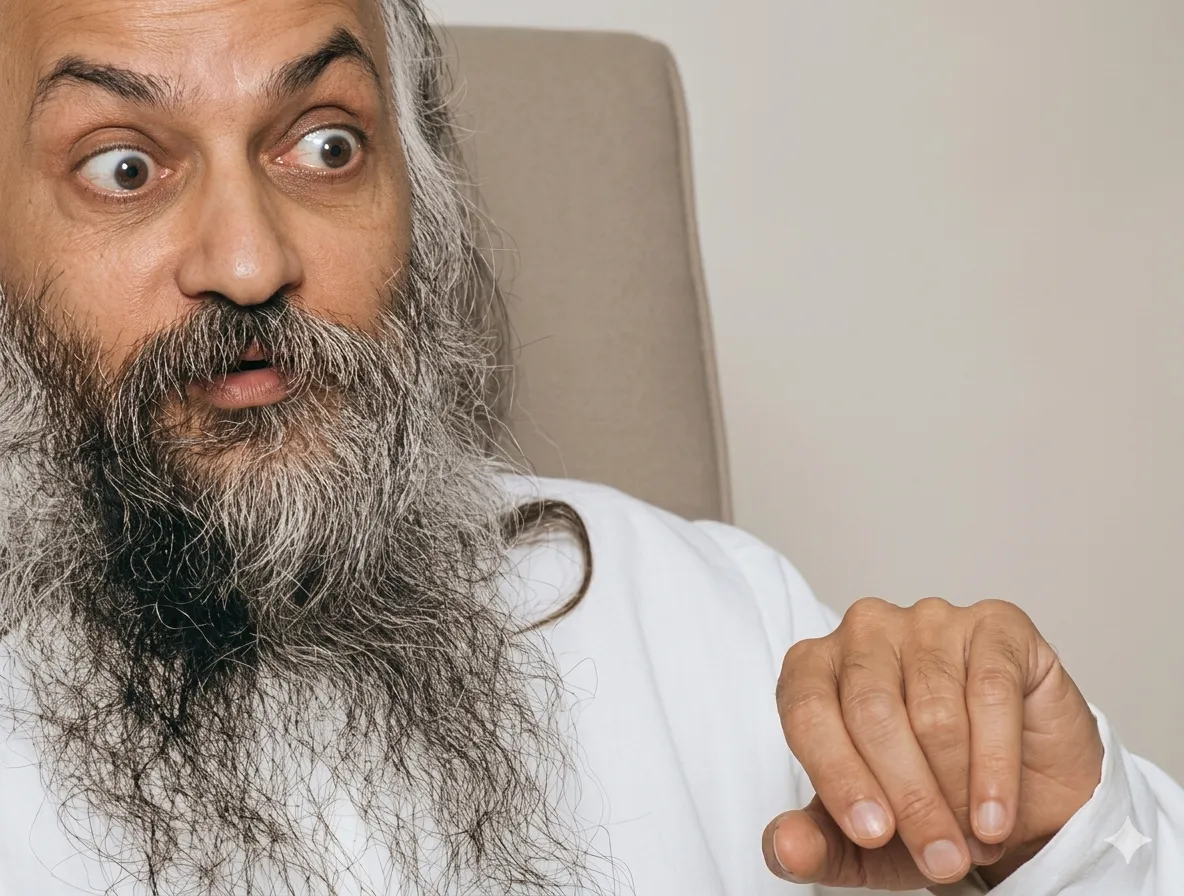
A teacher is like an alarm clock: you already have light inside, but you’re asleep; they wake you up, and once awake, you don’t need the alarm—just gratitude.
From the Discourses
Passages where Osho speaks to this question — each links to the complete discourse.
Beloved master, in your various discourses you have said that the divine is in everybody. If this is true, that we are divine in ourselves, then why should we need you?
It is a beautiful question, beautiful because it has the answer in itself. You have heard me say that the divine is in everyone, but you have only heard half the statement. I have been telling you again and again that whatever is in me is also present in you. There is just a little difference you have not heard: I am awake and you are asleep. There is not much difference. And your question itself gives proof to what I have been saying. You say, "IF this is true..." Underline "if." It is not true for you, you have not experienced it -- you have heard me making a statement. Unless it becomes a truth of your own experience, you will need me. I would like to get rid of you as soon as possible, but if you go on clinging to `ifs' and `buts' then it will be…
It is very easy to contact a child. The more grown-up you are, the more difficult you are, because then between me and you there is a great mind, your mind. The child has no mind yet. It is just a clean slate, and anything written on a clean slate comes bold, loud and clear. To write something on a slate which has so much written on it already is not so easy. Even if you write, to decipher it is difficult, to read it is difficult. In every way it is possible to be lost in the confusion that you have carried. In this way a child can have a deeper contact with me. On the other hand, because the child has not decided yet, he may decide later on to drop out of it.
Osho, immediately after his enlightenment Buddha said: Having known by myself, whom shall I call a master and whom shall I teach, whom shall I make a disciple? And yet for forty years he initiated and taught millions. But before the Mahaparinirvana, his final instruction was: Atma Deepo Bhava! Bhagwan, please shed some light on this.
You know how to play the veena. Your fingers are skillful. The veena is there. Yet music is not arising. You are not placing your fingers on the strings. You are not pouring your skill onto the veena. Pour your skill onto the veena; the veena will shower music on you. Everything is present. You know how to cook. There is flour, salt, ghee, lentils, water, the fire is lit—and you sit hungry! And you also know how to cook! Nothing is lacking. Everything is there. Only a little coordination is needed. A little arrangement is needed. There will be no need to remain hungry. Therefore Buddha says: Whom shall I teach? What shall I teach? Truth cannot be taught at all. Whatever is taught will not be truth. Even to say “taught” is too much; truth cannot even be said. Whatever is taught is not your nature. All teaching…
Osho, you have said that the divine is found not by effort but as grace; Sahajo, in a mood of awed gratitude, sings of the grace of her master Charandas, and Kabir of the grace of his master Ramananda. Upon you, whose grace descended? Did you attain the supreme enlightenment without a master’s grace? Please say something about this.
I have explained two approaches to you: the jnani and the bhakta. The jnani attains through his own worthiness; the bhakta through his prayer. The jnani “acquires” the divine by austerity; it is his achievement. He is a claimant. “If I have found, I have found it by my own labor.” Hence the religion and culture that Mahavira founded is called the Shramana culture. Shramana means: not by grace, but by effort. That is why Mahavira is known as the Shramana Bhagwan—one who attained the ultimate through effort. The jnani says, “Through austerity, renunciation, and merit I attained God—not for free, not by anyone’s grace. I earned it.” That is the jnani’s claim. The bhakta says, “Through prayer, worship, dancing, cajoling—by pleasing you. I had no worthiness of my own. I danced and delighted you. I sang your songs, praised your glory, won you over. In some deep moment of…
Osho, is it wrong to try to save somebody? Is it not part of compassion?
That reminds me again of Natthu Kaka. I was a regular visitor to his salon. I had no beard at that time -- I was a child -- and no mustache, so there was no fear, but I had to use a scarf because I had long hair, and if Natthu Kaka was in the mood he might start cutting. And once he had cut your hair you could not do anything. And he was such a nice man, he would say, "Why be worried? -- you need not pay." It was, every day, a problem that he had shaved somebody without asking him, and now the man was angry. Particularly in India, people shave if they become sannyasins; that means they are dying in a ritualistic way. When a person dies, he is shaved; it is just symbolic. Just as when a person dies he is shaved, in the…