
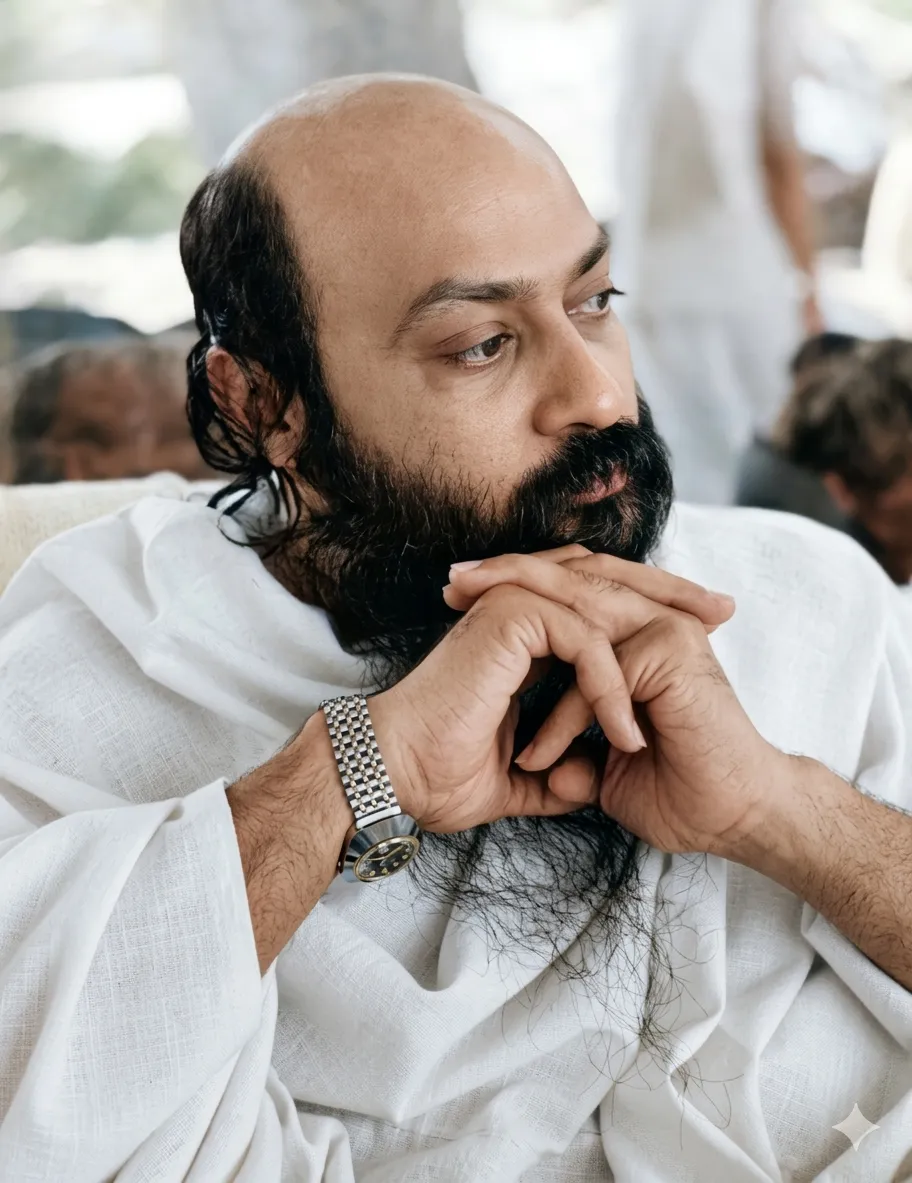
You didn’t lose your inner God; you haven’t discovered it yet because it’s the quiet watcher inside—when you stop clinging to things and thoughts and just observe, that silent awareness becomes clear.
From the Discourses
Passages where Osho speaks to this question — each links to the complete discourse.
Why do we forget our divinity? What is the meaning of this?
When we say that one has forgotten, the word 'forgotten' is used metaphorically. It is not very true, factual. Nobody can forget. A Buddha can never become anything else but a Buddha. He cannot forget. He knows. He knows even while he is asleep. There is no way to forget it. Once known it is known eternally. But we have never known it -- and we have been it always and always. From the very beginning we have been it. But we have not allowed our energy to turn upon itself. You must have seen old symbols -- there is an Egyptian symbol -- of a snake turning upon itself, a circle of a snake. The snake has its own tail in its mouth -- that's what knowing is. The snake has its own tail in his mouth, it is a complete circle, the two ends meet. When you turn…
Osho, we were talking about the practice of yoga and its necessity. You had explained that religion and the soul are our very nature. They are not to be attained; they are already given. But yoga has to be practiced to cut through impurity. Please say something about how impurity is cut through by the practice of yoga.
Omkarnath Thakur, a great Indian musician, was Mussolini’s guest in Italy. At dinner Mussolini joked, “They say Krishna’s flute drew wild animals, made cows dance, peacocks spread their plumes. I can’t understand how music can do that!” Omkarnath said, “My capacity is not Krishna’s. None on earth understood music as Krishna did. But I can demonstrate a little.” Mussolini said, “Don’t explain; show.” With only spoon and fork and the china before him, Omkarnath began to play on the cups and saucers. Within minutes Mussolini’s eyes drooped as if drugged; his head began to strike the table. The utensils rang louder; his head struck harder. He shouted, “Stop! I can’t stop my head!” When it stopped, his forehead was bleeding. In his autobiography Mussolini apologized for his earlier statement: surely Krishna’s flute could summon wild creatures—when a civilized man cannot even stop his head under the spell of mere spoon-and-cup…
Osho, what is the relationship between meditation and patience?
If you sit to meditate to remove mental restlessness, you will keep looking back again and again: “Has it gone yet?” And the irony is that when you begin to meditate, restlessness will increase. Because what has been repressed will start surfacing; catharsis will begin. The rubbish you have kept hidden within and never allowed to express—meditation will break open those doors too. It will clean the house. Dust piled up for years, for births, will rise again; there will be gusts and storms. For a while even the little peace you had will be lost. Then you will panic: “I came for peace, and even what I had is gone.” Without patience, you could even become unhinged, because meditation brings such a great storm. The disease is not from a day or two; it’s from lifetimes. Meditation will break through all the layers to reach your innermost core. In…
Beloved Osho, I have heard you say that we are all enlightened, and that we have just all forgotten it. Did we forget it at a precise time, and if so, why?
Prembodhi, yes we have forgotten it at a precise time, and I will tell you why. Just try to remember backwards -- how far back can you go? Four years of age, or at the most when you were three years of age. Beyond that comes an absolute blank -- no memory, no remembrance. One thing is certain, that in those three years many things must have happened. You must have cried, you must have been loved, you must have been left alone, you must have been afraid in the dark night -- a thousand and one experiences must have happened. You may have fallen, you may have been hurt, you may have been seriously sick ... but you cannot remember anything. It seems as if in those three years, nothing was recorded by your memory mechanism. That's exactly the time when you forgot your self-nature. Let us say it…
Another friend has asked: if meditation leads to samadhi and samadhi leads to god, then what need is there to go to the temples? Shouldn't we do away with them?
Those who see God in temples and those who destroy temples -- both are wrong. One who only sees God in the temple is mistaken. His mistake is: who else does he see outside the temple? Obviously, his mistake is that he does not see God except in the temple. Your temple is very puny; God is very vast -- you cannot confine God to your puny little temples. The other person's error is: he wants to get into doing away with temples, into destroying them -- only then, he thinks, can he see God. Your temples are too small to serve as dwelling places of God or to prevent anyone from seeing God. Remember, your temples are so ridiculously small they cannot become God's residence, nor can they become his prison, which, when destroyed, would supposedly make him free. You need to understand exactly what I am saying. What…