
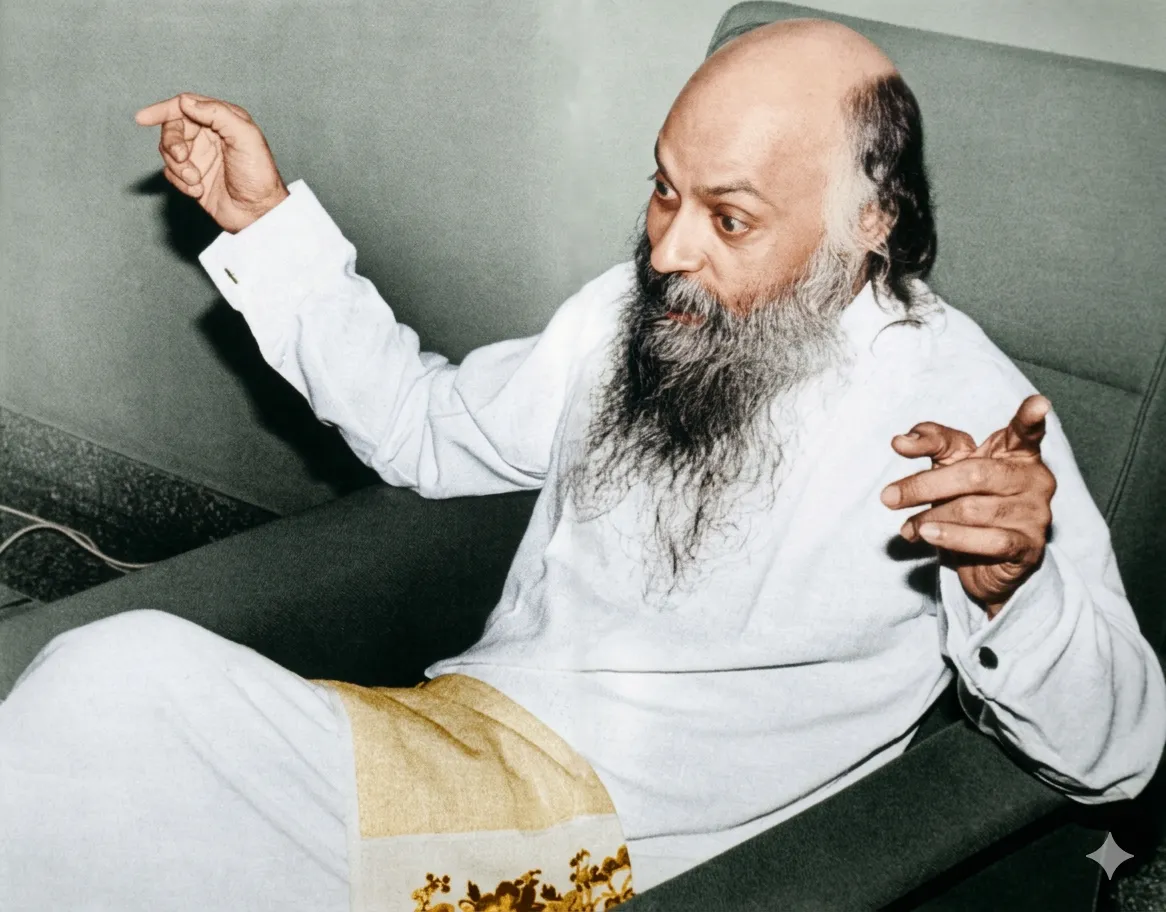
We stay away so our love heats up enough to last—like water that must fully boil—otherwise we come too early and can’t remain.
From the Discourses
Passages where Osho speaks to this question — each links to the complete discourse.
Osho, is it necessary to pass through the state of separation for union with the Divine?
I wrote and sent countless letters, still, cruel one, you did not come. The desolate garden’s days rolled by, dark monsoon clouds kept gathering; the henna beds breathed fragrance, the thresholds rang with birdsong, the neem in the courtyard flowered, the mango grove at home bloomed. Everything spoke—only you were silent; I sat alone, my heart caged. Laughter lost, joy lost, sleep was sold, peace squandered. At whose temple shall I wave the lamp? At whose door shall I surrender? To whom shall I send my silent messages, to whom my tender invitation? I wrote and sent countless letters, none ever returned to me. All came—only you did not; why this cruel spell upon me? Such intense longing took hold, such efforts did it compel. The threshold fell hush and mute, the latch kept clicking, waiting; the clouds swayed low and bowed, the rains held back, still waiting. Whenever your…
Osho, when God stands directly before the devotee, why does the longing still not lessen?
He says: Seeing this, I fled. I was so afraid I even set the chain down gently, lest it ring by mistake. And I was so afraid I took my shoes—worn up the temple steps—into my hands, lest the footfall be heard inside; lest he open the door and say, Come; lest he embrace me—and then I would be annihilated. There would be no rescue then. And seeing him standing there, even running away would seem unseemly. The song’s final stanza says: From that day, having fled, I wander on all roads except the road to that temple. My search continues. I tell people I am seeking God, practicing yoga, meditating. And I know very well where he is. Leaving only that place, I search everywhere else. For me, the atheist is precisely that person who, in some birth, suffered a very profound pain—so terrible that he does not wish…
Beloved Osho, I feel warm love in your presence and now I realize that when I am not close to you it does not happen in the same way. Is it still true that time and space do not make any difference in the great affair between master and disciple?
People's understanding was absolutely wrong that Ananda, who had burst into tears, must have loved the master more. Asked, he said, "I am crying because he was alive, and for forty-two years I have been his most intimate disciple -- intimate in the sense that I was always with him. In these forty-two years not even for a single day was I separate; even in the night I used to sleep in his room, just to be present in case he needed something. I am not crying because I was the most intimate, I am crying because even with such a long physical intimacy I have remained separate from him. Something has remained like a barrier." Gautam Buddha was not dead yet. He had closed his eyes, and he was relaxing into the eternal. He came back, opened his eyes, and said to Ananda, "Don't be worried. It was my…
Osho, I want to go very, very far away from you. It feels that if I stay close, you will erase me.
People are afraid of love, have always been afraid. That is why the earth has become loveless. That is why master and disciple have been lost; only the names remain, only the words remain. In place of masters there are teachers; in place of disciples there are students. Between student and teacher there is no dying, no love—it is a matter of transaction. The student buys something from the teacher, gives something in return—the matter is finished. There is no exchange of life-breath. O heart, do not revive the tale of worn-out love; do not entangle the people of the gathering in this thorn-thicket. People have begun to fear. They think love is a thorn, a thicket in which, if you get caught, you won’t be able to free yourself. People walk around it. Ordinary love entangles so much—what then to say of extraordinary love! When the thought arises in…
Osho, to long for you is easy, but you are difficult. I have not been able to quiet this longing for you. A lifetime has passed in longing, yet you did not come. Death has begun to glimmer in life, yet you have not come.
Santosh Saraswati! To realize the Divine, first there must be an intense longing—in the first stage—indomitable, unwavering, unmoving. A longing bold enough to stake everything. Like a moth racing to the flame—such a longing! The longing to be annihilated. The courage to take every risk. Such urgency, such density that only one longing remains, and all other longings are absorbed into it. Let your heart become a single arrow, catch the flight of the Divine, and set out for the Divine’s destination. First such longing is needed. And then comes a very paradoxical law: the longing must be dissolved. No one arrives merely through longing; and without longing, no one arrives either. Longing is indispensable—but in the final moment the longing itself becomes the obstacle. In that last hour, longing too must fall away, in that very instant. First, longing refines you, shapes you, makes you undivided; then the longing…