
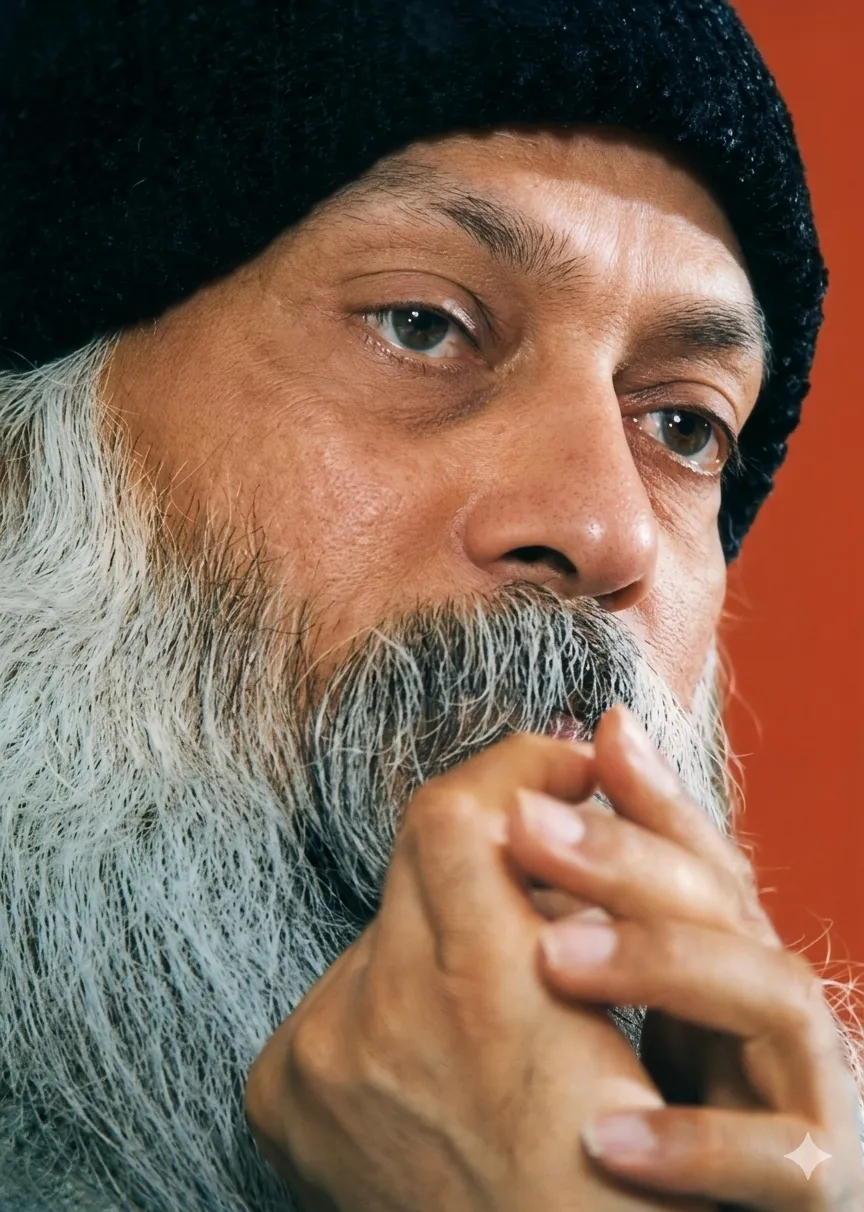
Stop trying to reach God with thoughts or effort; sit quietly, drop the ‘me,’ and in that empty stillness wholeness appears by itself.
From the Discourses
Passages where Osho speaks to this question — each links to the complete discourse.
Osho, we are incomplete. However much we search outside or inside, how will the Whole ever be seen? How will we find the Whole?
It’s true. You are incomplete; all your seeking will remain incomplete. But non-seeking can be complete. Whatever you seek, you will be the seeker; it will be a search of your own hand, it will be like you. Whatever you make will carry your imprint. Whatever you construct, whatever you create, will be incomplete. If the maker is incomplete, how can the creation be complete? Quite right. Whatever you think will be incomplete. Whatever ideas you entertain will be fragmentary. Whatever conclusions you draw can never be whole and total. If you have faith, it will be incomplete; if you doubt, that too will be incomplete. You go into the world—half-and-half; you enter the temple—half-and-half. Because you are incomplete. That’s right. Then is there no way? God is complete and you are incomplete. And whatever you do will be incomplete—prayer incomplete, sadhana incomplete, samadhi incomplete. So how will you find…
तीसरा प्रश्न: ओशो, हम अधूरे हैं। हम बाहर या भीतर कितनी ही खोज करें, हमें पूरा कैसे दिखेगा? पूरा कैसे मिलेगा?
तुम जो भी खोजोगे, तुम्हीं खोजोगे; तुम्हारे हाथ की ही खोज होगी, तुम्हारे जैसी ही रहेगी। तुम जो भी बनाओगे, उसमें तुम्हारी ही छाप होगी। तुम जो भी निर्मित करोगे, सृजन करोगे, वह अधूरा ही होगा। क्योंकि अधूरा बनाने वाला है, तो कृति कैसे पूरी हो सकती है? बिलकुल ठीक बात है। तुम जो भी सोचोगे, वह अधूरा होगा। तुम जो भी विचार करोगे, वह खंडित होगा। तुम जो भी निष्कर्ष लोगे, वह कभी संपूर्ण और समग्र नहीं हो सकता। तुम श्रद्धा करोगे, तो अधूरी; तुम संदेह करोगे, तो अधूरा। तुम संसार में जाओगे, तो आधे-आधे; तुम मंदिर में प्रवेश करोगे, तो आधे-आधे। क्योंकि तुम अधूरे हो। बात ठीक है। तो क्या फिर कोई उपाय नहीं है? क्योंकि परमात्मा तो पूरा है और तुम अधूरे हो। और तुम जो भी करोगे, वह सब अधूरा होगा--प्रार्थना भी अधूरी, साधना भी अधूरी, समाधि भी अधूरी। तो तुम पूरे परमात्मा को कैसे पाओगे?
Beloved Osho, for years I have contemplated what seems to me to be the basic message for well-being: love yourself. When I was a therapist, all day hearing, "I hate myself; I feel sorry for myself; I am proud of myself; I want to destroy myself," I started wondering -- who is this self? I love when you say there is no self. That seems so freeing. Could you please say more?
The whole therapeutic movement has gone wrong on that point: Love thyself. Socrates used to say, "Know thyself." And there have been masters, particularly Sufis, who say, "Be thyself." But there is only one person in the whole history of man, Gautam Buddha, who said, "There is no self. You are an emptiness, utter silence, a non-being." His message was much opposed by all the traditions, because they all depended in some way or other on the idea of the self. There may have been differences on other points, but on one point they were all totally in agreement -- and that was the existence of the self. Even people like George Gurdjieff, who used to talk about a very novel idea -- that you are not born with a self, you have to earn it: "Deserve thyself" -- finally, he also ends up with the self. Gautam Buddha does…
Beloved Osho, being near you, looking into your eyes, feeling you, I am losing my ground. And I feel what I am, what I am not. Osho, how can I find myself? There seems to be nothing to find.
You have found it! Yes, nothing is there to be found. But to say it from the very beginning is to destroy the whole business. So religions go on saying to you, "You will find God, and you will find the soul, and you will find this and that." The truth is: you will not find anything. And it is better that you don't find anything, otherwise there is going to be trouble. Just think: if you find God sitting inside you, what are you going to do stuck with the fellow for eternity? Nothingness is beautiful. It implies freedom, infinity. The whole sky is yours. And you don't find anyone, so there is no question of quarrel, no question of who is higher and who is lower; no question of how to coexist because to anybody who is there you will be a stranger -- red people in Oregon!…
Osho! I set out to seek the Beloved; how is union with the Beloved attained?
Yog Neelam! The Beloved is not far. Not even so far that any meeting would be needed. There has only been forgetfulness, not separation. Separation cannot be. The Beloved abides within. He is the breath of our breath, the heartbeat of our heart. Without him we have no being. Because he is, we are. As the ocean is, so the waves are. The ocean can be without waves, but the waves cannot be without the ocean. Yet a wave can fall into a delusion—the delusion that “I am separate from the ocean.” In that very delusion, forgetfulness happens. Only forgetfulness happens; separation cannot. The whole search for the Beloved is nothing but remembrance—re-remembering. That is why the saints have called this search surati. Surati means remembrance, recollection. Surati is the folk form of the word smriti. What the Buddha called smriti, by the time of Kabir and Nanak became surati—dearer,…
पहला प्रश्न: ओशो! पिय को खोजन मैं चली, पिया मिलन कैसे हो?
योग नीलम! पिया दूर नहीं है। इतना भी दूर नहीं कि मिलन की भी जरूरत हो। सिर्फ विस्मरण हुआ है, विछोह नहीं। विछोह हो ही नहीं सकता। पिया तो भीतर विराजमान है। वही तो हमारी श्वासों की श्वास है। वही तो हमारे हृदय की धड़कन है। उसके बिना तो हमारा कोई होना नहीं है। वह है तो हम हैं। जैसे सागर है तो लहरें हैं। सागर तो बिना लहरों के हो सकता है, मगर लहरें बिना सागर के नहीं हो सकतीं। लेकिन लहर को एक भ्रांति हो सकती है--इस बात की भ्रांति कि मैं सागर से पृथक हूं। बस उसी भ्रांति में विस्मरण हो जाता है। विस्मरण ही होता है, विछोह तो हो सकता नहीं।
How to he total? How to give everything?
Every evening, people come to ask me: "How to share?" And my problem is that I don't see anything that they are going to share! There is nothing. When you don't have anything, this question arises: "How to share?" This question keeps you happy that you have something to share but you don't know how to share. This keeps you unaware of the fact that you don't have anything to share -- because when you have, it happens spontaneously. You cannot resist it, it has to be given forth. There is no way to avoid, it is inevitable. So first thing, you ask: HOW TO BE TOTAL? Not to be is to be total. Second, you ask: HOW TO GIVE EVERYTHING? Know that you have nothing. And wait... and wait in silence, in patience. Something will start flowing out of your being. It will take you unawares. It will be…