
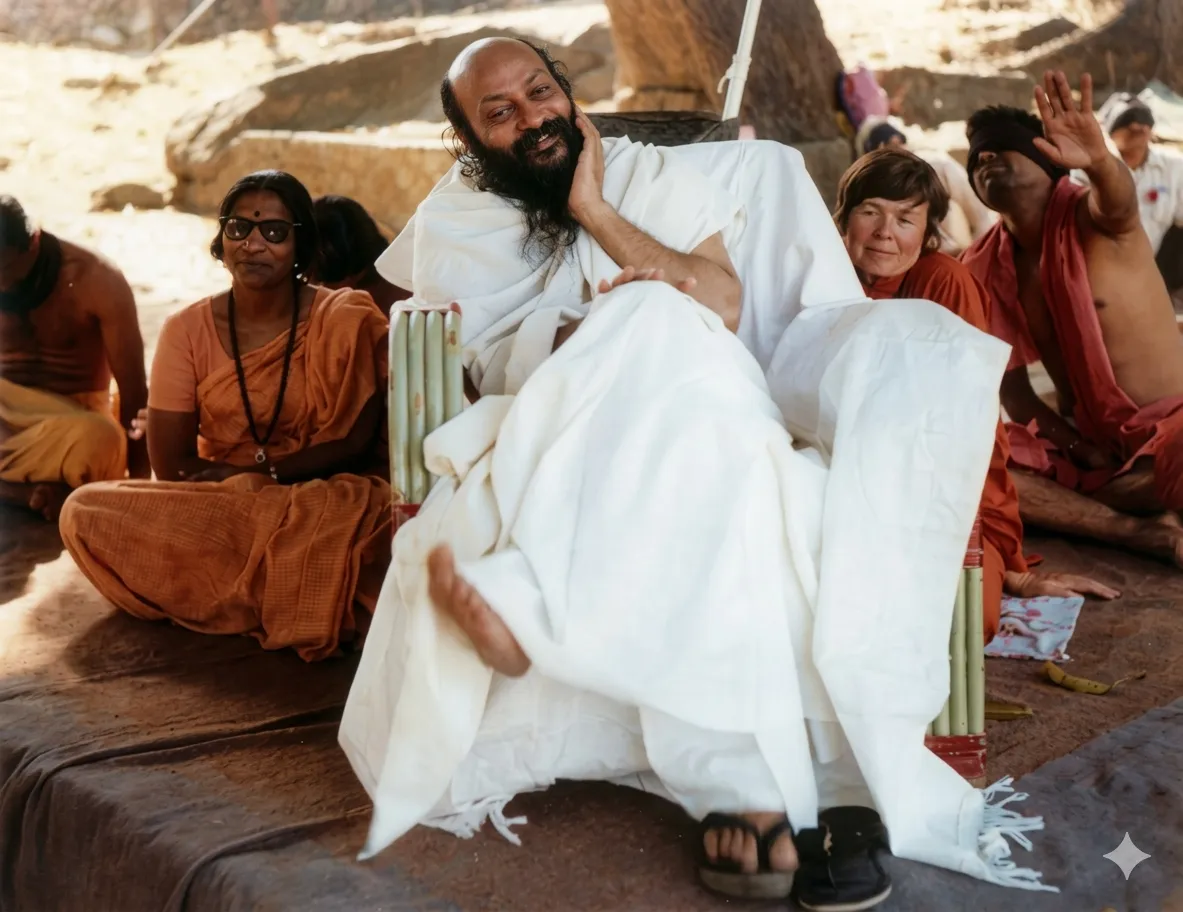
According to Osho, surrender cannot be done; the doer is the very thing to be surrendered. It happens when thought slows, silence arises, and the ego dissolves. Don’t aim to surrender to a conceptual ‘God’; that’s borrowed belief. In egoless silence, godliness—an ungraspable, joyous totality—is revealed. When you are not, surrender is, and unity with the whole is naturally known.
Stop trying to give yourself to an idea of God; get truly quiet so the “I” fades, and then surrender and living godliness appear on their own.
From the Discourses
Passages where Osho speaks to this question — each links to the complete discourse.
Osho, what is surrender and how to do it to god? Please elucidate.
You are just living with rumours, and those rumours have passed through so many ignorant people that those rumours have become utter lies. Even if you hear it from a Buddha, the moment he has said anything and you have heard it, it is no more the same thing. He was saying something else, and you are BOUND TO hear something else. Even a Buddha, who knows the truth, cannot transfer it to you; it is untransferable. No verbal communication is possible. So what about your parents and the priests? Those who have not even known, they are teaching you what God is. And you go on carrying those stupid ideas about God. And you go on trying to surrender. In the first place, those Gods are false; in the second place, surrender is not something to be done. And this is where millions of people are caught: a false…
Why and how should surrender happen?
Surrender, because we only appear to be persons—we are not. We only appear separate—we are not. It is a great illusory perception that we are separate. This totality of life—we are connected to it. Like a leaf may be under the illusion that it is separate from the tree. And of course it is under the illusion that it is separate from the other leaves on the same branch. This illusion arises naturally. The neighboring leaf dries up, yet this one does not dry along with it—if they were one, it too would dry. A neighboring leaf gets plucked, this one is not plucked with it—if they were one, it would be plucked too. One leaf is like a child, fresh and new; another like an old man. So it is quite natural that each leaf considers itself separate, though it is not the truth. But if the leaf looks…
Question: First question: Osho, how can the state of surrender be attained? In life, the most difficult, the most arduous inner state is surrender. The mind is built around the ego. It is easy for the mind to assume, “I am the center of the whole universe,” as if the earth, the sun, the stars all revolve around me, for me; the whole of life is a means, and I am the end. The ego-state means: I am the goal and everything else is a means. Everything exists for me; I exist for no one. I am the target; all that happens is for me. All is an arrangement to serve me. This is the ego-mood. Surrender is exactly the opposite: I am nothing. My being is like a void, and the center lies outside me.
Osho, wherever there is a feeling of surrender—whether to God or to a master—there must be some concept about the one we surrender to. Then that surrender is also only to a concept, isn’t it? Or is surrender something different? Please explain.
Surrender does not arise from your concept. Where all your concepts fall away, there is surrender. Before the one in whose presence you lay down all your notions. You say, “I have looked through many concepts and found nothing but blindness. Through the lenses of my beliefs I have looked and looked, and nowhere did I see the divine. Now I place all concepts at your feet. Now let me be without concepts. Now, empty, I look at you.” This is the meaning of surrender. To sit by someone in emptiness is surrender. Become empty, and you have surrendered. Surrender is not a declaration to be made with band and drum. Surrender is the tone of zero—shunya. It happens in silence. There is no need to make noise, to stake a claim, to summon witnesses. Wherever you go and sit down empty, there surrender happens. And then what to say…
Osho, you have earlier said, “Live moment to moment, live in the present.” Now you are saying, “Return to the past.” What should we do?
So it is with the mind—there are ruts. The past means endless grooves. However much you understand, your intellect agrees, you make decisions, you resolve—at the moment of resolve you feel something is going to change. But not even an hour passes before your decision breaks. Then only self-condemnation is produced, nothing else. Your saints, your fakirs, your priests and pundits—most of the time they only succeed in producing self-condemnation in you, nothing else. Their words are logically correct. You cannot even say they are wrong; you have to admit they are right. In that admission you take a decision. But against what are you deciding? Inside are grooves carved since who knows when, deep tracks. Walking in them has become a habit. It is easy to walk in them. They will pull you again and again. The meaning of returning into the past is: these grooves must be erased.…