
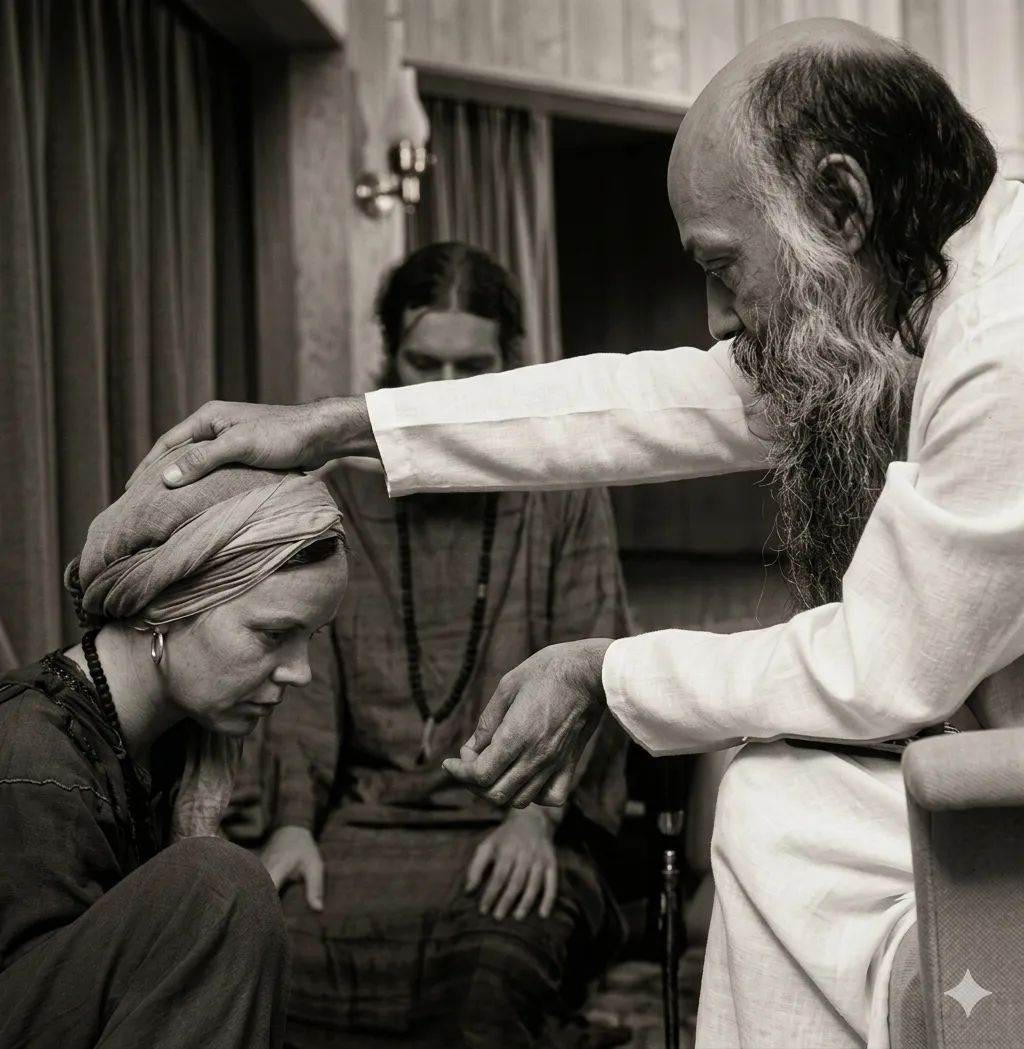
Watch your thoughts like a dream on a screen, remembering you’re the silent watcher, not the pictures, so they can’t push you around.
From the Discourses
Passages where Osho speaks to this question — each links to the complete discourse.
Osho said that there was no need to try to still the mind, to stop the thoughts. He said that just as the traffic goes by and one remains on the sidewalk, unaffected, just a watcher, so one should simply witness the thoughts as they went by. We are not our thoughts, and recognising that we are the witness is enough. The very acceptance of the thoughts makes one more relaxed. The relaxation helps to create a distance, to separate oneself. To evaluate a thought as good or bad means that you are attached to your thoughts -- so one should not put labels on them.] ... put yourself aside, sit under a tree, and just watch the traffic. Soon, one day, the traffic disappears and the road is empty. Suddenly there is an interval and in that interval is meditation. But that interval cannot be created or cultivated.
Beloved Osho, how does watching lead to no-mind? I am more and more able to watch my body, my thoughts and feelings and this feels beautiful. But moments of no thoughts are few and far between. When I hear you saying "meditation is witnessing," I feel I understand. But when you talk about no-mind, it doesn't sound easy at all. Would you please comment?
The small child rides on the horse with a servant riding on another horse. A tremendous desire arises in him when the road turns, just to have a look again back to the family house, its garden. The father must be standing there, the mother must be crying... but he remembers that the father has said, "Don't look back." And he does not look back. With tears in his eyes, he turns with the road. Now he cannot see his house anymore and one never knows how long it will take -- perhaps years and years -- until he will be able to see his father and mother and his family again. He reaches the monastery. At the gate of the monastery the abbot meets him, receives him gracefully, as if he is a grownup, bows down to him as he bows down to the abbot. And the abbot says,…
Question: Third question: Osho, how can one control thoughts? He came back dancing. He placed his head at Buddha’s feet and said: You have given me a very deep message. Today I have found a sutra. I will use this same sutra with the mind. Today a great thing has become clear within me. Your great compassion sent me back. I was not willing to go—but a revolution has happened—just sitting on that bank. Sitting by that spring I understood: had I stepped into the water—had you not told me otherwise—I would have tried to purify it, and in doing so I would only have made it more impure. The moment I stepped in, more mud would have risen. You spoke rightly: sit on the bank and wait. Do nothing; just keep watching. The spring will clear by itself. So too I will do with my mind.
Osho, I practice self-analysis, “introspection,” to awaken the witnessing. Is this right as a first step? Kindly explain.
That is why you see: the wife is happily sitting, listening to the radio, knitting her sweater; the moment the horn honks downstairs—husband has arrived—she lies down: “I have a headache.” Don’t think she’s faking; it really happens. I’m not saying she is deceiving—this has become her habit. The husband’s horn is enough to trigger a headache. Association has formed. Don’t think I say she’s cheating. Perhaps in the beginning she faked it; now that is long past—now it’s a habit. As the husband comes, the headache rises—because only when she has a headache does the husband put his hand on her head. Otherwise, who puts his hand on his wife’s head! Someone might put a hand on another’s wife; who puts a hand on his own! Only when the wife is troubled does the husband show a little sympathy. Love is gone; now only sympathy keeps things moving. The…
Osho, last night you said that the mind cannot do two things together -- that is, thinking and witnessing. It seems then that witnessing is a mental faculty and an act of the mind. Is it so? Please explain. Is there anything like partial witnessing and total witnessing?
WITNESSING is not a mental activity; thinking is a mental activity. Rather, it would be better to say that thinking is mind. When the mind is not, when the mind is absent, when the mind has disappeared, only then do you have witnessing. It is something behind the mind. Zen Buddhism uses mind in two ways: the ordinary mind means thinking; then Mind with a capital "M" means the Mind behind thinking. Consciousness is behind the mind; consciousness comes through the mind. If mind is in a state of thinking, it becomes opaque, non-transparent, just like a clouded sky -- you cannot see the sky. When the clouds are not, you can see the sky. When thinking is not there, then you can feel the witnessing. It is the pure sky behind. So when I said that you cannot do two things, I meant either you can think or you…