
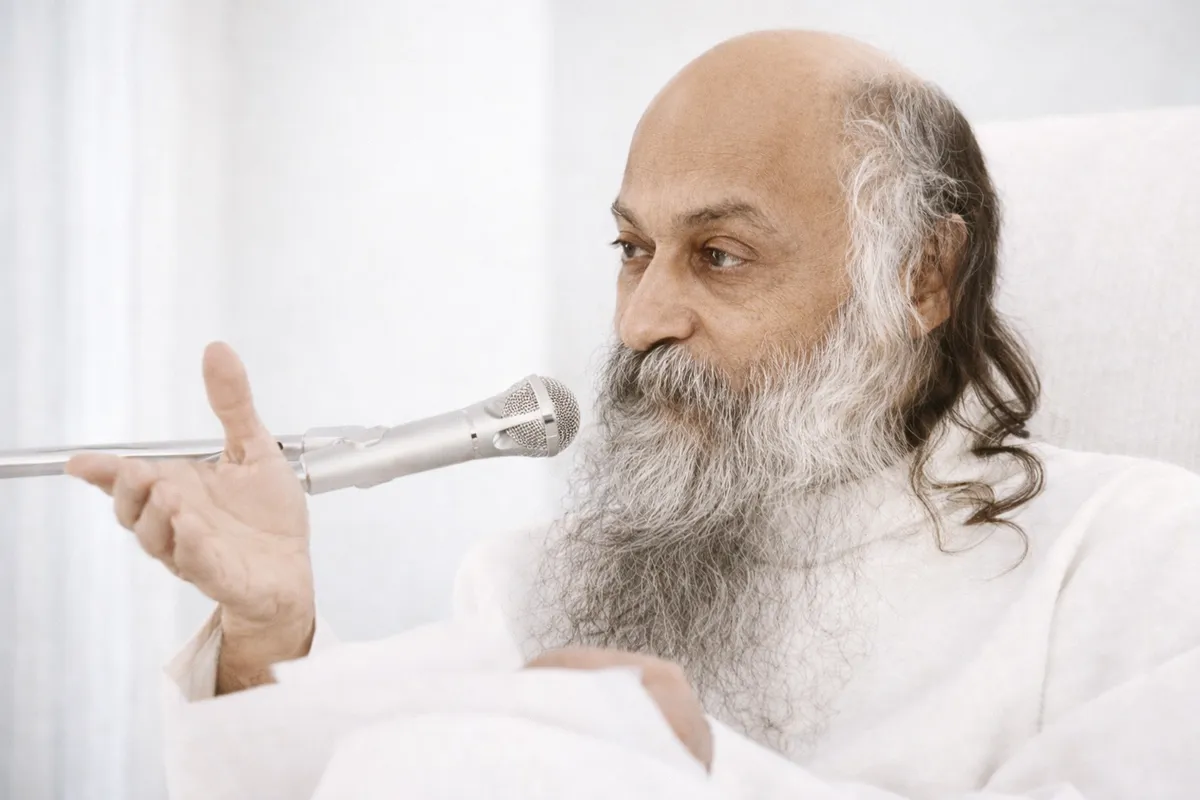
When your mind is empty like a mirror, you don’t need to recognize truth—it's just there by itself.
From the Discourses
Passages where Osho speaks to this question — each links to the complete discourse.
[recording starts here]
OSHO: .... There is no mind. Everything will be, it will be as it is. Nothing is disturbed, because no one can disturb it. Things will be in their suchness and a little[?]. So the question is not where to seek truth, the question is not where is truth. No, truth is everywhere, that which is is known as truth. But the mind we seek [microphone disturbance] if it creates illusions, if it imposes something on that which is then the illusion is created. So how to disturb an illusion-creating mind? Now how to attain a mind which does not disturb, which sees things as they are? So how to achieve a mirror-like mind? That is the question: a mirror-like mind which has nothing to project, nothing to impose, which just reflects. So the question, the basic question is never where is truth? how to find it? No, rather ask…
Beloved Osho, for the past seven years I have heard you speaking about truth. But this is still an empty word for me. Often you say that one knows truth when one is silent inside. I know this delicious feeling that takes me over when I close my eyes and become quiet inside, but what is truth to do with that?
That is the truth. Truth is not an object that you will find somewhere when you are silent. Truth is your subjectivity. Just try to understand. You are there, and the whole world is there. Whatever you see is an object, but who is seeing it is the subject. In silence all objects disappear -- and the word `object, has to be remembered; it is the same word as `objection.' `Object' means that which prevents you. So all preventions, all objects, all objections, disappear; you have the whole infinity, and just silence. It is full of consciousness, it is full of presence, of your being. But you will not find anything as the truth -- that will become an object. And truth is never an object. Truth is subjectivity. To discover your subjectivity -- unhindered, unobjected to by anything, in its total infinity and eternalness -- is the truth. "The…
Here, o sariputra, form is emptiness and the very emptiness is form; emptiness does not differ from form, form does not differ from emptiness; whatever is form, that is emptiness, whatever is emptiness, that is form; the same is true of feelings, perceptions, impulses, and consciousness. Here, o sariputra, all dharmas are marked with emptiness;
Buddha says nothing is ever defiled and nothing is ever immaculate. Purity, impurity, are mind attitudes. Can you tell about a tree whether it is moral or immoral? Can you say about an animal that he's a sinner or a saint? Try to see this ultimate vision: there is no sinner, no saint, nothing moral, nothing immoral. In this acceptance, where is the possibility of worrying? There is nothing to improve either! And there is no goal, because there is no value. This journey is a journey without any goal. It is a pure journey; it is a play, a leela. And there is nobody behind it, doing it. All is happening, and there is nobody doing it. If the doer is there then the problem arises -- then pray to the doer, then persuade the doer, then become friends with the doer. Then you will be benefitted, and those…
Butei, the emperor of ryo, sent for fu-daishi to explain the diamond sutra. On the appointed day fu-daishi came to the palace, mounted the platform, rapped on the table before him, then descended and, still not speaking, left. Butei sat motionless for some minutes, whereupon shiko, who had seen all that had happened, went up to him and said, "may I be so bold, sir, as to ask whether you understood?" the emperor shook his head sadly. "what a pity," said shiko. "fu-daishi has never been more eloquent."
I have heard that Wittgenstein, a great Western philosopher, who comes nearest to the Zen attitude, used to say that he did not solve philosophical problems -- he dissolved them. And he used to say: "We leave things as they are but perhaps for the first time we come to see them as they are." Nothing can be done about things as they are. All that can be done is to help you to see them as they are. "We leave things as they are but perhaps for the first time we come to see them as they are." And again: "Philosophy simply puts everything before us, and neither explains nor deduces anything -- since everything lies open to view, there is nothing to explain." Yes, life is a mystery, and there is nothing to explain -- because everything is just open, it is just in front of you. Encounter…
Osho, is it not necessary to desire, to long and to seek truth and avoid the untrue, to seek truth and renounce the false?
The Master said, "Now you are clinging to the idea of emptiness. This is not emptiness -- this is not true emptiness. Now you are full of the idea of emptiness. Once it was light, once it was energy, once it was fragrance now it is emptiness. It is nothing but labels changing. And unless you throw this too you will not be truly empty. A truly empty person is neither empty nor nonempty. There is nothing to experience, not even emptiness. And in that state of silence when there is nothing to experience -- no object, no content, but only consciousness, only the observer and nothing to observe only the seer and nothing to see -- one attains truth." Yoka says: <q>OUR SPIRIT IS LIKE A CLEAR MIRROR THUS IT REFLECTS THE UNIVERSE HARMONIOUSLY OUR SPIRIT AND THE UNIVERSE ARE ONE.</q> Once you are utterly empty you are a…