
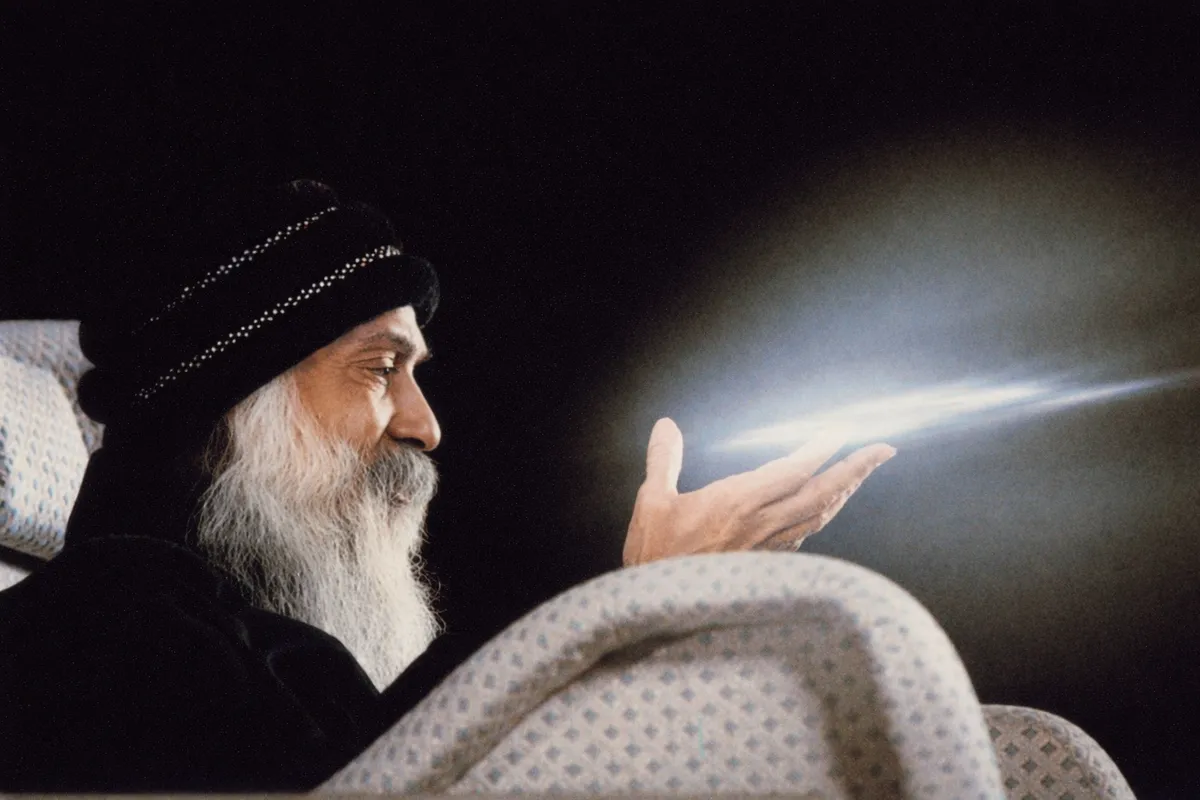
When you feel unsettled inside, your mind starts wanting things so it doesn’t have to feel that uneasiness.
From the Discourses
Passages where Osho speaks to this question — each links to the complete discourse.
How is anxiety related to desire? It seems easier to see that one is desiring than to see that one is 'anxieting' -- in fact, there is no verb form for anxiety, at least not in english. Am I desiring my anxiety or anxieting my desire?
Desire is a way to avoid anxiety, but only to avoid. You cannot destroy it by desiring. And desire gives you small anxieties, remember, VERY small anxieties, which are not existential. Of course, when you are earning money you will have a few anxieties: the market and the share market, and things like that, and prices. And you have put so much money -- are you going to earn out of it or are you going to lose? These small anxieties. These are nothing compared to the real anxiety -- these are tricks to avoid the real. Of course, when you are ambitious for politician power, you will have anxieties, a thousand and one. But they are nothing! they are play-things compared to the fundamental anxiety. You ask me: HOW IS ANXIETY RELATED TO DESIRE? Desire is a cover-up for anxiety. It is a trick, a strategy. And meditation is…
Only a person free from holding onto the ego attains to self-nature. Therefore, becoming spotlessly clean like the full moon, one becomes ever blissful and self-luminous.
ON CESSATION OF THE SENSE OF DOING, ALL ANXIETIES CEASE. ON CESSATION OF THE ANXIETIES, ALL DESIRES CEASE. THE CESSATION OF DESIRES IS EMANCIPATION -- AND THIS IS CALLED JEEVANAMUKTI, LIBERATION WHILE LIVING. SEEING ALL, EVERYWHERE, IN EVERY DIRECTION, AS BRAHMA, THE ABSOLUTE REALITY -- ON THE RIPENING OF THE FEELING OF SUCH GOODWILL DO DESIRES CEASE. NEVER BE NEGLIGENT OF YOUR ALLEGIANCE TO BRAHMA, THE ABSOLUTE REALITY, BECAUSE THAT IS THE ONLY DEATH -- SAY THE ONES WHO ARE WELL-ROOTED IN BRAHMA. EVEN IF SHIFTED ASIDE, THE ALGAE DO NOT LOSE TIME IN COVERING THE WATER AGAIN. SIMILARLY, EVEN IF A WISE MAN SWERVES FROM HIS ALLEGIANCE TO BRAHMA EVEN FOR A LITTLE WHILE, ILLUSIONS COVER HIM. Our real center is an emperor; our soul is sheer bliss and a treasure. But this 'I' is a false ditch where, however much we may dig, we will find no treasures…
He alone realizes the self, who is free from the clutches of egoism, and spotless
LIKE THE MOON; HE REMAINS EVER-BLISSFUL AND SELF-ILLUMINED. CESSATION OF ACTION LEADS TO THE CESSATION OF ANXIETY, AND CESSATION OF ANXIETY LEADS TO THE ENDING OF DESIRE. THE ENDING OF DESIRE IS FREEDOM, AND THIS IS WHAT IS CALLED JIVAN MUKTI, OR FREEDOM IN LIFE ITSELF. TO SEE THE DIVINE EVERYWHERE, IN EVERY DIRECTION, AND IN EVERY THING IS RIGHT ATTITUDE; AND BEING FIRM IN THIS ATTITUDE BRINGS AN END TO CRAVING. DO NOT BE SLOTHFUL AND WAVERING IN YOUR FAITH IN THE SUPREME, BECAUSE THIS IS DEATH -- SO SAY THE KNOWERS OF THE DIVINE. AS WATER WEEDS COVER UP THE WATER, EVEN AS THEY ARE REMOVED, SO DOES ILLUSION TAKE HOLD OF A WISE MAN IF HE SWERVES A BIT FROM HIS FAITH IN THE SUPREME REALITY. Basically, psychologically, anxiety is just the tension between being and becoming -- between that which is and that which is desired.…
It is a very unique insight; very ancient; and psychologists are only now discovering it. If you become free of anxiety, desire weakens. If you become utterly free of anxiety, the mind will not run toward lust. Lust is only a necessity when inner storms cross the limit and must be expelled. If that storm never rises so high, lust diminishes—not energy, but lust. Energy accumulates. And beyond a certain point, every energy transforms. Heat water, and at one hundred degrees it becomes steam. When that degree accumulates, water becomes vapor. When your semen, your energy, your power gathers to a point within and no storms arise, and there is no need to throw it out, suddenly—there is a point—when energy reaches that, the very energy that once flowed downward begins to flow upward. Notice: water flows downward; steam rises upward.
Osho, why does every desire come carrying its opposite? Is its dividedness inevitable? And is no whole and undivided desire possible? What is desire?
One day, by mistake, he wandered into the camp of a Muslim chieftain. He was going along in ecstasy, dancing; the camp happened to be in the way—that was all. The women, frightened, screamed. A naked man, dancing in ecstasy, had walked in—they thought he was mad. Seeing a naked sadhu intrude, the chieftain, too, grew angry. He drew his sword and struck. One of Sadashiva’s hands was cut off and fell to the ground. But Sadashiva’s joy suffered no interruption. The hand fell, blood began to flow, yet the dance continued. Just as he had been dancing, he turned and kept dancing as he walked away. The chieftain was astonished, and also pained—he had never seen such ecstasy. And that a hand could be cut off and he would not even notice—such ecstasy! The man was in some other realm. Looking into his eyes, it was as if he…