
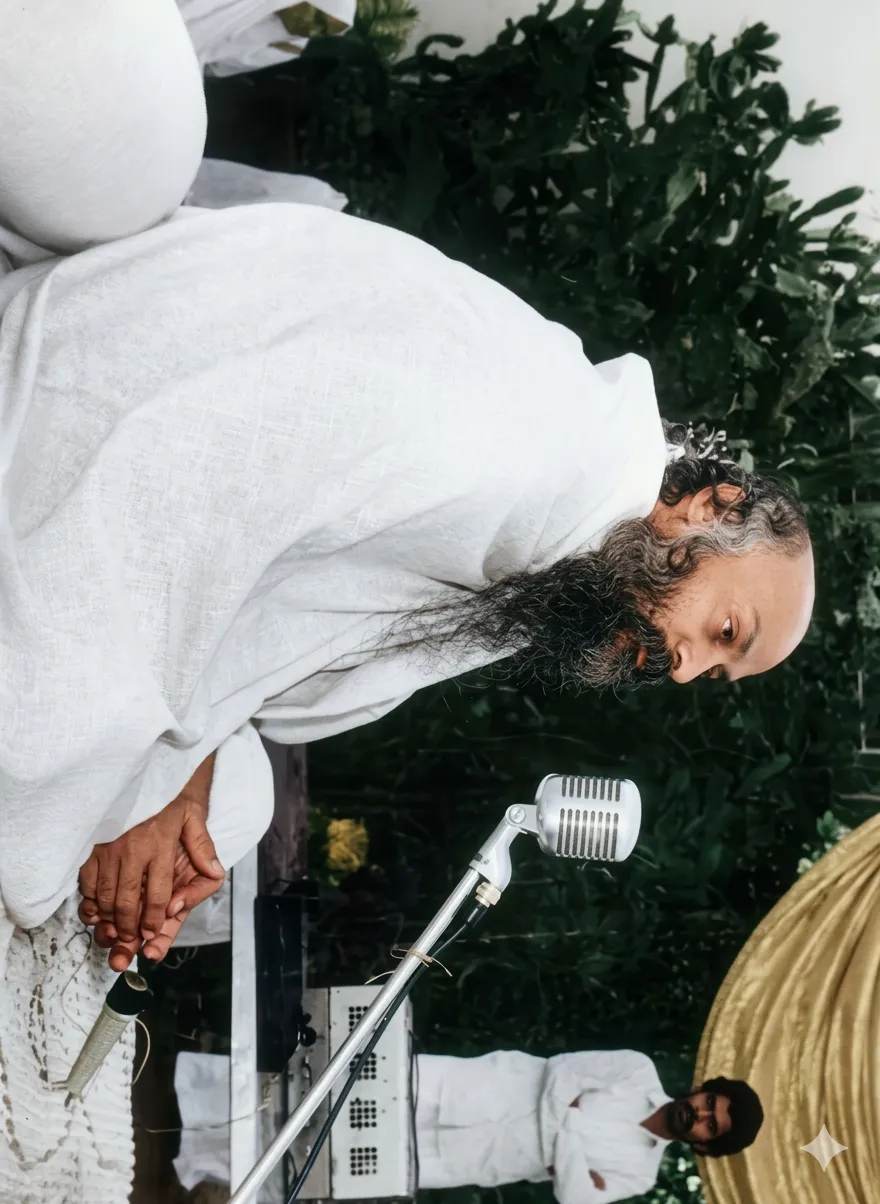
According to Osho, you can't 'leave the ego outside' because the ego is the mind's substitute identity, built from names, roles and borrowed opinions. Instead, look inward and watch the mind without judgment. In pure witnessing, you see you are not the mind or its 'I'. This awareness dissolves the false center by itself; authenticity appears without effort or compromise.
You can’t drop ego like a coat; calmly watch your thoughts and labels, and the fake 'I' melts away by itself.
From the Discourses
Passages where Osho speaks to this question — each links to the complete discourse.
Beloved Osho, how can I leave my ego outside the front gate? It follows me like a shadow and even hides behind my back and then I am not able to see it.
I said, "I understand perfectly well. You don't understand with whom you are talking." But I did not leave the chair. I told him that whatever he wants to do, he can do. He can go to the vice-chancellor, he can bring the vice-chancellor... "I am going to remain in this chair." He said, "What is the purpose of all this mess?" I said, "The purpose is to show you that it is not my sitting in the chair that is hurting you, it is your ego. If you accept it I will leave the chair. If you don't accept, then you can bring anybody to help you... but as far as I know the students, nobody is going to help." He waited a minute. There was utter silence in the class. Everybody was afraid that if the vice-chancellor came and the proctor came, there was going to be trouble…
Osho, ego is the greatest obstacle to taking sannyas. How can it be removed? The ego-sense does not go.
Ego has no reality. Then how to define it? Understand ego in this way: when you look outward, there is ego; when you look inward, ego departs. Enter meditation; drop the very worry of fighting with ego. Fighting the ego is like someone fighting darkness—pushing at it, trying to throw it out. No, I say, light a lamp. Enter meditation, enter prayer; light the lamp—turn within. Close your eyes and begin to look inside—what is there? You will discover one thing: you will never find the ego. And where there is no ego, there is the Divine. The Divine is your true nature; ego is your delusion. As someone sees a rope and takes it for a snake—or sees a snake in a rope—so is ego: a mis-seeing. To see what is, as it is—that is God-experience. And certainly, ego is the greatest obstacle to taking sannyas. But sannyas is…
Osho, what is the fundamental anguish of human life?
There is only one anguish: that a human being cannot become what he was born to be. There is only one anguish: that the seed remains a seed and does not bloom like a flower; that it cannot scatter its fragrance to the infinite winds; cannot converse with the moon and stars; cannot offer its colors to the sky; cannot be expressed. If the poem within the poet cannot be revealed—anguish. If the painter cannot paint—anguish. If the dancer cannot dance—if chains lie on his feet—anguish. Anguish means only this: that what we are meant to be—our innate nature and destiny—does not come to fruition, and we are forced to be something else. Then anguish is born. Then melancholy gathers over life. And all those countless people you see burdened with sorrow, living in a kind of hell—the reason is only this: each has come carrying the seed of becoming…
"Become the witness and keep watching the ego."
There will be nothing left there to see. That is exactly the whole mess. It is a matter of supposition. We say, “Become a witness to the ego...” Where witnessing is, how can ego be? The two cannot be together. The moment witnessing happens you will find—ego was not, is not, and cannot be. Like someone who, having seen a dream at night, says in the morning, “How can I break the dream?” We will tell him, “Break sleep; forget the dream.” If he says, “Yes, that’s right—wake up and keep watching the dream,” what sense would that make? How will he go on watching the dream once awake? With awakening, the dream breaks. With waking, nothing remains there to watch of the dream. It belongs to sleep. The dream is not primary; sleep is primary. Sleep can be without dreams, but a dream cannot be without sleep. Therefore, do…
Osho, you said... then you will find that the devotee is God. The question arises: if one devotee prefers to be God and another wants to remain only a devotee, then which of the two is superior?
The one who wants to be God will not be able to be. And the one who wants to remain a devotee will become God. The question of superior or inferior does not arise, because only one of the two will happen. The one who does not want to be will be. The one who wants to be will be deprived. That very wanting is of the ego. But the matter is a little delicate. Sometimes humility too belongs to the ego. Beware that your humility may not be of the ego. Perhaps you are saying, “No, I don’t want to be,” because you know that those who refuse are the ones who attain. Then you are clever. Then your humility is adulterous. Your humility is not pure, not sacred, not virginal—it is like a prostitute. The one who wants to be God, whose ego says, “I must become God,”…