
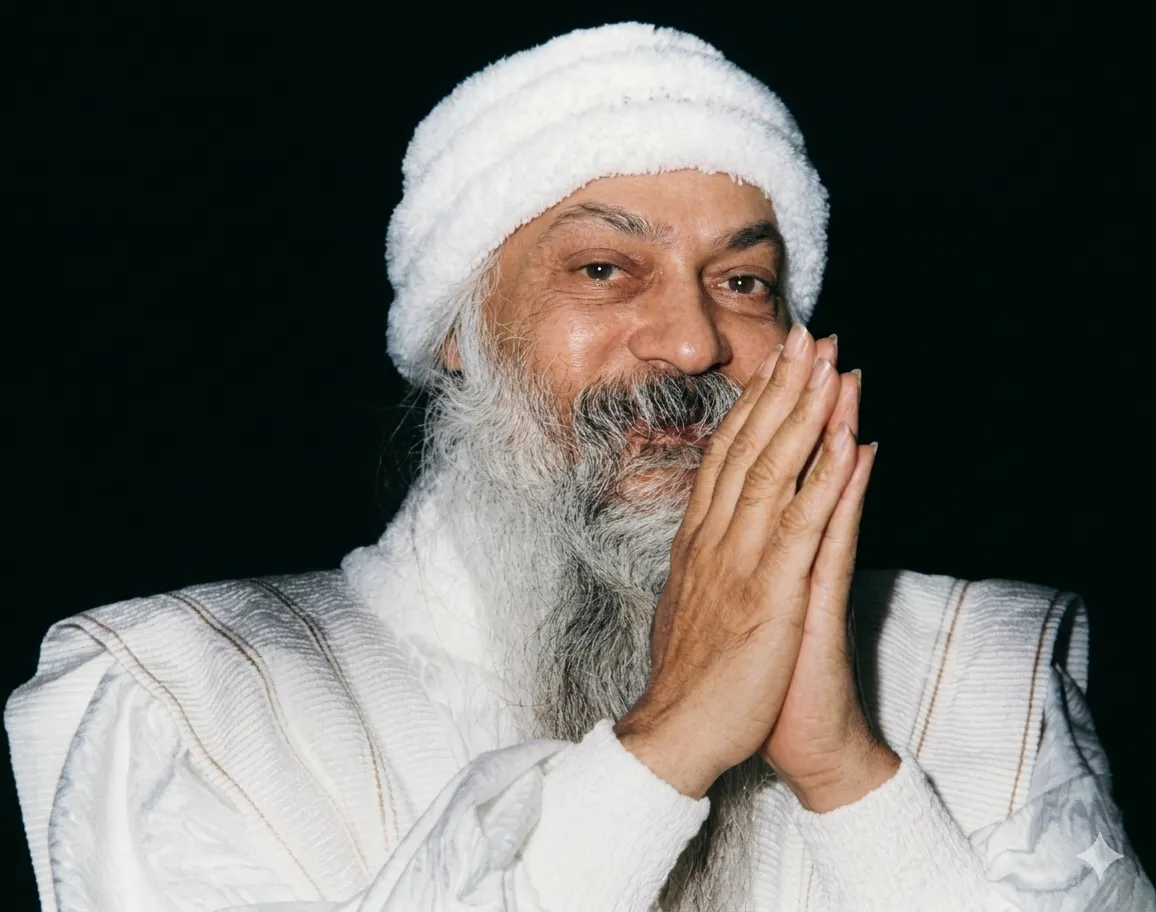
According to Osho, freedom from the 'I' is not achieved by methods or effort. Asking 'how' presumes bondage; the chains are illusory. Simply be wakeful—just watch. Non-doing dissolves the ego because doing feeds it. Recognize the Whole as the only doer, relax into what is, and the separate 'I' loses grip, revealing innate liberation here and now.
Stop trying to get rid of ‘me’; quietly notice everything as it is, and the fake ‘I’ fades on its own.
From the Discourses
Passages where Osho speaks to this question — each links to the complete discourse.
Osho, you said, “You are free—now, here, in this very moment”; but how do I get free of this “I”?
This is the marvelous principle of destiny, of fate: everything is happening by itself. The wrong people took it in the wrong sense—that was their mistake. Properly understood, fate means only this: if you understand the principle of destiny rightly, you become a witness, and there is nothing to do. But people did not become witnesses through fate; they became inert, indolent. There is a difference between a non-doer (akarta) and an idler (akarmanya). The idler is lazy, sluggish, dead. The non-doer is overflowing with energy—he simply does not say, “I am doing.” The Divine is doing. I am only seeing. This play is happening; I am watching. Man is very dishonest; he uses even the most beautiful truths in ugly ways. Fate is a very beautiful truth. It means only this: everything is happening; nothing is happening by your doing. All is ordained. What has to be, will be.…
You said that, "you are liberated here and now, this very moment." but how can I get free of this "I"?
But no, we have been taught these diseases since childhood. Since childhood we have been told, "Do something before you die. Don't die without doing anything. If you can, do something good, if not, do something bad, but make a name for yourself." People say, "So what if you get a bad name, at least your name is known. If you don't find the right way, then do something crazy, but make a name for yourself!" People are so crazy that they go to the mountains and inscribe their names in stone. They go visit an ancient castle and scribble their name on the walls. And the man writing his name doesn't see that he is rubbing out another name to write his: someone else will come and rub his out and write over it. You have erased someone else's, you are writing over the top of others writing --…
Question: OSHO, EXACTLY HOW DO YOU NOT DO IT? I said, "This feeling is not from the awareness that you are, because your consciousness has remained the same. This sense of a new birth is coming from your ego; your ego is tremendously gratified, strengthened. That is your 'gain.' But according to those who know that is your loss." What is gain to the ego is loss to the soul. What is a blessing to the ego is a curse to the soul. What seems to be of tremendous importance to the ego is just sheer stupidity to the innermost core of your being. The logic of the ego is that it is never interested in the simple things, because if you say, "I can breathe!" that is not going to bring crowds to welcome you, to say, "Teertha, you are great! Your name will remain immortal because you breathe.
Osho, how does the cessation of this ego-sense happen? That is, witnessing is not something that is brought in, nor does one make oneself into a witness. It is only because we have become something else that the feeling of witnessing does not arise. So this ego-sense—the “made-ness” we are—how does it come to an end?
No, no—you cannot bring about its cessation. Because the very one who is asking, “How should I end it?”—that itself is the ego. You cannot end it. The ego is so subtle that when it asks, “How do I erase the ego?” it is the ego itself that is asking. The question is not coming from anywhere else. Beyond the ego there is no questioning at all; there, the ego is not. Ego belongs to the mind that asks; it is not part of the consciousness-state of being a witness. Understand it like this: there is water. The water asks, “How can I eliminate my fluidity?” Water can only be by being fluid. It cannot remove fluidity, because in the very definition of water, fluidity is included; it is part of it. We say to it, “Cool down below zero degrees,” or “Heat up to a hundred degrees.” If you…
Freedom means: the life of the Paramatman. Where I am not, only the Whole remains. I am one with all—one-flavored. I do not have to become; I only have to know what is true. Am I separate? Am I distinct? Can one live even for a moment in separateness? Is a separate life possible at all? Lock a person into a capsule, sever every connection—will he live? Will he last even a moment? Life is interrelationship. Life is vast interconnection. Imagine a person locked in a vacuum capsule, sealed in emptiness, unrelated to the world. Could he be there even for a moment? He would not be. It cannot be. But all of us have built a capsule of ego. Inside that ego we stand apart and say: ‘I am!’ Although we are connected, still we say, ‘I am’—separate and distinct! Life is union. Ego is disjunction.