
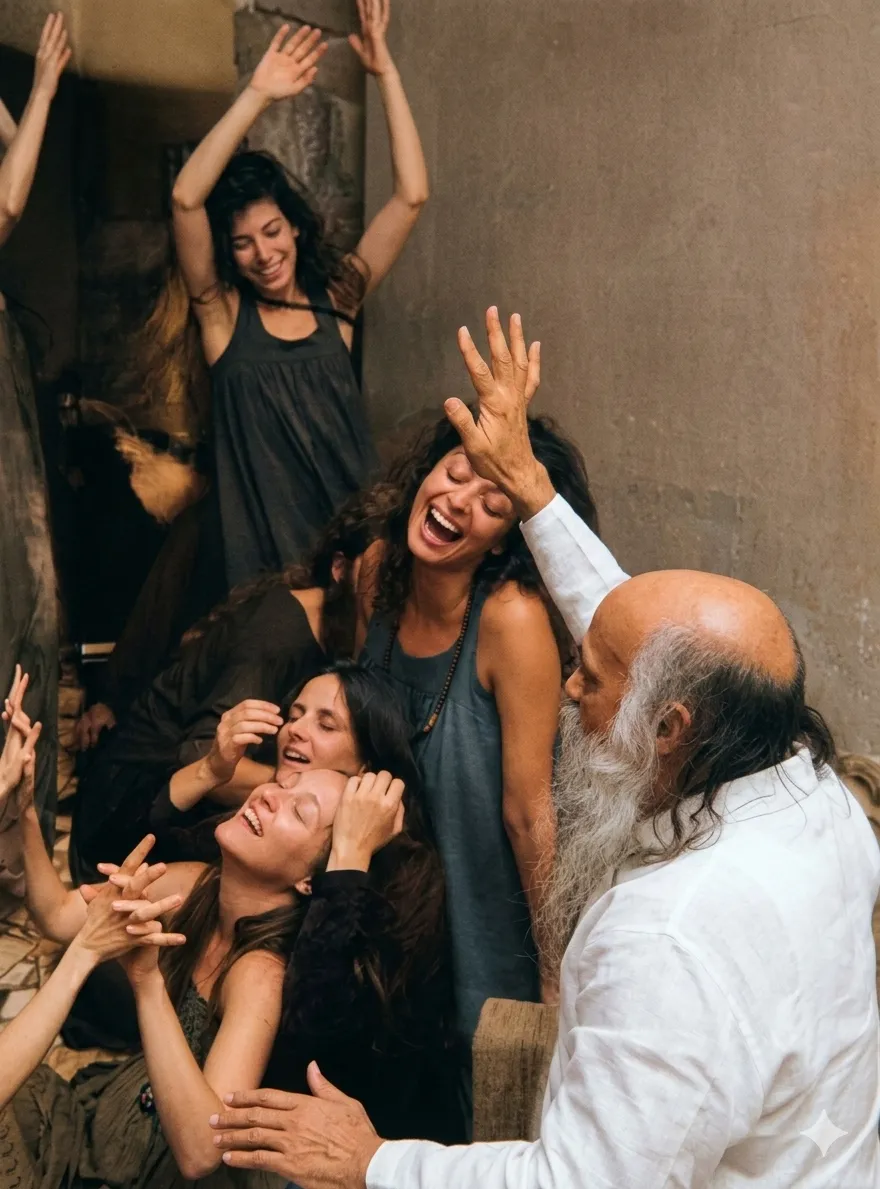
Stick with it for a few days and let your feelings move; the soreness fades as trapped tension leaves your body.
From the Discourses
Passages where Osho speaks to this question — each links to the complete discourse.
Beloved Osho, the first few days of active meditation tend to tighten muscles, causing pain everywhere. Is there any way to get over that?
Look at any animal and see the grace of the body. What happens to the human body? Why is it not so graceful? Why? Every animal is so graceful: why is the human body not so graceful? What has happened to it? You have done something with it: you have crushed it and the natural spontaneity of its flow has gone. It has become stagnant. In every part of your body there is poison. In every muscle of your body there is suppressed anger, suppressed sexuality, suppressed greed -- and everything -- suppressed jealousy, hatred. Everything is suppressed there. Your body is re#ally diseased. So when you start meditating, all these poisons will be released. And wherever the body has become stagnant, it will have to melt, it will become liquid again. And this is a great effort. After forty years of living in a wrong way, then suddenly meditating,…
The same friend has asked: Osho, then all day there is aching in the arms and legs, sometimes there is pain in the back.
It will happen. If you get tired in two minutes, what else but pain will happen! No—don’t get tired in two minutes. Put in your total energy. The one who puts in total energy for thirty minutes will be the least tired. I say this to you from my daily hundreds of experiences. The person who gives his total energy for thirty minutes will be the least tired. And if you truly give your total energy, after thirty minutes you will suddenly feel light and fresh, not tired. We get tired because we don’t put our total energy—one. We do put energy, and all the while keep thinking inside, “I might get tired”—two. We do put energy and at the same time we hold ourselves back so that we don’t overdo it—three. That’s where the whole disturbance happens. Now, as you say there is pain in the back, or for…
A friend has asked: with meditation practice the body gets tired—should one continue the practice or not? Another friend has asked something similar: in meditation the hands move a lot and the hands begin to ache—should one continue the practice or not?
Many of you will also feel that some part of the body gets tired. It is natural. When any limb moves so much, when it gets so much exercise, it will get tired. But only for two, four, six days. Just as with any new exercise you feel fatigue; the same here. In two or four days it will be fine. And when it settles, for the first time you will realize that the limb which was moving during this period was ailing. But until it becomes healthy, you cannot even know it. Like a man who has had a headache since childhood, a pain twenty-four hours a day—he will think that the pain is his head. Only when the pain drops will he know that the pain was not the head. The limb that is moving more is proof that it is afflicted by some tension. It is not…
Osho, you have often said that the true master calls the disciple close, and then also sends him away. How can one know whether the master has sent him away in displeasure, out of anger, or as a blessing, out of joy, for the disciple’s further growth?
First thing: a master who gets angry is no master. Second: a disciple who, when sent away, thinks it must have been out of displeasure is not of the right mettle for discipleship. The master does not get angry; the very possibility of anger has ended. If ever a master seems angry, know that he is acting—for sometimes there is no other way. Gurdjieff would often appear angry—so angry it seemed there would be bloodshed. Those who ran away were deprived. Those who still remained came to know how rare it is to find a heart as tender as his. But why would he behave so angrily? Perhaps that was exactly what was needed for the disciple. Such things happened—and only Gurdjieff could do them—that two people would come to see him, one seated on the left, one on the right. When he looked to the left, it was with…
So even if there is fear sometimes, let it be, but never forget that you are the cause of your life, you are at the very source of your life, and that you can change because nobody is forcing any structure on you. To understand this much is to understand what we mean by liberation, freedom, moksha. Never get caught in any definition. Then your purity, your freedom, always remains uncorrupted. Have you got a box with you? (She shakes her head) (Osho passes her a box) Now at this moment you are a receiver of a box! Dhyana means meditation and ananda means bliss; bliss that comes through meditation. This word dhyana is one of the most significant words. In English you have three words: concentration, contemplation, meditation. Concentration means putting your mind, focusing your mind on one object, centering the mind on one object.