
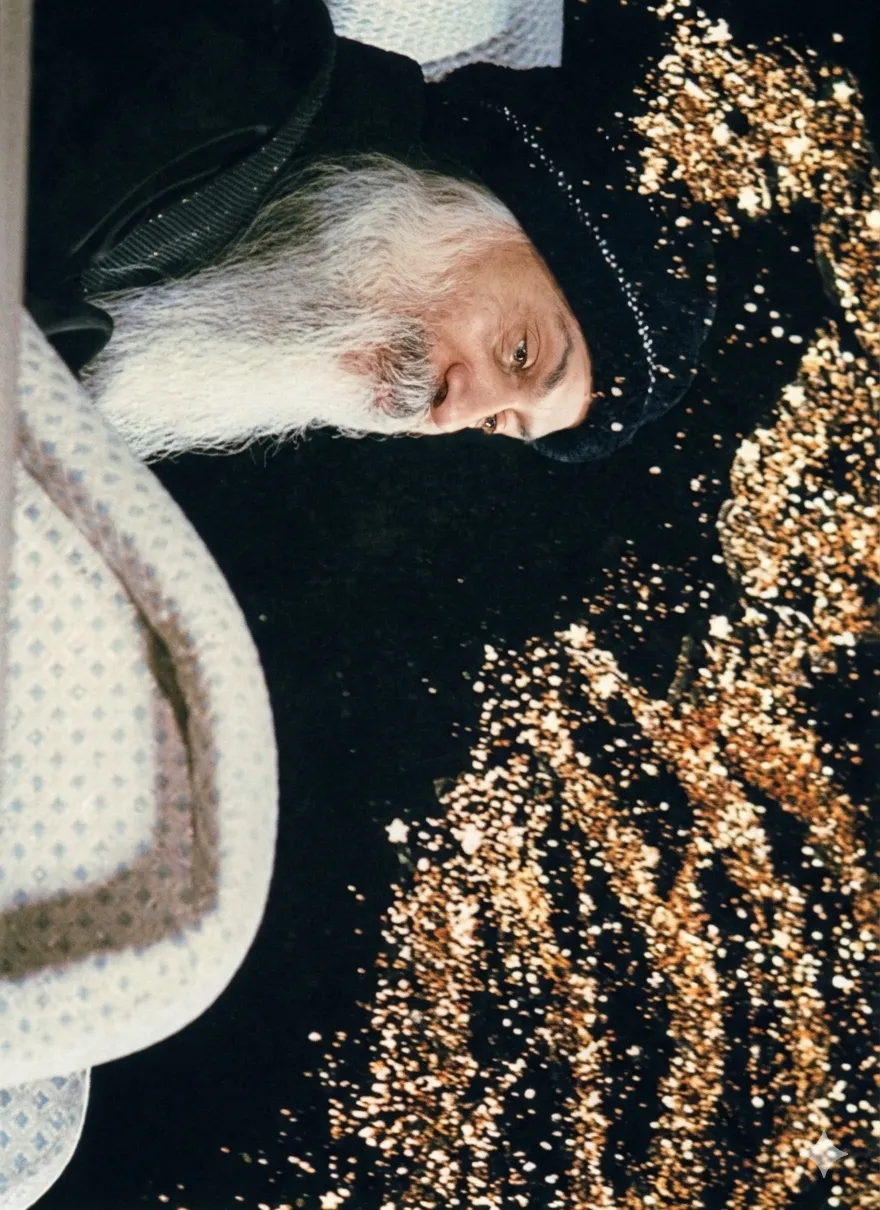
You don’t need to delete memories—just stop living inside them and use them only when needed.
From the Discourses
Passages where Osho speaks to this question — each links to the complete discourse.
Beloved Osho, you said that to live moment to moment one must throw away one's dead past and memories. Does it mean that all the memories have to be dissolved and destroyed to transcend the mind? But one needs a strong mind and an intense and sufficient accumulation of memories to function in this world.
The atom bomb is not such a great danger as these secrets are because the very soul of man can be enslaved through them. If Jesus is born now in Soviet Russia or communist China, they will not crucify him; first they will try to destroy his memory. They cannot be successful with Jesus but they can be successful with you. They cannot succeed with Jesus because he is already unidentified with the memory. If you destroy the memory nothing is really lost because he lives in his consciousness, not in his memories. You don't really have any consciousness separate from the memories, so if your memory is destroyed your consciousness is destroyed. You don't know how to function without the memories. So for the new generation, the coming world, meditation is a must because only that can protect you from political dictatorship -- nothing else. They will not put…
Osho, when it happens—when the leap takes place—will memory completely vanish, go far away? But words should still be remembered, right? Technical words, technical education—these should remain in this process.
So today when you come, I will see you—not the one who abused me yesterday. Where is he now? Much water has flowed down the Ganges. For all I know, you may be coming to ask forgiveness, and I am thinking you are the same man who abused me. Who knows what you have become in twenty-four hours! In twenty-four hours one has no certainty about oneself—how can one have certainty about another? So memory is a corrupting element. If you identify yourself with it, you are finished. In the end you will go mad if you are completely caught in its corruption. But if you stand entirely outside it and memory remains only a mechanical device that serves you—where the house is, where the shop is, where what you have read is kept—then it is merely a mechanical device you use. Soon enough, we have already made small computers…
Osho, regarding the mind—as you say it continues from lifetime to lifetime and remains the same—does any subtle memory remain after a person dies?
Yes, the mind remains the same, and after a person dies all the memory remains with them. But layers settle over it. Imagine we don’t clean this room for seven years: today dust will come, and it will keep coming every day for seven years. After seven years, when we return, the top layer will be today’s, and below it the earlier layers will be pressed down. The seven-year-old layer will still be there, but buried very deep. It’s possible the top layer won’t even know that seven years of dust lie underneath. So the mind is traveling, and the journey is progressive. Every day you add something to it. Yesterday gets buried under today; then today will be buried under tomorrow. The previous birth gets buried under this birth, and the one before that under two births, and so on—down into what psychologists call the unconscious. Sometimes it happens…
In the middle age hua-tzu of yang-li in sung lost his memory. He would receive a present in the morning and forget it by the evening; give a present in the evening and forget it by the morning. In the street he would forget to walk; at home he would forget to sit down. Today he would not remember yesterday; tomorrow he would not remember today.
HIS FAMILY WERE TROUBLED ABOUT IT AND INVITED A DIVINER TO TELL HIS FORTUNE BUT WITHOUT SUCCESS. THEY INVITED A SHAMAN TO PERFORM AN AUSPICIOUS RITE BUT IT MADE NO DIFFERENCE. THEY INVITED A DOCTOR TO TREAT HIM BUT IT DID NO GOOD. THERE WAS A CONFUCIAN OF LU WHO ACTING AS HIS OWN GO-BETWEEN CLAIMED THAT HE COULD CURE IT. HUA-TZU'S WIFE AND CHILDREN OFFERED HALF OF THEIR PROPERTY IN RETURN FOR HIS SKILL. THE CONFUCIAN TOLD THEM: 'THIS IS CLEARLY NOT A DISEASE WHICH CAN BE DIVINED BY HEXAGRAMS AND OMENS, OR CHARMED AWAY BY AUSPICIOUS PRAYERS, OR TREATED BY MEDICINES AND THE NEEDLE. I SHALL TRY REFORMING HIS MIND CHANGING HIS THOUGHTS THERE IS A GOOD CHANCE THAT HE WILL RECOVER.' THEN THE CONFUCIAN TRIED STRIPPING HUA-TZU AND HE LOOKED FOR HIS CLOTHES; TRIED STARVING HIM AND HE LOOKED FOR FOOD; TRIED SHUTTING HIM UP IN THE…
The audio recording of the question is not clear.
I did not say—please, listen to me; no, no, listen to me—I did not say that it is a comedy; I said that it is not a tragedy. I have understood your point. Consider it in two or three parts. First, I did not say that because death came it was a good thing. I did not say that, not even by mistake. I only said that we are not entitled to decide whether it was good or bad. We know nothing about what happened.