
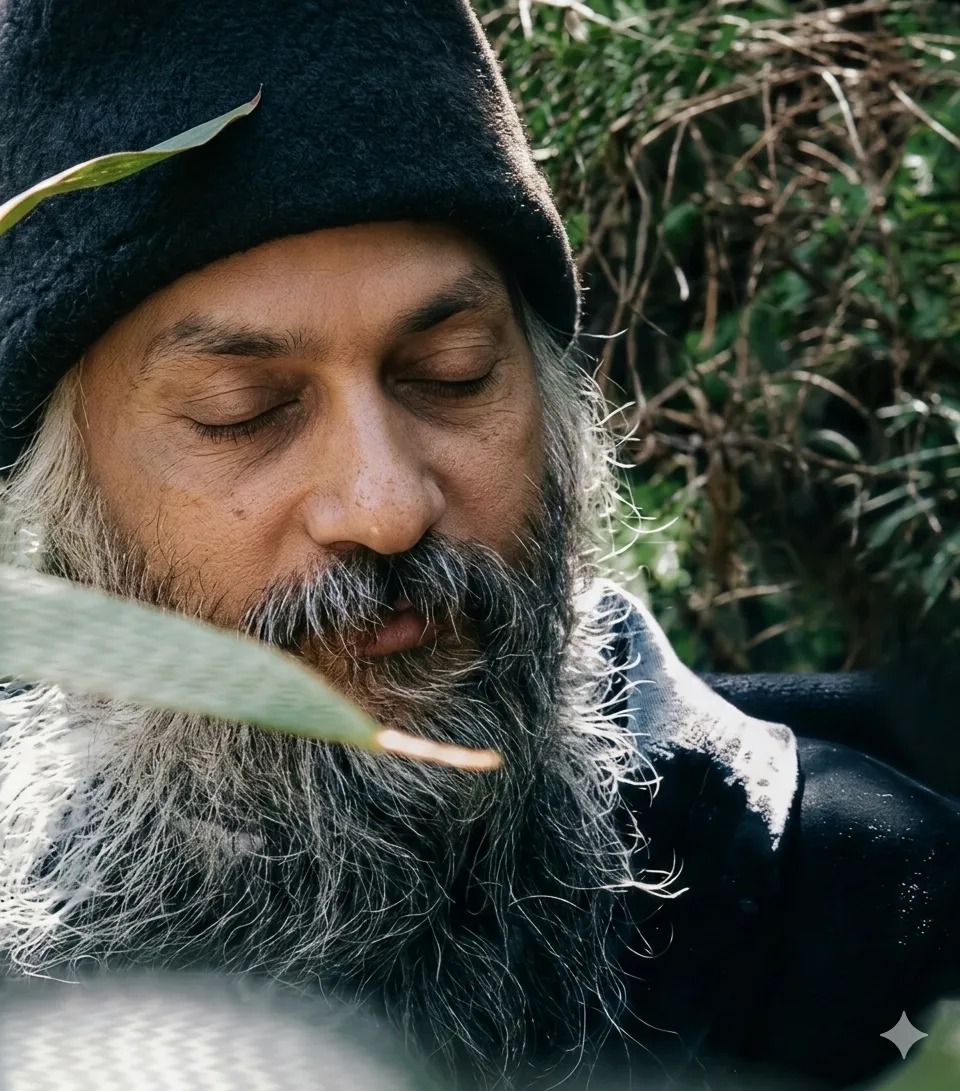
Krishna’s horn wasn’t angry payback; it was a calm “we’re ready” to whatever comes.
From the Discourses
Passages where Osho speaks to this question — each links to the complete discourse.
One who loves existence would find God as much in the darkness as he would find him in the light. The truth of the matter is that due to fear we are never able to recognize the beauty of darkness. We are never able to appreciate the flavor, the mystery of darkness. Our fear is man-made. We have emerged from the caves, we have passed through the wild -- where the darkness was dangerous, wild beasts would attack, night was frightening. That is why when fire appeared we accepted it as God -- because the night became safe. We got rid of fear by lighting a fire. So in our experience, darkness has become associated with fear. In our hearts light is associated with fearlessness. Nevertheless, the darkness has its own mystery, as the light has its own also.
Questioner: a part of the question yet remains to be answered. Please give us an outline of human civilization and culture patterned on krishna's life and teaching.
It will need a lengthy answer. All these days, however, I have been doing the same thing -- drawing an outline of human civilization reflecting Krishna's vision. Yet I would like to say a few things in this regard. Human civilization, according to Krishna's vision, will be life-affirmative and natural in the first place. This is my vision too, that affirmation of life and nature should be the cornerstone of human civilization if it wants to be healthy and holistic. Such a civilization will be dedicated to the moment, to bliss and to celebration. This civilization will refuse to be life negative, renunciatory, masochistic and time-oriented. It will reject all fragmentation of life. Life will be accepted as a blessing, and there will be no division whatsoever, between life and God. This civilization will declare that life is God, and there is no other God in opposition to life or…
Osho, the question was about the chakra—Sudarshan—and about Panchajanya. And regarding the rasa-lila—yathā arbhaka sva-pratibimba vibhramaḥ? So what is the interpretation of the rasa-lila?
In truth, those who composed the poetry labored greatly with words. The very life of poetry is the word. And they worked on words with chisel and hammer for centuries. Now, Krishna’s discus has been named Sudarshan. It is a carrier of death, and yet it is named Sudarshan—“beautiful to behold.” Death is not beautiful to see, nor is it pleasing in form. But in Krishna’s hand even death becomes beautiful. That is all it means. We could not give the atom bomb the name Sudarshan. It is as destructive as the atom itself. Its strike is unfailing; the death it brings is certain. Once released, it returns only after killing. Where death is absolutely certain, would we still call that weapon Sudarshan? And yet it has been so named. In the hands of a man like Krishna, even death becomes Sudarshan. In the hands of a man like Hitler,…
ओशो, इस प्रकार नया शरीर मिलने भर से अतीत के संस्कारों व मन वाला सूक्ष्म शरीर भी बदल जाता है क्या?
वह अपने आप नहीं बदल जाता, लेकिन कृष्ण जैसे आदमी के हाथ से मरने का मौका मिले तो उसमें बहुत फर्क पड़ता है। सभी को नहीं मिलता, बहुत पुण्य कर्मों के फल से मिलता है। साधारणतः नहीं बदल जाता। अगर एक आदमी मरता है, तो शरीर ही बदलता है, उसके भीतर का और कुछ भी नहीं बदलता। लेकिन कृष्ण जैसे आदमी के हाथ से मरना बड़ी भारी घटना है, क्योंकि कैटेलेटिक एजेंट मौजूद है। उस आदमी की मौजूदगी में यह घटना घट रही है तुम्हारे मरने की, और तुम्हारे शरीर के छूटते ही उस आदमी के व्यक्तित्व से जो सूक्ष्मतम किरणों का जाल फैलता है, वह तुममें एब्जार्व हो जाएगा, उसे तुम पकड़ पाओगी, वह तुम पी जाओगी। जो तुम्हारा शरीर बाधा दे रहा था कृष्ण से मिलने से, वह बीच से हट जाएगा तो कृष्ण से मिलना आसान हो जाएगा। उस मिलन में बहुत कुछ होगा। वह मिलन अर्जुन के लिए ऐसे ही हो पाता है क्योंकि अर्जुन इस शरीर के बाहर छलांग लगा पाता है। हम प्रेम में शरीर के बाहर छलांग लगा लेते हैं। शत्रुता में हम शरीर के बाहर नहीं छलांग लगाते, शरीर के भीतर शरीर को दुर्ग की तरह बना कर बैठ जाते हैं।
Osho, in Krishna’s time there was the great war of the Mahabharata, and Krishna held a central place in it. He could have stopped the war if he had wanted to—but he did not. A vast devastation followed, and much of the responsibility for that devastation seems to fall on Krishna. Can Krishna be blamed for that war?
This race resembles the one that began some three centuries ago when ships from Europe rushed toward Asia—Portuguese, Spanish, English, French, German. Then, expansion and development demanded possession of Asian lands. Now that has become meaningless. Asians think their independence movements freed them; that is only half true. The other half is that there is no longer any point in holding Asian territory. That era is over. Now the struggle is to possess other ground—celestial ground. Eyes and energies have turned there. Life is an adventure of power. Those who embrace lifelessness are gradually destroyed. We are such a people—being destroyed. All the more reason why Krishna’s message is meaningful—not only for us. I would say the West too stands at a point where it may have to fight one more decisive war—surely not on earth. Even if rivals on earth must fight one another, they will likely do it…
ओशो, कृष्ण के समय में बहुत बड़ा महाभारत का युद्ध हुआ था और कृष्ण उसमें बड़े प्रमुख स्थान में थे। और वे चाहते तो महाभारत का युद्ध रोक सकते थे। लेकिन वैसा नहीं हुआ। और एक बड़ा भारी विध्वंस हुआ। और उस विध्वंस की बहुत बड़ी जिम्मेवारी कृष्ण पर जाती है। तो क्या कृष्ण पर यह लांछन लग सकता है युद्ध का?
यह दौड़ अब वैसी ही है जैसे एक दिन दौड़ आज से कोई तीन सौ साल पहले यूरोप से एशिया की तरफ लग गई थी और सारे जहाज एशिया की तरफ भागे जा रहे थे--पुर्तगीज भी और स्पेनिश भी और अंग्रेज भी, और सब, फ्रेंच भी और जर्मन भी, सब भागे जा रहे थे। तीन सौ साल पहले जैसे एशिया की जमीन पर कब्जा करना जरूरी हो गया था विस्तारवादी के लिए, विकास के लिए। अब वह बेमानी हो गया, अब कोई मतलब नहीं है। एशिया के लोग समझ रहे हैं कि हमारी स्वतंत्रता की लड़ाई ने हमको आजाद किया है। इसमें आधी ही सचाई है। आधी सचाई तो दूसरी है, और वह यह है कि अब एशिया की जमीन पर कब्जा करने का कोई मतलब नहीं रह गया है, अब वह बात खतम हो गई है। वह दौर खतम हो गया है। अब तो कहीं लड़ाई और दूसरी जमीन पर कब्जा करने की है। अब वहां दृष्टि और जगह चली गई है, अब वहां दौड़ है। कल चांद-तारों पर और दूर तक दौड़ हो जाएगी। शक्ति का एक अभियान है जीवन। उस अभियान में जो मुर्दानगी को पकड़ लेते हैं, वे धीरे-धीरे नष्ट हो जाते हैं। हम ऐसी ही नष्ट हो गई कौम हैं। …
Osho, it is surprising that among animals there is hardly any hypocrisy or deceit, and among indigenous people it is also very little, whereas in the so-called educated and civilized society it is at its peak. Has humanity’s long and arduous journey from barbarism to civilization then gone in vain? And in that case, is the tribal order preferable?
Animals are without falseness, without hypocrisy—not because they have achieved something, but because they are incapable. They cannot be hypocrites; there is no way for them to be. They have no facility for being bad, no possibility of falling. But precisely because an animal cannot fall, it also cannot ascend to divinity. One who cannot fall cannot rise. And where there is no possibility of sin, there is no possibility of the divine either. The animal is in a kind of stupor; it does as nature makes it do. Its journey is mechanical. It has no free will. Therefore an animal cannot do evil, but it cannot do good either. It simply does what nature impels. It has no individuality of its own. Hence an animal can be neither wicked nor virtuous, neither a great sinner nor a great saint. An animal remains an animal. The animal is born complete.…
पहला प्रश्न: ओशो, आश्चर्य की बात है कि पशुओं में पाखंड या मिथ्याचरण नाममात्र भी नहीं है और आदिवासियों में भी अत्यल्प है, जब कि तथाकथित शिक्षित व सभ्य समाज में सर्वाधिक है। तो क्या बर्बरता से सभ्यता की ओर मनुष्य की लंबी व कठिन यात्रा व्यर्थ ही गई? और तब क्या आदिवासी व्यवस्था वरेण्य नहीं है?
पशुओं में मिथ्याचरण नहीं है, पाखंड नहीं है, इसलिए नहीं कि पशुओं की कोई उपलब्धि है, बल्कि इसलिए कि पशु असमर्थ हैं, पाखंडी हो नहीं सकते, होने का उपाय नहीं है; बुरे होने की कोई सुविधा नहीं है; पतित होने की कोई संभावना नहीं है। लेकिन चूंकि पशु पतित नहीं हो सकते, पशु दिव्यता का आरोहण भी नहीं कर सकते। जो गिर नहीं सकता, वह ऊपर भी उठ नहीं सकता। और जिसके जीवन में पाप की संभावना नहीं है, उसके जीवन में परमात्मा की संभावना भी नहीं है। पशु मूर्च्छित है; प्रकृति उससे जैसा कराती है, वह करता है। यंत्रवत उसकी यात्रा है। उसकी कोई स्वेच्छा नहीं है। इसलिए बुरा भी पशु कर नहीं सकता; भला भी नहीं कर सकता। प्रकृति जो कराती है, वही करता है। पशु की अपनी कोई निजता नहीं है। इसलिए पशु न तो असाधु हो सकता है न साधु; न महापापी हो सकता है न महा संत। पशु पशु ही रहेगा।